Category Archives: Uncategorized

Bedtime Story


blog-graphicAs a writer, I hold tight to the belief that the stories we tell our children help shape them and teach important lessons. The ways that adults and children share the stories- bedtime and naptime stories, post-recess read-alouds, road trip audio-books or the retelling of family lore, influence their lives. Stories and the way they are told help children know who they are and who they can become.

A Memory:
We were snuggled together on the yellow flocked sofa. Steve, wearing his spaceship pajamas to Dad’s left, Martha clad in frilly yellow babydolls on his lap and me, leaning in on his right, wore a pink acetate nightie. The new baby Paul had finally stopped screaming from his daily bout of evening colic and he lay peacefully in Mom’s arms. His angelic presence defied his rather loud and demanding daytime personality.

Mom had settled into the rocking chair and had closed her eyes, wearing weariness, but also contentment, on her face. Dad smelled of pipe smoke and wore his plaid smoking jacket- a robe-like wrap with satin lapels and deep pockets. We settled comfortably in… it was time for our bedtime story.

“Chug-a-rum,” croaked Grandfather Frog. Dad’s rich baritone brought the character to life. Old Mother West Wind’s children, the Merry Little Breezes, flitted through the moralistic tales and we lived vicariously in the land “when the world was young and all.”

Dad’s voice changed with each new character. His theatrical nature, subdued at his 50’s style doctor’s office, found a perfect stage in the well-lit living room of the little suburban house.

The antique pages of the book, shared from Dad’s own childhood, took us all on an adventure, to a place where problems were huge, but it all worked out in the end. In the course of a chapter, wrongs were set right and errant creatures got what they so deeply deserved.

That memory defies the darker times that lay ahead. Even then, I knew that life’s challenges were never summed up neat and tidy at the end of a chapter. As the family ventured beyond the familiar vistas of the Smiling Pool and the Laughing Brook for the Great World Beyond, life became much more complicated.

For now, I bask in the warm glow of that living room, in that atmosphere of love and imagination, where Reddy Fox is out-tricked and Hoppity learns a valuable lesson, where mothers snuggle their perfect babies and where little heads fall comfortably against a Daddy’s broad chest.

I believe that the lessons my siblings and I learned so long ago on that couch infused each of us with the belief that, no matter how bad it seemed, it could perhaps, all work out in the end. And from that brief time we spent snuggled on that yellow couch, we also know the mystery of love and what being a family can be.

As children’s book writers, what we do is important. We should persevere with our calling and tell the stories that will influence the lives of children and their families

Leave a Comment

Filed under Uncategorized

What Makes a Great Book?

By Susan WrobleIMG_0579

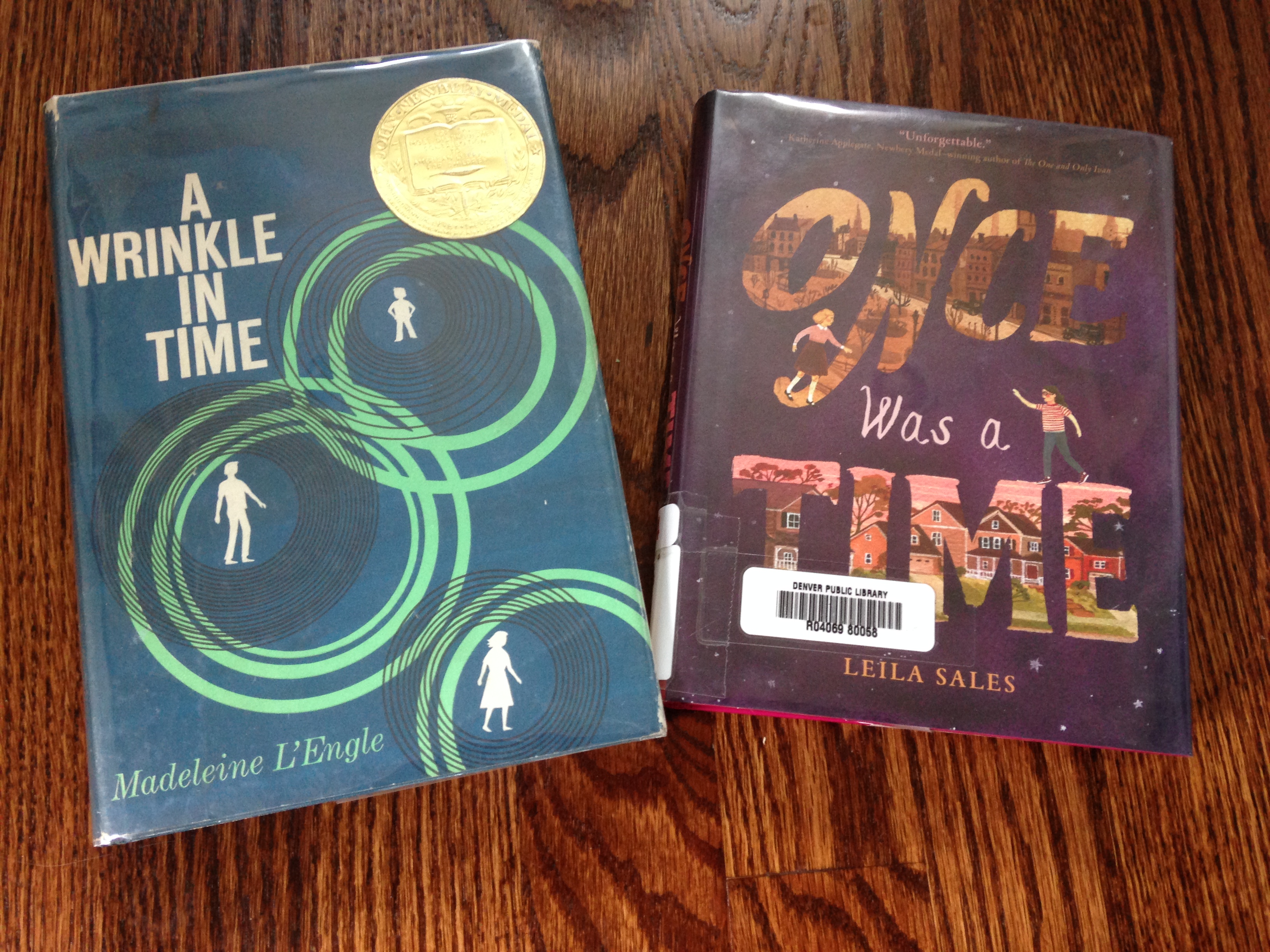
I picked up Leila Sales’ amazing book Once Was a Time at the library last week. Immediately, I was engrossed in its themes of history and time travel and, above all, friendship. It made me start thinking about what makes a book great. I know what I do when I read what I think is a great book (and what I did with Sales’ book) – I fall in love with the language and the characters and the intricate weaving of the plotlines. I cry towards the end, hug the book when I finish, and finally turn right back to page one and voraciously start the whole thing all over again.

But, as I said, that’s what I do. It isn’t what a great book is. Author and rare book dealer Rick Gekoski tried to answer this same question in the context of the Man Booker Prize, the annual award for the best book written in English and published in the United Kingdom. In a 2011 article for The Guardian titled What’s the definition of a Great Book?, he wrote “When you read works of this quality you often feel, and continue to feel, that your internal planes have shifted, and that things will never, quite, be the same again.”

Shift, change, movement, transport… My definition of a great book would be one that transports the readers — in both meanings of the word. Readers should feel first that they are in another place or time, and second that they are overwhelmed with emotion. For me, that feeling initially came when I read Madeleine L’Engle’s A Wrinkle in Time. Reading Wrinkle gave me insight into concepts of advanced physics, and changed my beliefs of what is possible and what is real. The book transported Meg and Calvin and Charles Wallace and me across space and time, but more importantly, it transported me to a place of happiness in the knowledge that love will always triumph.

I narrowed my question, no longer concerned about what makes a book great, focusing instead on what makes a book great for me. It’s a book that transports, that carries me away, that lifts me up. And when you find a book like that for you, give it a hug from me!


Leave a Comment

Filed under Uncategorized

Embracing the Tortoise Writing Life

6Tp6R4AkcTortoiseAUGusethisConfession: When I started meeting with my critique group and attending writing workshops, I envied how quickly others answered questions, gave on-the-spot feedback, and completed manuscripts. Everyone sounded so clever, eloquent, insightful. I felt like the slow study, as I multitasked between listening, jotting notes and figuring out, “what was the question?” and “what did she say?” My insecurity took me back to grade school days when teachers said, “She’s a daydreamer, always off task, staring off in space…”

Today, I laugh and am incredibly grateful for my attentive graduate school advisor who helped me discover my learning disability, slow logical processing, which makes it difficult to track conversations, follow instructions, and, as my husband and friends will attest, keep track of time. No wonder, I journaled my way through school, never finished books, and loved wandering (and still do)!

I can’t imagine life without journaling and writing. The past year, my writing has been my truth mirror, my reality check. I’ve realized, Okay, so you’re slow…so what if you take much longer (to write, revise, critique) than your peers. Then, “the” truth hit me: my frustration with my slowness is not because of my learning style, it’s because I compare myself to others. It’s my ego. Big sigh. Or, as Natalie Goldberg says, “it’s just resistance…it’s me battling myself.”

When I embrace and sink into my tortoise shell, I’m totally lit. I’m curious and sparked. I sing and dance. I’m me. I just have to trust myself. I have to trust and practice ancient wisdom about the tortoise – they carry all they need on their back and remind us to make good use of our abundance.

Thanks to my critique group and author-teacher-mentors, I’ve found abundant tools that reel me in and stimulate my writing practice. I rely on them. Of course, I still get stuck in the mud, but it’s getting easier to pick up my tools, put them on my back and start again.

Here are the tools that keep my writing and revising on track, slowly and steadily.

  • Set a timer. I put my cell phone in another room and set the timer for 50-60 minutes of writing or revising. Then, I re-set it for a 15-minute break and repeat. When time is limited, I set the timer for a 15-20 minute session (even if that’s all I can do that day).
  • Start anywhere. Who said I have to write and revise in order? One week, I may work on the middle of my YA, the next week, I dive into the last chapter. I follow my gut and lately, my main character.
  • Type your purpose for each chapter. I started doing this in revision #1 of my YA – type a set of questions above each chapter and answer them before digging into the chapter. It’s like holding a magnifying glass to my work; it pushes me (big time!) to hone in and tightly focus on the purpose of each chapter. The first question I answer: What does your main character want or need at the beginning of this scene? I learned this technique in award-winning children’s author Denise Vega’s workshop, “Crafting Compelling Scenes in Your MG/YA Novel”. (Find out more about Denise’s classes at https://lighthousewriters.org & www.denisevega.com.)
  • Leave it and move on. When I’m completely stuck or can’t figure out a word, sentence, or entire paragraph, I just leave it. I insert a parenthetical sentence or question mark in blue. I move on and do not return to the blue lines till my next revision.
  • Go outside. Walking around my yard or eating lunch on my patio clears my head and rekindles creative, positive thoughts. On a long walk this summer, I videotaped birds flying from branch to branch and poof, it hit me: move my main character out of her neighborhood, put her on a bus, get her out of her comfort zone…
  • Switch things up. When my writing feels blah, I switch to longhand and let it rip. Or, I lay out big sheets of paper and markers on the floor and play – mapping out a family tree, drawing my main character’s bedroom, etc.
  • End each session with a question or thought. Regardless of where I end each session, I try to type (in red) a list of questions or thoughts. Usually, it’s a part I can’t figure out or need to research. This one’s tough for me, since I jump around, but wow, it reels me in!
  • Be gentle with yourself.

What reels you in and helps you stay steady and on track with your writing?

The tortoise crawled on
Slow and steady was his pace.
He was determined

–The Hare and the Tortoise Storytime Song by Shauna Tominey


Leave a Comment

Filed under Uncategorized

Getting To Know My Characters Again

By Rondi Sokoloff Frieder

I did some serious preparation before pounding out the first draft of my current MG novel. After thinking about the story for years, I came up with a plausible beginning, a somewhat-hazy-but-action-packed middle, and what I thought could be a satisfying ending. I did rough character sketches and gave each person a name, a family, and a physical appearance. I visualized the various settings. Then I typed out a detailed five-page chapter outline. But when the actual writing began, things changed. A lot. You know how it goes. My characters came to life and did what characters do. They went on unexpected adventures and made unanticipated decisions. They directed the action and their personalities and passions bubbled up and morphed along the way. I thought I knew these kids before I wrote the story. But they’re different now. Their voices and desires have evolved. Some names have even been changed. So before I begin revision #1, I’m sitting down to interview each one of them again to make sure I know exactly who they are.

I like using the character inventory from Debbie Dadey and Marcia Thornton Jones’s book, STORY STARTERS, but have modified it over the years. This is  the interview form I use today. I open my computer, visualize my character sitting across from me, say hello, and ask away:

What is your:

  1. Full Name:
  2. Nickname(s) Who calls you these nicknames and why:
  3. Age and grade in school:
  4. Birthday:
  5. Name of school:
  6. Hair color:
  7. Eye color:
  8. One distinguishing physical feature you like about yourself and one you don’t like at all!
  9. Who do you resemble in you family? Appearance, personality?
  10. A physical habit you have:
  11. One speech mannerism that makes you sound like you:
  12. Hobbies:
  13. Family members:
  14. Earliest childhood memory:
  15. One distinguishing personality feature that you love about yourself and one you don’t:
  16. Pets you have and pets you want:
  17. Thing of which you are most proud:
  18. Thing you hope nobody will ever find out:
  19. Strengths:
  20. Weaknesses:
  21. Fears:
  22. More than anything, the one thing you want is:
  23. The perfect way you might spend a summer day:
  24. The perfect way you might spend a winter day:
  25. Favorite sports to play, watch, or attend:
  26. Favorite musicians:
  27. Type of music you listen to:
  28. Games you like to play:
  29. Favorite foods and snacks:
  30. Clothes you love to wear:
  31. Clothes you hate wearing:
  32. The best part of school:
  33. The worst part of school:
  34. Best friend(s):
  35. The one thing worth fighting about with your friend?
  36. Prized possessions:
  37. Best birthday party:
  38. Favorite holiday and why:
  39. Where do you live? Describe in detail.
  40. What does your room look like?
  41. Favorite place to spend time alone:
  42. What new relationships do you develop in this book?
  43. How do you change and grow in this story?
  44. What part of what you want do you get in this story?
  45. What new thing(s) happens to you that you didn’t expect in this book?

This form is also great to fill out before you “Scrapbook Your Novel.” Our very own Carrie Seidel has written a blog about how to do this. Check out her post from October 2015 or read her article in the SCBWI newsletter Spring/2016. Then Google, cut, and paste.

You’ll be surprised at how these new details will add depth to your story and get your readers to deeply connect with your characters. For example, after I realized how important astrology was to my main character Cori, I assigned birthdays to two of her close friends based on compatible signs! What other items would YOU add to this personality inventory? Let me know and I’ll add it to the list. Write-on!


Leave a Comment

Filed under Uncategorized

Children’s Literature Throwback

IMG_2902It’s been several years since I enjoyed children’s literature as a child. But, no matter how much time passes, I remember the excitement of reading a beloved story from way back in the day.

The first picture book I made my parents read to me night after night was THE MONSTER AT THE END OF THIS BOOK. I don’t know if it was Grover, a favorite character from Sesame Street, that captured me. Or if it was the plot of Grover begging the audience not to read one more page because of the monster at the end. SPOILER ALERT: Little did Grover know, that he was the monster at the end of the book.

If Grover epitomized my early years, HATCHET embodied my reading during middle school. It was Brian Robeson’s survival story that hooked me. I felt like I was watching a movie, a thriller, and I had to know how it ended. I hadn’t read anything like it up to that point. It was my crossover from sweet and fun books to daring middle grade.

My tastes continued to evolve over the years. While I grew up listening to and reading Judy Blume books, I discovered one of my favorites, FOREVER, in high school. The book and Judy spoke to me about love, the love of your life, and break ups. Something, I didn’t have much knowledge about but was anxious to experience.  In a way, reading these stories helped me comprehend things that weren’t in my world.

While I enjoyed these books when I was young, they have stuck with me and I think of them fondly, like a good friend. What about you? What book memories do carry with you from back in the day?

Leave a Comment

Filed under Uncategorized

Insight and Inspiration from Student Writers

Blog GraphicI have the opportunity to facilitate the lunchtime Creative Writing Club at the elementary school where I teach. Student creative writers give up their recess and lunchtime with classmates to come and be part of our writing community. These students are motivated, bright and eager. They are students who recognized writing as a way to express themselves. They love to write and thrive in this situation that encourages and supports their efforts to use writing to tell a story they need to tell.

I have gained insight and inspiration into my own writing by working alongside these young artists as they hone their skills and grow into the writers of the future.

• Writers write. They write a lot. No one can be a writer without filling up a lot of pages and spending time and energy writing.

• Sometimes the deepest and most brilliant ideas are found in incomplete sentences and misspelled words that speak to the essence of the story.

• You have to tie everything together. A story that is all middle isn’t much of a story. You must have a beginning and an end.

• Imagination is the best guide. Although some accuracy is important, don’t let the facts get in the way and obscure your story.

• Use adjectives and action verbs. Don’t use adverbs. Use the very best words you know and don’t ever worry about spelling- you can figure how to spell words later.

• Sometimes you have to slog through a lot of boring stuff to get to the great stuff.

• Some stories don’t need to be taken to completion. They just don’t turn out to be interesting or meaningful. So, let them go and put energy into something that you want to finish.

• Writers really, really hate to revise, but they have to do it anyway.

• Try to find new ways to say something. A lot of people have the same ideas… but it matters that you say the idea in your own way.

• Play with emotion- make others cry or laugh or gasp. You know it’s good if your teacher gets the shivers.

• Writers have to share their work. Creative writing is meant to be shared.

• If people don’t understand something that you have written, you need to listen to them. They want to help you make your work stronger and work for everyone, not just you.

• The best writers are the best readers. Reading is the springboard for writing.

Leave a Comment

Filed under Uncategorized

Revising On The Wall

Long long ago at one of my first SCBWI conferences, I remember a speaker talking about revision and recommending, “Tape your manuscript on the wall…lay it all out…” It appealed to me because it sounded like a lot of fun, bnotebook-paper-25738068ut, I was no where near revising. For me, it was out there in a land far far away. The thought of revising was so intimidating. After all, I was working on a rough draft and had just learned the meaning of PB, MG, and YA.

Today, if you entered my studio, you would see sheets of paper on the walls. They greet me daily; they challenge big time. I’d like to report that I carefully planned this, but well, it just happened.

Here’s how: I couldn’t find a chapter (an organizational consultant would keel over at the sight of my Word files!) and was feeling overwhelmed and confused about my plot. I resorted to pen and notebook which always clears my cobwebs. I started writing on individual pages, “Chapter Number/POV/Year,” then below that, I wrote a tight one-sentence chapter summary. I ripped out (love that sound!) one sheet at a time and it hit me – Get tape! Put these on the wall! I taped each piece of paper in a horizontal line traveling across a wall. I couldn’t stop. If I was unsure about a summary, I left space on the wall and kept going. After I reached the corner of one wall, I moved to the next and the next, until I taped up the summary of the last chapter.

I stopped. I was a kid in front of a huge drawing board. I glanced over the first wall. Suddenly, I spotted a connection between two chapters (that are some hundred pages apart). I had no idea, had never thought about it. Then, it hit me – Get yarn and thumbtacks. I used the yarn to “draw” and tack a line between the connection. Then, I saw more connections, a possible plot twist, an ah-ha about what motivates a secondary character, a what-if… This went on for days, weeks; it’s still going on.

Putting my YA on the wall gave me a chance to stop (and stare at my walls!), be quiet, and interact with my writing. Ah, a perfect fit for my short attention span and very visual and tactile learning style. There’s only one problem: I may run out of walls! I love moving papers, and even wadding them up. I’m amazed and humbled by how much of my writing doesn’t show up in the words on my computer screen. As Natalie Goldberg says, “Behind writing, behind words, is no words. We need to know about that place. It gives us a larger perspective from which to handle language. Silence can be the door to listening, which is one of the great cornerstones to writing.”

Leave a Comment

Filed under Uncategorized

The Joy of Writing

IMG_5064

By Rondi Sokoloff Frieder

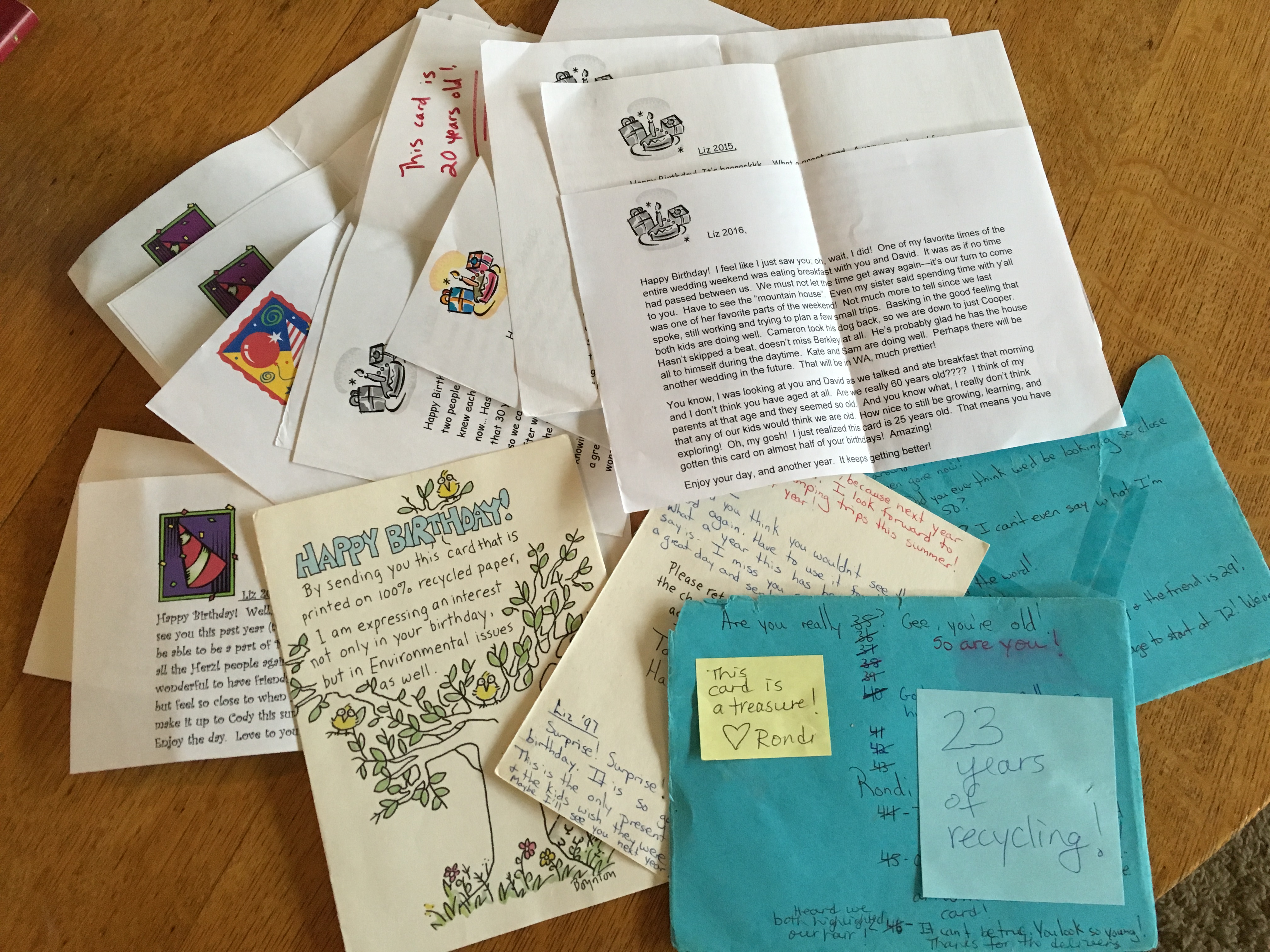
Twenty-five years ago, my co-teacher Liz gave me a birthday card that said, “This card is printed on recycled paper. Please return it to me when you get the chance so I can send it to you again next year.” I smiled and dutifully handed the card back to her, totally forgetting about it in a few weeks. But when March rolled around the following year, there it was on my desk, complete with a new note inside: “Here it is again! Have a great day! Soon you’ll have someone else around to share a birthday.” My second son was about to born. I returned the card to Liz and you can probably guess what happened next. The back and forth of the card became a yearly tradition. Little did we know it would continue for at least a quarter of a century.

Five years after I first received the card, Liz and her family moved to Texas. This meant we would need to use the United States Postal Service to transport the card back and forth between Denver and Dallas. We developed a system. Liz sent the card to me in March, and I sent it back to her in October, along with a new card for her own birthday.

After ten years, every inch of possible writing space on the card was filled with Liz’s newsy greetings, meticulously dated. So by year eleven, she began typing her messages on the computer. She added a birthday graphic on top, printed the note, and tucked it inside the original card before mailing it to me.

By year fifteen, the spine of the original card was beginning to fray. Its blue envelope was also split into two pieces. I’m not sure why, but neither one of us felt the need to tape it back together. We just stuffed the entire pile of paper into a manila envelope, stuck two Forever stamps onto the top right-hand corner, and dropped it into a nearby mailbox. It was around this time that Liz’s notes were becoming longer and more literary. Maybe it was the large, blank space on the computer screen, aching to be filled. Or perhaps she (and I) had reached an age that made us prone to nostalgic ramblings. One thing was for sure. In a world of abbreviated texts, flashing Emojis, endless emails, and Facebook photo postings, Liz’s notes had become full-fledged letters. Letters that chronicled our lives with meaningful reflections and joy. Great-big-smiley-joy.

Next week, I will be throwing a huge party for my dad’s 90th birthday. After sending out a slew of invitations, the RSVP’s began to pour in. Our guests had the choice of calling me or sending an email. Although most of the respondents are in their 80s, many chose the email option. I was amazed at the touching words that flooded my “in” box. “With happiness in our hearts, we look forward to joining you and your family in celebrating Harold at this momentous time. 90 years is special – how appropriate for such a special friend!” And this one: “We can’t wait to celebrate this occasion with our friend Harold whom we love.” Also: Judy and I are delighted to accept the invitation to this milestone event!” The people who called me were more matter-of-fact in their responses. It was either “we’ll be there” or “we can’t make it.” But the writers – the writers were filled with joy.

Writing enables us to express ourselves deeply. We often write what we cannot say out loud. So when you open your journal or turn on your computer to compose, edit, revise, cut, rework, or scream… take a minute to remember why you are doing this in the first place. It brings you joy. Really, it does.


Leave a Comment

Filed under Uncategorized

“Dear Author…” Advice to Middle Grade Writers from 5th Grade Students

04b6989eb2113beb1449373af2a2f16b

What advice do you have for authors who write books for you? I posed this question to my gifted and high ability 5th graders- and was not at all surprised that they were eager to offer guidance and insight to middle grade authors.

I have had the opportunity to teach this group of students for the past five years, meeting them when they were sweet 1st graders, wide-eyed at the prospect of all that school offered. Now, sophisticated and school savvy, they have developed into thoughtful, passionate learners and readers. Here are some highlights of their responses.

Dear Author….

• Put lots of emotion and love into your books. I want deep meaning in a book. -Kylah

• I like to read about what happens in the real world. My world. -Kylah

• Give me action and horror! –Tyler

• Don’t force your creativity. Just write what you love and we’ll feel your love and love it too. -Nicolas

• I love descriptive language—I want you to make me feel like I am right there. -Nicolas

• Have the book teach me life lessons like “don’t give up” or “you can overcome evil” or “be nice to your family.” -Nicolas

• I read novels so that I can have a doorway into stories and situations that are extraordinary. -Bennett

• I want to be sucked into the story as soon as possible. When I’m done, I want the book to be so good that I feel sad when I am finished. -Bennett

• Write about other cultures. We need people to understand each other better. -Ella

• Fill your book with emotion. The best part of a book is the emotion. Whatever you write… realistic fiction, historical fiction, fantasy or something else, it’s the emotion that makes it a good book. -Ella

• I want to be able to put myself in the story and to imagine the characters as my friends. I like a book where you get attached to the characters and wonder what you would do in the same situation. –Quinn

• I like complicated books; books that make you understand something totally new. A book can teach me that there are different people in the world and many different ways to live and solve problems. -Talile

• Make some characters bad and some good and some a little of both, but have at least one character that everyone loves. -Elly

• I want a book to be so descriptive that it makes a movie in my head. I want to get sucked in… -Elly

• Make the book really, really, really, really long. -Ezekiel

• I like books about people who are not like me. I want to understand other people and books help me to do that. -Ezekiel

• It doesn’t matter if the book is set in the past, present or the future. What is important is how the characters figure out what is around them and what they have to deal with. -Ezekiel

• Don’t make the books for older kids so much harder to read than the books for younger kids. Just make the situations more complicated and interesting. -Ben

• Do NOT start your book slow. Don’t be dull. Don’t make the book too long. Long isn’t necessarily better-Ben

• Write a series. Then I’ll read your books for a long, long time and never want them to end. -Ben

• I want you to write books that tell about others and life all around the world. I want to read about characters that are kind, helpful, hopeful and who never give up. -Ximena

• I read to learn about how I can improve myself and become a better person. A good character is a better teacher than a long lecture. -Ximena

• Don’t write to me like I am a kid. Write to me like I am a person. -Marcos

• I like to read novels because I like to get lost in adventure and action and EXPLOSIONS. I want emotion, destruction and suspense. Make your books exciting. -Tai

• I hate “happily ever after endings because they are extremely cliché. Make it real. -Tai

• I like very long books because I want to feel like the book will never end. -Tai

• One word: Magic. Fill your book with magic. All kinds of magic. -Sasha

• I read so I can enter and explore a world other than my own. I like to learn about history through books, so I can imagine what it was really like in the past. -Henry

• I read to escape the world. Make me imagine a whole new world. -Rowan

• Don’t make the characters stupid. -Rowan

• I know you don’t want to hear this, but graphic novels are the best. -Ahmed
Leave a Comment

Filed under Uncategorized

To Conference, To Conference

By Denise Schurr

SCBWIOne of my favorite activities at a writing conference is learning about the recently released books. As a teacher, I’m looking for books to add to my classroom library. As a parent I’m looking for books to capture my kids’ interests. As a reader/writer, I’m looking for something inspiring. The last conference I attended, SCBWI Letters and Lines in September 2015, did not disappoint.

I picked up Todd Tuell’s picture book, Ninja, Ninja, Never Stop! I have two pint-sized ninjas at home who I knew would love it! I think they picked up some cool moves after reading. And it’s one I can share with my school kids too. The ninja topic paired with the rhythmic rhyme is a homerun for both sets of kids!

Another treasured find was Sean Ferrell’s picture book, I Don’t Like Koala. While you think you know the whole story, when you get to the end, there is a fun twist. It’s humorous for kids and adults.

And little did I know at the beginning of the school year, when I read The Kissing Hand to my kindergarten class, I would be picking up my very own copy at the conference. Only this one was signed by the very talented illustrator, Ruth E. Harper. When I took it to school my class was in awe. It was inspiring for them to see something autographed from the person who makes stories come to life through illustration.

Finally, I was disappointed when I was unable to pick up my own copy of Tara Dairman’s middle grade novel, All Four Stars because it was all sold out. Lucky for me, one of my critique group member snagged a copy and let me borrow it. Tara has a feel for the flow of a story and I was swept up from the beginning. For the record, that read wasn’t for my school kids or for my own kids, it was a perfect fit for me.

What about you? What is your favorite find from attending conferences?

2 Comments

Filed under Uncategorized