Tag Archives: Organizing information

Change of Scene (and genre)

It’s been a tough writing year for me. And by tough writing, I mean no writing.


Which isn’t actually true.


While my work on my middle grade fantasy novels stalled (basically completely) which makes me feel like I am not writing at all, I did start co-writing a series with one of my amazing critique partners, Samantha Cohoe. We’ve written two novels so far, including setting aside time, limiting distractions, and writing 30,000 words combined in only three days.


So my no writing, looks very much like being quite productive after all.


What are some of the not-so-secret secrets to our success?

  • Meeting genre-expectations: We’re writing mysteries with a light romance touch to it. That gives us a structure and a framework. We need a body. Someone to have actually done the deed. Other suspects who could have reasonably murdered our dearly departed character. A hot person of interest who our main character wants to get close to but something is keeping them apart. Knowing things we have to include to meet the expectations of reader in this genre give us a bunch of scene and character ideas. Which leads me to…
  • Bookends: We usually know roughly where the book will start but importantly, we know how it ends. We know the climax scene and the basics of how our main character will discover the true killer. But what to write?
  • A runway: Rather than calling it an outline, we start laying out the scenes of the book and developing a ‘runway’ – and once we have enough runway, just like at your local airport, we take off! Calling it a runway vs. an outline feels lighter, and also removes some of the pressure. And takes us out of a singularly linear approach. Because we runway…
  • Front to back and back to front: Our runway starts at the beginning-ish – and then usually somewhere around the middle, we hop around to our end scene (which as I said, we already know), and then we work back toward the middle again. Layering in, fleshing out, leading us to our destination, tightening and weaving as we go. But what’s the most important syllable in that sentence?
  • Collaboration: WE are writing a book. WE are brainstorming together. WE are counting on each other to get the thing done. Whichever one of us has the most energy helps motivate the other, and WE go back and forth on who is cheerleading who. And we have a built-in audience and readership – each other! Which also means we have more than one opinion to take into consideration, so it’s important that we decided…
  • We will not be too precious: We made an explicit agreement that we’re not going to be rigid in our thinking or in our demands. If something isn’t really crucially critically important to us, and the other person has a different opinion… we bend. We move on. We find a third option we can both dig. Something like that. There is basically no hill that we’re going to die on. And when the other person has a way to make a scene funnier, a line tighter – we take it. Take the edit. Make it better. Two heads are better than one.


This experiment/experience has been a real game changer for me. Having someone else count on my productivity keeps me to deadlines. Writing in a completely different genre has opened a brand new well of creativity.


Have you switched it up? What changes have you made that have inspired you and worked well for your writing?

 

6 Comments

Filed under Coral Jenrette

ODE TO REVISION

Revision.

You make me crazy!

“Explain,” you say.

You’re akin to blisters, pests, chores, and petty necessaries.

I have sweat and steamed over you,

rehashing plots, revamping chapters, recasting characters.

“Your point?” you ask.

Now, I am a fanatical, fervored writer

glued to my written mess.

Revision,

others warned

you would be a storm, thorns, and bricks on my brain!

“Why stay?” you say.

For those spectacular moments

when my story flows smooth as syrup

and sparks fill me,

singing “you can do this!”

And suddenly,

I’m a dancer, a bird, a shooting star, a perfect snowflake…

“Follow your characters,” you declare.

Exciting when I let them get into grand muck,

but then, I’m stuck in another written mess.

I breathe, cuss,

resume re-doing:

reorganizing scenes,

recalibrating action,

reconditioning description and dialogue.

Again.

Repeat.

Again.

Insane.

But my hope is refueled.

Alas, my main character has a new coat of conviction and chutzpah.

I can’t let her down.

Revision,

you’re a wild renovation that I can’t fully resolve.

“Congrats!” you say. “Resolving is for readers.”

Revision,

you wake me to characters in chaos,

off stowing secrets and lies.

Please give me a shortcut!

“Butt in chair,” you remind.

Revision,

my thick-skinned constant,

you make me crazy,

but I’ll keep my seat on your train,

wrecks and all.

Thank you.

Much obliged.

Appreciate you.


5 Comments

Filed under craft advice, critique, Karen McChesney, Main character, Motivation, Picture Books, Revision process, RMC-SCBWI

DISCOVERING THE ROOT OF OUR STORIES

My mom asked me to stay while she napped. “Take a nap, honey…on my bed.” I couldn’t refuse my 92-year-old mom. Plus, her air conditioning felt wonderful. We had just come back from being outside on a very muggy day. She quickly dozed off on her small couch. I sat close by on her twin bed and looked around her studio apartment. I was tempted to stretch out and nap, but I was too distracted.

I found myself studying all her favorite things – fragile figurines, throw pillows, antique lamps. Then, I honed in on the walls, studying decorative plates, framed art prints, framed photos of my parents wedding day… I disappeared into studying everything on her walls and atop her furniture. I felt a bit comforted. Afterall, I grew up surrounded by all these things. They were home. My mom was an incredibly talented decorator. Our home was beautiful inside. Every plate, print, figurine had a specific place. And a story. She bought most things at antique stores or from collectors out on farms. In a way, she had bought someone else’s “story” and then went on to create her own. I admit, I didn’t appreciate these things growing up. My chore was dusting them. But then I learned to negotiate with my brothers, so I could mow the lawn – and one of them was happy inside dusting away!

My mom let out an occasional snore as I tip-toed around her little apartment. I wanted to stand close and get a good look at things. I got a bit misty eyed, thinking about all the stories behind them. I was surrounded by story. Then, it hit me. Lots of these things have shown up in my fiction writing – in my character’s homes, in my themes, plots, etc. How could they not, I suppose… Afterall, they are still deep in my roots. These things. Each one holds so many stories. Each one holds part of my story. Each one.

Cards and letters: A red file next to her phone contains recent cards and letters from her kids. Growing up, she stored cards and letters in a mini wood trunk. I love having my characters write or receive letters. And I’m over the moon just imagining one of my characters opening a drawer, then discovering a bunch of letters. I get so excited about the “and then and then”! Especially when a letter holds a secret.

Framed photos: Many black-and-white photos decorate her walls; many feature her parents and grandparents. I never knew them. They were born in Poland, but my mom never told their stories. Oh my gosh! One of my characters is growing up in a Polish family. Even though I only saw my Polish relatives a few times a year (and they taught me how to polka), I never knew their origin stories, their roots. Perhaps, I have desired “finding” them in my writing. Actually, I have.

Shoes: Her brown leather lace-up shoes sit on the floor across from her couch. They have sat there ever since she started wearing a pair of white Reebok shoes. I always picture my character’s shoes, even if I don’t mention shoes in my story. The color, the brand, the style. I’m especially intrigued with why my character would choose a certain shoe.

Landline telephones: My mom has three landline phones, each within a few steps. In our teen years, my brothers and I were always vying for our one landline. All of my YA’s take place in the days of landlines. I prefer the challenge inherent in a landline, such as a family eavesdropping, everyone racing to the ringing phone…

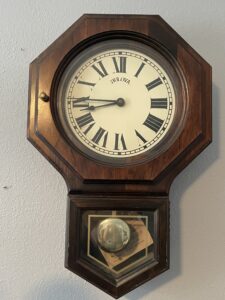
Clocks: There are four clocks spread throughout my mom’s. I remember the obnoxious sound of our cuckoo clock while the seven of us ate Sunday pot roast. Despite my struggle with chronology in writing, I thoroughly enjoy giving clocks a major role. Nothing like an alarm clock startling a character! By the way, my childhood kitchen clock hangs in my writer studio.

Here’s to the finding, discovering the root of our stories, where ‘er they come from! Children’s author E.E. Duncan summed it up best: “It’s interesting to look to ourselves and find those themes that recur in our writing and discover their roots.” Elizabeth is a member of my amazing critique group, Story Spinners. Her biographies and historical fiction explore how history affects everyday people. Her books include, Florence Sabin, Teacher, Scientist, Humanitarian; Felipe and Dolores Baca, Hispanic Pioneers; Ralph Carr, Defender of Japanese Americans; Helen Hunt Jackson, Colorado’s Literary Lady.

3 Comments

Filed under Karen McChesney

Building your TBR Pile

Stack of Books

A new year is coming, and that means another year of writing and reading goals! I wrote about creating categories around your To Be Read (TBR) list. Nothing beats word of mouth hearing from a friend that they loved a book you must try, or having a bookseller or librarian listen to some of your favorites and make a recommendation or two. But if you’re thinking about reading in specific categories, here are some ideas of where you might look for books to try.

No matter how you find your 2021 TBR books, I wish you a massive and diverse list of books and many happy days and nights of reading!


Diverse Books

Diverse books make up a fraction of publishing, yet they are so critical for readers young and old to see themselves, and to see people other than themselves.

We Need Diverse Books has compiled a list of sites that recommend diverse titles – by going to this page you can access many different sites that suggest diverse books.


Award-Winning Books

The Newbery was “the first children’s book award in the world… [and is] the best known and most discussed children’s book award in this country.” A full list of award winners going back to 1922 can be found here.

The Geisel Award is given annually to the author(s) and illustrator(s) of the most distinguished American book for beginning readers published in English in the United States during the preceding year.

The Caldecott Medal goes “to the artist of the most distinguished American picture book for children.”

A great list from @sailyreads on Instagram highlights book awards that celebrate diverse authors and stories. Here is how these books are described on their websites.

  • The Pura Belpré Award, established in 1996, is presented annually to a Latino/Latina writer and illustrator whose work best portrays, affirms, and celebrates the Latino cultural experience in an outstanding work of literature for children and youth”
  • The Coretta Scott King Book Awardsare given annually to outstanding African American authors and illustrators of books for children and young adults that demonstrate an appreciation of African American culture and universal human values.”
  • “The goal of the Asian/Pacific American Award for Literatureis to honor and recognize individual work about Asian/Pacific Americans and their heritage.”
  • “Awarded biennially, the American Indian Youth Literature Award identifies and honors the very best writing and illustrations by Native Americans and Indigenous peoples of North America. Books selected to receive the award present Indigenous North American peoples in the fullness of their humanity.”
  • “The Schneider Family Book Awards honor an author or illustrator for a book that embodies an artistic expression of the disability experience for child and adolescent audiences.”
  • The first and most enduring award for LGBTQIA+ books is the Stonewall Book Awards, sponsored by the American Library Association’s Rainbow Round Table.


State/Regional Lists

Consider adding local authors to your list! Almost every state has an award list. “The Colorado Book Awards annually celebrates the accomplishments of Colorado’s outstanding authors, editors, illustrators, and photographers.”

There are also regional awards that highlight specific interests. For example, “the WILLA Literary Awards honor the best in literature, featuring women’s or girls’ stories set in the West that are published each year.”


SCBWI

Of course, our beloved SCBWI is a great place to find possible books! You can browse the BookStop, where members’ books are listed. SCBWI has multiple awards as well that are given each year to published books, including the regional Crystal Kite Awards (“a peer-given award to recognize great books from 15 SCBWI regional divisions around the world”), the Golden Kite Award (“the only children’s literary award judged by a jury of peers”), and the Spark Award (“recognizes excellence in a children’s book published through a non-traditional publishing route”).


Recommended Books

According to the Goodreads website, they are the world’s largest site for book recommendations. They have a recommendation engine that will make suggestions, you can browse books by genre, and you can see readers’ favorites by looking at the Goodreads Choice Awards, which have finalists and winners broken out by genre.

The Indie Kids’ Next List includes recommendations from indie book stores, where you can read a paragraph about why a particular bookseller recommends that book.

Big bookstores will be happy to recommend you books: you can look them up here, even if you end up checking them out from your local library or purchasing from an independent bookstore. Amazon offers a best children’s books of the year (this one is for 2020), broken out by age group, as well as monthly recommendations.


Starred Books

Books are ‘starred’ when specific book reviewers award them a star as part of their review. They are hard to come by, and many excellent books and many popular books don’t receive them. These reviewers include Booklist (published by the American Library Association, also known as ALA),  Kirkus, and School Library Journal (also known as SLJ). Some are subscription-based to see the full review, but a search of the title will usually show if it has been starred. Some publishers will post quotes from these reviewers on their book. These review journals will also publish ‘best of’ lists.


Best-Selling Books

There are lists available that include the books that are selling the best over a period of time. Two major ones include The New York Times Bestseller list, which includes books ranked by format and genre, and USA Today’s Bestseller List, which shares the top-selling 150 books, across formats, including bookstores and online retailers.

Indiebound aggregates sales from hundreds of bookstores across the country to create their bestseller list, which is broken down by genre.

Amazon shares their top selling books if you click on Books and then a particular category. So does Barnes & Noble, which will break it down by Kids and YA.

***

This list is by no means exhaustive, or an endorsement – hopefully it will help you find new books to love and give you new ideas of where to search.

Other places you love to look at for book recommendations? Add them in the comments below!

9 Comments

Filed under Coral Jenrette, WORD NERD

ACCOUNTABILITY: A WRITER’S BEST FRIEND

“I have to get back to work. Goodbye.”

That’s what I say if I’m talking to someone, and it’s time to show up in my studio and write. The time is blocked out on my calendar, like any meeting or appointment. I got the idea from a writer friend while sharing our routines – and how we show up to our writer job.

Oh, the tricks I play on myself! But, they work. Well, okay, not always – especially during this pandemic, when my teaching and personal schedule are topsy-turvy, and my self-motivation is wavering. But, I keep trying. While sipping morning coffee, I turn on my studio light and open the curtains, so my office shouts, “I’m ready and waiting”. I set my alarm for writing sessions. I put my cell phone in another room, so I can’t hear the buzz of incoming texts or calls (which are perfect distractions when I’m stuck on a scene that I’ve re-written a dozen times!).

Unfortunately, the demons of distraction and procrastination still like to hang out in my office. Ugh! Good news is, I know my own worst enemies really well. Gradually, I’m learning to negotiate with them, so, my favorite co-worker, accountability, can kick them out and pull up a chair!

Here’s what accountability and I have been up to – and what’s really working:

Setting a timer. I try to follow a rigid routine during my scheduled writing time: For writing, I set a timer for one hour, take a 10-15 minute break, repeat. For research, I set a timer for a maximum of 30 minutes.

Monday accountability group. Every Monday, I do an email check-in with a group of kid-lit writers. We submit our goals for the week and report briefly on progress made the previous week. Wow! Keeps me honest and realistic! In our brief format, we manage to celebrate, challenge, and remind each other to keep plugging away, and that it’s okay to take a break.

Text-writing. Once a week, I have a writing “date” with another children’s writer. We text a few minutes before our start time to share what we’re working on or what we want to accomplish. Usually, we do two 45-minute rounds. Then, we briefly check in. We’re always amazed at how much we get accomplished in such a short time.

SCBWI Rocky Mountain Chapter critique group. Once a month, my SCBWI critique group meets in person. We’re the Story Spinners and we’ve been meeting monthly for 20 years. We email our work in advance, then, when we meet, each writer has 20 minutes for their work to be critiqued. When members don’t submit work, they can use their time to update the group on projects, invite brainstorming or advice on a project, share notes from workshops/classes, or etc. They’ve helped me think through SO many critical bits and pieces, such as how to end a pb or write a hook for a YA synopsis, a book title, an angle for a nonfiction article, and the list goes on. We hold separate meetings, as needed, to critique a member’s full manuscript.

Story Spinners are my rocks! Without their passion, drive, support, professionalism, desire to learn, confidence, nudges, wisdom and wit, I would have given up on my projects a long time ago.

SCBWI British Isles North East critique group. While living short term in England (twice), I met weekly with the same critique group. Through email, we continue to: exchange same genre manuscripts for overall feedback, check in bimonthly on current projects. We’re considering holding FaceTime meetings, as needed. They, too, are my rocks, my support group!

Oops! My alarm is going off. I have to get back to work on revising my YA. Goodbye!


Writing is hard, hard, messy work. Going out and doing talks and signing books is all wonderful, but a writer has to return home and go back to work.   

Julia Alvarez, author of AFTERLIFE, BEFORE WE WERE FREE, ALREADY A BUTTERFLY


Leave a Comment

Filed under critique, Karen McChesney, Revision process, Uncategorized

The Squibby Notebook

By Susan Wroble

Over the years, I’ve attended a lot of conferences and workshops, but after this year’s Spring RMC-SCBWI conference, I felt that what I needed most was some way to organize the information so that it would stay relevant and useful.

That’s when it hit. I already knew how to do this! About a dozen years ago, I had taken training in document organization. In addition to writing for children, I moderate a support group for parents whose kids are twice exceptional (2e). These are highly gifted students with a myriad of learning differences, and anyone who has a special needs kid knows that the paperwork mounts quickly. There are medical reports, 504s and IEPs, neuropsych evaluations… the list is endless. In my role as facilitator, I had attended a WrightsLaw Special Education Conference, where a major part of the conference was teaching parents to manage the papers.

And so, with a nod to both dyslexia, which is a frequent piece of the 2e puzzle, and my critique group, who affectionately refers to SCBWI as “Squibby,” I present to you THE SQUIBBY NOTEBOOK, also known as Children’s Writing Resources.

You’ll need a big three-ring binder (preferably the type with plastic outside that lets you slip a paper into the front and back covers and spine), a hole punch and a pencil. Slide something eye catching in the front plastic sleeve (I use a page from an SCBWI calendar) and make a label for the spine (my label says “The Squibby Notebook”).

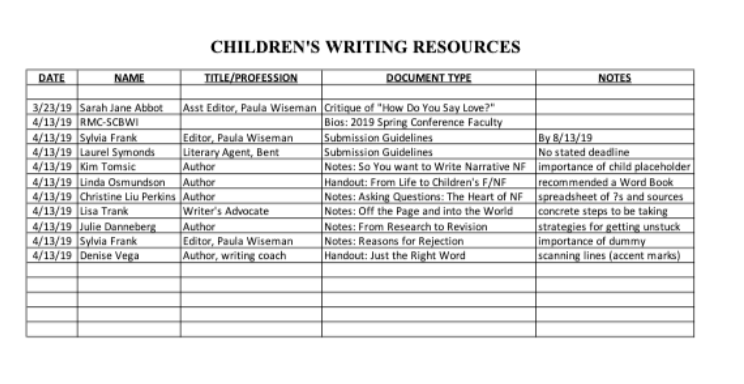
The hardest — and most valuable — part of this system is the Table of Contents. Create a spreadsheet (landscape orientation) with the following five columns:

  • Date
  • Name
  • Title/Profession
  • Document Type
  • Notes


Make a header for the Table of Contents that reads “Children’s Writing Resources.” And then start filling in information on the spreadsheet. The “Notes” section is the most important. That’s where you connect the dots, linking this document to one or more of your works in progress. The notes section reminds you of why that document is important.

And then you file documents chronologically: oldest in front, newest at the back. With the pencil, date each document on the bottom right-hand corner. One of the beauties of this system is that each time you attend a webinar, workshop, or conference, you update that Table of Contents, and in the process review what the notebook holds. You’ll know which agents and editors you’ve seen and when you saw them. And with luck, by keeping the lessons at the top of your brain, and the documents corralled, you’ll shorten that journey from idea to publication. Happy filing!


2 Comments

Filed under Susan Wroble, Uncategorized