Category Archives: Revision process

Writing Alone, But Together

I’m done. No, not with my revising. Darn it. But, even better, at least from my birds-eye view: I’m done trying to feel like a writer and I am darn giddy to report that I no longer imagine suppose-to’s, like cozying up my studio or writing at coffee shops. No more! For the past few years, I have been a writer; I have kept my behind in a chair. Yes, I still slug through, mumble ugh, write total crap… Doesn’t matter. I am writing!

I know I’m not the only writer who has tried to feel like one. Maybe I’m growing up as a writer. Hear ye! Finally. Oh, I have a long, long way to learn. But I am saving a lot of time – getting right to writing, instead of fussing with lighting candles (great if helps you!). Now, I arrive at one of my favorite writing spots – my studio or kitchen table – and do my quick set-up: cups of java and water to left of laptop, paper and pen to right, blanket o’er my lap, timer set. By the way, my red-black plaid blanket is full of childhood stories from when I would use it to build forts, watch tv, trick ‘n tease with my brothers.

A brief trip back to those days… I always needed complete quiet to do my homework. I vividly, fondly recall high school nights – my brother Jim at one end of our long Formica kitchen table, me at the other. We read, took notes and penned essays in silence, while our dad was at his second job, our mom and youngest brother sound asleep, our oldest brothers away at college. Even though Jim was a quick study, whipping through homework while jotting social plans, he always checked in with me. It was as if he knew the exact moment I got restless, started daydreaming. “How ya doing, kid?” he would say. Whether I grumbled frustration or not a word, he would smirk, jump up and open the fridge. Message: Let’s take a break together.

Together. Today, I still need complete quiet when I write (and lotsa jumping up, taking breaks!) and to be with other writers. I prefer writing alone, but together. So, that’s what I’ve created for myself – being with other writers, being held accountable. Every week, I get and give plenty of “how ya doing?” check in’s and everyone is a-okay with a short answer or not a word. We’re sticking together.

Here’s my list of formal and informal sessions that keep my behind in my chair. There are plenty more, including for writers who prefer chatting, music, dogs barking, prompts… You go! My sessions – with strangers or writer friends – guarantee someone is at the other end of “the table” and we’re together writing in silence. And, I get to stay in my favorite spot! May you, too, find your table and whoever you need at the other end.

Virtual Sessions: Writers from across the globe, including many U.S. SCBWI members.

Writers’ Hour https://writershour.com/

3 times daily Monday-Friday

The Chicago Writers Circle meetup.com/The-Chicago-Writer-s-Circle

1 time daily Sunday-Saturday

My (Private) Writing Session:

Text Partner: I write with a long-time writer friend minimum twice weekly. We text at start and end. Revs my creativity and writing!

My Accountability:

  • Monday Morning E-mail: I exchange weekly goals and accomplishments with other children’s writers. Keeps me honest, nudges me.
  • YA Accountability Partner: Email and phone call meetings. Motivating!
  • Story Spinner SCBWI Critique Group: We meet twice monthly for feedback on manuscripts, query letters, ideas, outlines, research, etc. Can’t imagine writing without them!!
  • SCBWI British Isles Group: E-mail check ins. Inspiring!


I am writing the success of my every breath.
–Mahogany L. Browne, award-winning author of CHLORINE SKY and other YA novels, board books

I have never heard a more eloquent silence.

–Laurie Halse Anderson, award-winning author of SPEAK and other YA novels, picture books
3 Comments

Filed under 2022, craft advice, critique, Karen McChesney, Picture Books, Revision process, RMC-SCBWI

Why you should invest in coaching as a writer or illustrator

Bill Gates said in 2020 — “Everyone needs a coach. It doesn’t matter whether you’re a basketball player, a tennis player, a gymnast, or a bridge player.” But let’s finish that sentence.

It doesn’t matter whether you’re a writer. Or an illustrator. Or both.

Everyone needs a coach.

If you don’t immediately agree with me (or Bill) here are some benefits for you to consider. And if you do already agree with me, and are a member of the RMC-SCBWI, head right on over to read specifically about the Michelle Begley Mentor Program, a six month program that offers great value for investment, which I am thrilled to co-coordinate this year with Laura Perdew. The application is open until November 9, 2021 and this year we are offering a scholarship courtesy of the Writing Roosters and two grants!


Ongoing Critique and Feedback

I am part of two wonderful critique groups that meet regularly, yet working with a mentor is still a unique experience because *your work* and *your craft* are the entire focus of the conversation. Together you discuss your vision and over the course of multiple months, you bring that vision to light.


Improve your current work in progress

First and foremost, your mentor will work with you on a manuscript (or illustration portfolio) that you’ve been working on. As established professionals, they bring their expertise to your work and will help you develop it to be as strong as it can be. In my own mentorship with Anna-Maria Crum as my mentor, she helped me rework my plot and character motivation – my inciting incident was buried way down deep in my manuscript, and this reorganization immediately made my work stronger.


Improve your craft going forward

There will be countless elements of what your mentor points out in your work that you will be able to carry forward for years to come. Two personal examples — I learned about some of the weaknesses in my plot (build stronger motivation for action – no coincidences!) as well as in my dialogue (make sure my characters react to what is said as opposed to making unrealistic leaps in the conversation because the lines sound cool). It opened up my eyes not only to what I could improve in the novel we were discussing, but what I could carry over to every scene I’ve crafted since.


Coaches can help you set realistic goals

Our mentors have been there, done that, but the fact is that every artistic creator is different. A mentor can talk through your process and experience and help you set goals for your work – goals that are within your control and that you will meet during the course of the six months. Which leads us right to…


Having a coach is motivating

Coaches give you deadlines. They are there, waiting and expecting for you to work with them. They are looking forward to seeing your progress. And having that built in accountability can do wonders.


***

There are many other reasons to have a coach, and many personal experiences about successful mentor/mentee relationships. Read testimonials here about what others have gotten out of the Michelle Begley Mentor program, and share in the comments some of the benefits you have experienced in working with a mentor (or being a mentor!).

And consider securing a mentor of your own through the Michelle Begley Mentor Program. The application is open until November 9, 2021.


**Reading this after 11/9/21? Join us next time – the application period for the Michelle Begley Mentor Program is typically October through November 1.

2 Comments

Filed under Coral Jenrette, craft advice, critique, Revision process, RMC-SCBWI

Highlights of Highlights!

By Rondi Sokoloff Frieder

I have very strong childhood memories of getting the Highlights for Children magazine in the mail. First of all, it was mail – for me! (And my brothers, but mostly for me.)  I’d spot it on the kitchen counter, whisk it off to my bedroom, and immediately turn to the hidden pictures page. Then I’d search and search until I found every last rake, spoon, ice cream cone, and whatever else was listed at the bottom of the page! Today, Highlights publishes entire workbooks of these puzzles. They even have an app.

The first issue of Highlights magazine came out in 1946 and was published by the Pennsylvanian husband-and-wife team – Garry Cleveland Meyers and Caroline Clark. These days, the company’s corporate headquarters is  based in Columbus, Ohio, and includes Zaner-Bloser, Stenhouse Publishers, and Staff Development for Educators. But there’s another arm of the organization you may not know about – The Highlights Foundation. This is a 501 c-3 non-profit, established in 1984, that offers “workshops, retreats, and other support to writers, illustrators, and all creators of kid-friendly content.” (For a quick history of the company, go to: https://www.highlights.com/about-us/history.) The Foundation was established in 1984  in Chautauqua NY, but is now located in an idyllic rural setting in Honesdale, PA. George Brown, a descendant of Garry and Caroline, is its dynamic Executive Director.

During the pandemic, I took two of the Foundation’s classes online: “Filling the Writer’s Toolbox” with Emma Dryden, and “DIY Revision for your Novel or Non-Fiction” with Susan Campbell Bartoletti. But in August, after being prodded by my writing coach and award-winning author Sarah Aronson, and fellow Story Spinner and RMC-SCBWI Regional Advisor, Susan Wroble, I attended my first in-person event. And even though I am not a fan of mosquitos, ticks, humidity, or frizzy hair, this truly was the “highlight” of my summer.

“The Whole Novel Workshop,” was a six-day intensive for writers of MG and YA fiction. It differed from my other two classes in that it required an application. That meant submitting the first fifteen pages of my MG manuscript, a synopsis, and a cover letter. When my acceptance arrived, I literally whooped and hollered to the dog! Only that’s when the real work began. Not only would I be working on my revision during the workshop, I would also be receiving an in-depth critique of my full manuscript (from the brilliant, hilarious, and award-winning author, Crystal Allen) before I even arrived on campus. There were also three Zoom meetings with our  group (twenty participants and ten faculty), two books to read (one YA novel, one on craft), and partial manuscripts, synopses, and cover letters to read from the members of our assigned “Brain Trust” group (7-8 people). We used the Canvas platform to introduce ourselves (and our pets) and to explore writing prompts, articles, and podcasts. Needless to say, “The Whole Novel Workshop” could have been called “The Whole Summer Workshop!”

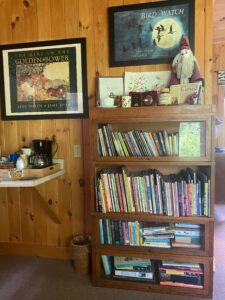
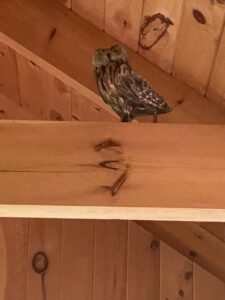
Finally, on August 21, the big day arrived. I pulled up to my home for the week, “#16,” the Jane Yolen cabin! (OMG – how did they know???) and basked in the beauty of my surroundings. There was a lovely front porch, with windows overlooking a wooded glen, a bookshelf filled with Jane’s books, posters on the wall, and an owl perched on the rafters. (I love OWL MOON!)

                .                                 

That evening, we all gathered for the start of what can only be described as a week of serious work, tremendous growth, and pure joy. There were craft workshops, thought-provoking morning prompts, critiques, time to write (alone or in community), Brain Trust groups (45-minute discussions about your manuscript led by YOU), one-on-one discussions, interviews with your main character (conducted by the dramatic Crystal!), pristine walks, and time to think about and work through your revision ideas. And the food! Ask anyone who has attended a Highlights workshop and they will definitely talk about the food. The chefs and servers prepare gourmet works of art three times a day, with snacks available twenty-four seven!

I could talk about this magical week for hours. (And believe me, I have.) Instead, here’s a  stream-of-consciousness recap:

Know who your audience is and what your character really wants. (So true, Rob.) Emotion drives action. Look for the fractals. (Jennifer) Journal until you’ve figured things out and do the swirlies. (Sarah) Discuss ideas with fellow novelists. (We love talking about these things, right Nora?!) Go for long walks. (Thanks for being our guide, George.) Play with tense and POV and balance dialogue, narrative, and description by using colored pens. (Nancy) Get rid of unnecessary characters. (Find your orderly, get rid of the priest- Crystal) Try new plotting tools. (Can’t wait to use yours, Erin.) Writing prompts open your mind to new possibilities! (Yes, Melissa!) No writing is wasted time. (More Melissa) Don’t be afraid of marketing. (I will be in touch, Mia.) And other assorted other words of wisdom: Pay attention to your secondary characters. It’s all about voice. Play and think in the rock garden. Be open about making changes. Make writer friends and support their work. (Miss you all!)

And of course… Keep going!

Our incredible faculty rocked it EVERY DAY and worked alongside us. (There was an open mike night on our last evening… WOW!) Endless thanks to: Crystal Allen, Sarah Aronson, Nora Shalaway Carpenter, Rob Costello, Erin Dionne, Mia Garcia, Jennifer Jacobsen, Erin Entrada Kelly, Alex Villasante, Nancy Werlin, Melissa Wyatt . Can you believe this line-up? I am still in awe of each and every one of them.

You must go to Highlights. (Even with the mosquitoes, ticks, and frizzy hair.) Put it on your to-do list. Right now. highlightsfoundation.org/upcoming/workshops.

I can’t wait to go back.


5 Comments

Filed under craft advice, critique, Partners in Literacy, Revision process, Rondi Frieder, Susan Wroble

Receiving Feedback

Critiquing is a critical part of the writing process – getting feedback from others gives us guidance and can shed a light on where we might focus in revision. There is so much we can’t see as the writer of our own work and getting other people’s responses to what we’ve written is truly illuminating.
 

But receiving feedback – literally sitting there while someone tells us what they think about our work –can be hard. Sometimes it can be really hard. It’s great when people say, “I love what you’ve done!” but it can be hard to listen to people say, “Here are the things I think you need to fix.”  It can even be hard when they say, “I love what you’ve done but here are some things to fix.” Someone can love your piece, and it can still need work.

The fact is, even if it it’s combined with positive feedback, receiving critical feedback can be challenging.

Here are a few recommendations for how to handle the moments when your piece is getting critiqued.

  • If your group is reading the piece for the first time while together, allow someone else to read your piece aloud. Hearing where they read smoothly and where they stumble can give great insight as to where you might want to revise at the sentence and word level.
    • No critique partners? Critique partners read everything in advance? Your piece is longer than a picture book or a few pages? Use a Read Aloud function, like you can find in Word – Google docs also seems to have a text to read function
  • Try to take feedback in and listen without getting upset.  It’s very natural to have a knee-jerk reaction to critical feedback. “But that’s not what I meant” or “you’re not understanding” – if they didn’t understand, it might not be on the page the way it is on your head. Try to take in critical feedback without being defensive.
    • If you’re too defensive or upset receiving critical feedback, it may hurt people’s ability to be honest with you in the future.
    • The exception — respond to any kind of clarifying question that will help someone provide feedback from a place of understanding
    • Sometimes one critiquer will say something is missing on the page (a motivation, for example, or an emotion), while another critiquer will have gotten exactly what you were trying to say. In this instance, consider whether what you are trying to get across is obvious enough. It may be. It may not.
  • Relish the positive things people have to say. You need to learn what works in your work. Even if a line is cut or a scene doesn’t make it, if people loved it, find out why so you can replicate.
    • Some people are great at this. For others, it can be really hard to take in the positive. Some people want to skip right over the positive and get to the critical because that’s where the work is, but make notes about what people love, so you can keep those things in your writing, and celebrate those things as the critical feedback comes rolling in.


What other recommendations do you have else for those moments during a critique while people are actively giving you feedback?


**Image by Gerd Altmann from Pixabay

4 Comments

Filed under Coral Jenrette, craft advice, critique, Revision process

WRITING IS A STICKY BUSINESS!

By Rondi Sokoloff Frieder

In the “About” section of this blog, In the Writer’s Web, we end our mission statement with the following sentence: “We want to provide insight, information, and inspiration to writers everywhere. Because… writing is a sticky business.” I love that last line. But what exactly does sticky mean? The Merriam-Webster online dictionary provides these synonyms: gluey, gummy, tacky, difficult, problematic, sensitive, tough, tricky, complex, complicated, hard, intricate, involved, serious, demanding, exacting, exhausting, stressful, and problematic. Yikes! On the other hand, here are some antonyms from the same site: easy, effortless, manageable, painless, simple, straightforward. So, if writing is a such a tricky-sticky business, why do we do it? Because we love it!

Most of you will agree that the past fourteen months have been extremely “sticky.” It was the epitome of so many of those adjectives I listed above. But the writer in me actually got a lot done. I became unstuck in many ways. I used my new stay-at-home lifestyle to develop a more serious writing practice. I hunkered down in my studio each morning to write and read. I revised a novel, got feedback from trusted critique partners, and revised again. I also dusted off another novel that had been sitting in a virtual drawer and began making some important changes. I attended online classes, webinars, conferences, and book launches. My critique group, The Story Spinners, began meeting on Zoom, twice a month, rather than once, in-person. And my Tuesday writing group, The Nanos, got together for Zoom writing sessions and lunch every week! I can honestly say that my writing, and my writing community, became my biggest comfort during this time of isolation.

But don’t get me wrong. I had many sticky writer moments during the pandemic. At one point, I had to put my novel aside. The events happening in our world today were so similar to what was going on in my historical MG novel. Hatred and bigotry still rage in our communities. On the flip side, I’m even more motivated to get my book out there, not matter how sticky the process might be.

When YOUR writing life becomes sticky, try some of these strategies:

  1. Write something new. A first draft written with abandon, or an early morning writing prompt might just be what you need to get those juices flowing. Journal, draw, make lists!
  2. Try writing in a different genre. If you’re writing picture books, take a stab at a middle grade or a novel in verse.
  3. Interview your characters, both primary and secondary, at various times. They may have changed during the course of your revision. (http://www.rondibooks.com/getting-to-know-my-characters-again/)
  4. Make a map – seriously – draw out where your story takes place with colored pencils or markers. It will help you navigate the details as your characters move through your setting.
  5. Chart out how many times each character appears in your book. Are they all necessary? If the answer is yes, you may need to have them do more so the reader will remember them.
  6. Color-code dialogue, narrative, and description, and see if you have a balance. You can print the pages out and use markers, or highlight with different colors on your computer.
  7. Take classes! I particularly enjoyed workshops with Emma Dryden, Kate Messner, Linda Sue Park, Julie Berry, and Grace Burrowes. I also worked one-on-one with Sarah Aronson and am looking forward to my next class with Susan Campbell Bartoletti. The pandemic has isolated us, but also brought us together. These classes were all available on Zoom along with handouts and recordings.
  8. Have others read your work and take time to digest the feedback. Emma Dryden says that 80% of the feedback will not resonate, 15% will make you think, and 5% will be so on point, you’ll go running to your computer to put in the changes!
  9. Make a list of strong verbs and inspirational metaphors from mentor texts. Then find ways to strengthen your own writing.
  10. Get rid of unnecessary words. I totally overuse: just, that, I think, begin. Also, trim tag lines.
  11. When you’re in the thick of revision, Sarah Aronson suggests writing down what your main character is like at the beginning and end of your book. Have they changed? How? Julie Berry had us write a love letter to our novel. So great! I go back and read this from time to time. It reminds me why I am working so hard to make this book the best it can be.
  12. Have the computer read your manuscript out loud to you. In Word, go to Review and click on Read Aloud. It’s a computery voice, but it still helps you pick up on repetitive sentences and awkward dialogue.
  13. Read books on craft. Even just a chapter or two. And do the exercises suggested.
  14. Read inspirational books about being a writer/illustrator. Here’s one of my favorites:
  15. Read  a wide variety of books, but be current on what’s being published in your genre. With picture books, you can also find read-alouds on Pinterest.
  16. Subscribe to writing blogs (like this one!), join groups on Facebook (especially SCBWI, Sub It Club, and Kidlit411) and connect with other writers/illustrators on Twitter and Instagram.
  17. Take classes and attend workshops. Places to look online: SCBWI regional and national webinars and conferences, local SCBWI regional Connects, Free Expressions, Highlights, Writers Barn, Lighthouse Writers, Writer’s Digest, StoryStorm, ReFoReMo, NANOWRIMO, etc.
  18. THINK about your book. Go for walks, ride your bike, or hang out in the shower. When an idea occurs to you, send yourself a text (or you may forget this little inspirational nugget) and transfer it to your notebook or actual ms when you get a chance.

No matter what – Stick with it, stick to it, and stick it out, because although writing is a sticky business, it is also very, very sweet!

Note: This was the blog I wrote in January before I left my laptop toooooo close to a humidifier. It got… misplaced for a while.

11 Comments

Filed under craft advice, critique, Main character, Revision process, RMC-SCBWI, Rondi Frieder, WORD NERD, Writing during the pandemic

Deep Dive into Your Target Word Count

As you develop your story, there are so many components to consider and perfect: a strong character arc, varied pacing, stellar dialogue, beautiful descriptions… the list goes on and on. But one factor you must always consider is word count.

If your novel is too short, it might not be considered ‘meaty’ enough for the age group. If your novel is too long, agents and publishers might worry that it has a ‘saggy middle’ or is filled with fluff. And for picture books, the current trend is definitely shorter over longer, but that can look very different depending on the age of the targeted audience and whether the book is fiction or non-fiction.

So what do you do?

First, because this can change over time, research the current trends for word length for the type of book you are writing (type something like “word length for picture books” in the search engine and see what you get). Here’s an article from Writer’s Digest to get you started.

Second, find comparison (comps) and/or mentor texts. Story Spinner Susan Wroble wrote a great post on how to do this.

Third, use a fantastic resource like Accelerated Reader Bookfinder (www.arbookfind.com) to see how those comp and mentor texts measure up when it comes to word count.

When you search for a book, AR Bookfinder will give you a lot of information (short blurb, ATOS book level, interest level, rating, whether it is fiction or non-fiction, subtopics, etc.), but most importantly (for this post) it will give you the specific word count for the book.

This is critical because page length can vary – just think about the difference between a story submitted in 11 point font, single spaced, with ½ inch margins vs. a double spaced, 14 point font, with 2-inch margins. This is why the industry is so specific about the formatting that you use when submitting materials – it gives some consistency about what ‘5 pages’ really means. But when you’re publishing a book, you have no such limitations. The pages can differ in size of the book itself, in margins, in fonts and font size… the list goes on and on. While, in general, more pages means more words, two books that are 250 physical pages can have very different word lengths. Nowhere can you see that more than in picture books.

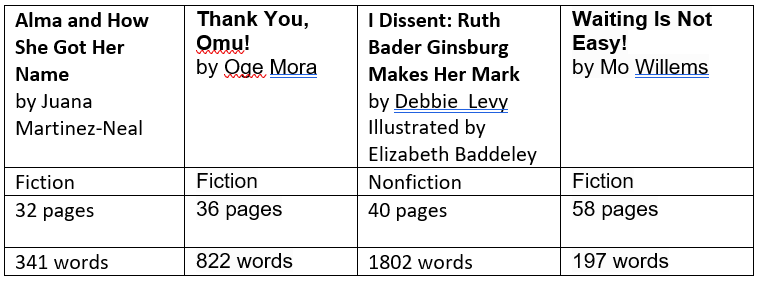
Here are four examples:

** If you have trouble seeing the table, the information is written at the end of the blog post


These are four wonderful books, all targeted to the K-3 reader, but they couldn’t be more different. And that is reflected not only in the way the books are written (prose vs. dialogue, for example) but in the word length. For these four books, the book with the most pages has the smallest number of words. Seeing how your book stacks up in word length to a book similar to yours can give you a good sense as to whether you are hitting the mark.


If your picture book is 700 words, and your comp titles all range from 400-500, your book may be too long for your target audience.  If your mentor texts are 45,000  – 50,000 words, and your novel is 17,000 words, again — potential problem. Your book lengths don’t need to be an exact match, but hitting market expectations is important in securing an agent and/or a publisher, or in getting readers if you decide to indie publish.


And … don’t use a single text to decide if you are hitting this mark because, just like rules for ‘i before e’ there are exceptions out there. Could your book be double (or half) the expected length and still sell? Of course it could! But make sure when you decide that your final manuscript is really final, you know how your book measures up.

***

If you couldn’t read the table, here is the information on the four picture books:

Alma and How She Got Her Name by Juana Martinez-Neal

Fiction, 32 pages, 341 words

Thank You, Omu! by Oge Mora

Fiction, 36 pages, 822 words

I Dissent: Ruth Bader Ginsburg Makes Her Mark by Debbie  Levy, Illustrated by Elizabeth Baddeley

Nonfiction, 40 pages, 1802 words

 Waiting Is Not Easy! by Mo Willems

Fiction, 58 pages, 197 words

9 Comments

Filed under Coral Jenrette, craft advice, Revision process

Mentor Texts and Comp Titles

By Susan Wroble

The Story Spinners critique group has a long tradition of having retreats. In 2020, when Covid-19 made meeting in person impossible, we weren’t willing to abandon the tradition. We each picked a topic to present to the others in our first (and perhaps only) virtual format. I choose a topic I needed to learn more about—mentor texts and comp titles.

Author Tara Luebbe defined the difference between mentor text and comp titles in her blogpost for SCBWI Southern California’s Kite Tails last January. The same book might be both a mentor text and a comp—the difference is in how you use it.


MENTOR TEXTS COMP TITLES
Are all about… Craft Sales
Can be in… Any genre Same genre as your work
Published… At any time Within the past five years
Serves as a… Template A way to “get” your story


Mentor texts are the books that you use to learn how to do something. Perhaps you need help on POV, or pacing, or story arc. Mentor texts are the books you use as guides to learn a writing skill. In contrast, comp titles are books that show where your story belongs in the market. They help identify the target audience and where your book will fit on the shelves.

How to Find Them: So now that you know the difference, how do you find mentor texts and comp titles? Hint: the answer is not to start by broadcasting for help on social media!

To start, spend some type analyzing what you need before you begin the search. For mentor texts, are you looking for help with the humor, with rhymes, with a character arc…? For comp titles, what are the identifying features of your manuscript—its genre, subject matter, formats, type of writing, and tone?

Now that you know what you are looking for, you can begin finding the books. While the way you use mentor texts and comp titles is very different, the process of finding them is similar. Some of the common ways to search include:

  • Children’s Librarians
  • Booksellers
  • Goodreads
  • Amazon, especially the features
    • “Customers who viewed this also viewed”
    • “Sponsored products related to this item”
  • Pinterest lists (these are surprisingly helpful), and
  • ReFoReMo lists (my favorite for picture book comps!)

Using the ReFoReMo Lists:

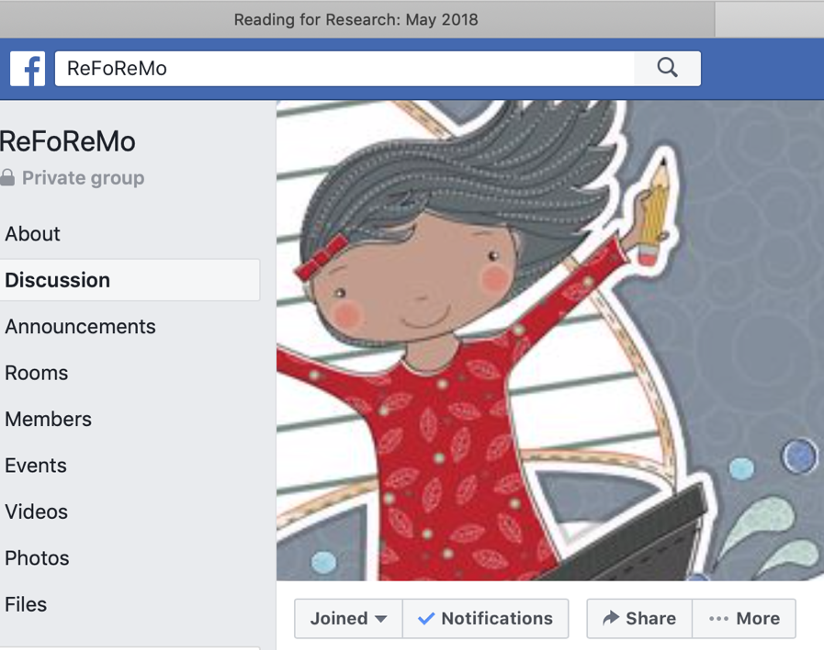
If you are writing picture books, I highly recommend the free “Reading for Research Month” held each year in March. This month-long picture book study was founded to help PB writers understand the form, market and craft of writing through the reading and study of current picture books. Registration for ReFoReMo typically opens in mid-to-late February, and one of the many benefits of ReFoReMo is their private Facebook group. Searchable lists—perfect for finding mentor texts and comp titles—are in the lists section of the ReFoReMo Facebook files.

Here’s an example of how to use the files: My work-in-progress WHAT’S IN YOUR CAULDRON? is a rhyming and lyrical nonfiction picture book with transformational change (witches to healers). Sometimes, the categories in mentor texts and comp titles will overlap. I might want to look at rhyming books for both mentor texts and comp titles.

I start by going to Facebook, and the ReFoReMo Page:

On the left, near the bottom of the list, you will see “Files.” Click on that. You get a (searchable!) long list, that includes things like:

  • How-to
  • Rule Breakers
  • Cumulative Structure
  • Unexpected Twists
  • Longer PBs
  • Universal Themes
  • Tough Topics
  • Wordless
  • Contradictions in Text vs Illustrations
  • Free Verse
  • Grief and Loss

From here, I will search for rhyming texts. “Rhyming” gets me nothing, but “Rhyme” leads me to this file: Rhymers

From this list, I might look at Elli Woollard’s THE DRAGON AND THE NIBBLESOME KNIGHT. The copyright date of 2016 means I could use this as a comp title, as it has been published within the past five years. Heading over to Amazon, I can use the “Look Inside” feature (it’s not on all books, but if it is there, it is just above the picture of the book cover). Like my work-in-progress, I can see that THE DRAGON AND THE NIBBLESOME KNIGHT is written in rhyming couplets. But the tone, the meter, and the arc are very too different; it is not a good mentor text in any of those areas. However, it might be a good comp.

A further search on THE DRAGON AND THE NIBBLESOME KNIGHT gets me a full reading via YouTube, and I can see that the dragon and knight go from being enemies to being friends. The combination of both a structural match (rhyming) and a thematic match (transformational change) makes this a potential comp title for my manuscript.

Success! And I hope that this post brings you some understanding and success in your search for mentor texts and comp titles as well.


4 Comments

Filed under Revision process, Susan Wroble, Uncategorized

I WRITE, BECAUSE…

I write because it’s my

rock,

church,

wrinkles,

pain,

loudest laugh,

amid deep doubt

on mornings when I’m convinced the birds are singing,

“scrap it, stick with vacuuming.”

Second chance,

even when revision and I aren’t getting along.

Need for risks,

such fun to throw terrible twists at my characters.

Addiction to curiousity

and what, where, when, why,

by the way, how the heck did my research lead to the story of the chef who made the world’s largest dumpling,

and then on to 10 synonyms for said

that I’ll delight in using way too many times.

Decisions,

as complex as Colorado weather

and a one word sentence.

Seeing through lotsa lenses,

each a chance to make metaphors,

as like

and like as.

One what if after what if,

navigating the creative mess I’ve made.

Commitment to writing The End.

Reminder to trust

and hope,

oh, please, may my 10 years of revising

90,000 words make some sense!

I admit, it’s often my desperate attempt to whittle, whittle away at a chunk of wood

seeking the perfect knot

that I want to sand, buff, stain,

repeat;

and often, it’s a return to my rebellious teen,

sneaking up the stairs after curfew

with secrets of my doings deep in my Levi’s pocket;

and often, it’s my science lab,

experimenting with wit,

but, ending up with the same result,

me laughing at my same corny ideas.

Raw truth,

much, much better than any mirror.

Every wee fear,

including those I haven’t met.

Pillow and blanket,

especially when I want to hide from characters that I can’t bear to inform:

“I don’t know if you would laugh or cry over this matter.”

Giddy childhood,

when my four brothers and I wrapped towels around our necks

and raced our bikes two miles to the public pool,

competing all day for the biggest cannon ball splash

and finding enough coins on the concrete to buy Baby Ruth’s and lemon drops.

Freedom,

flying down a mountain on my bicycle at 40 mph,

hearing only air,

only!

Tuner,

honing in on how-to’s,

like my character’s nervous habit,

or, whether she should whine, sigh or snicker.

Adrenaline rush,

when rarely, oh so rarely,

six sentences in a row,

flow,

flow,

as if my character is in charge.

Admission

to the humbling fact,

yes, my characters will lead,

if you would listen,

they’d love to whisper:

“Get your ego out of the way, god damnit!”

Shower,

making sure I scrub deep, bid farewell to the filth and start all over.

Challenge

that wakes, sparks and jests me,

like when I hide dark chocolate in the freezer,

yet, keep avoiding, avoiding

till I must have a bite,

and then, you know what happens next,

I eat the whole bar!

Shovel,

reminding me: dig up, dig up, dig up the muck,

more,

more,

because, beneath is the real stuff, THE story,

arriving at an unexpected reality sign:

“welcome to the story you never knew you were telling!”

My rescue crew,

always ready with a

hug,

wisdom,

feedback,

nudge,

prayer,

a plethora of ideas,

edits,

commas,

periods.

Fresh baked paper

just out of the oven,

ready for my pen to

dabble,

let go,

forgive,

say hello,

how are ya,

goodbye

to mom, dad, brothers, best buds.

Stories

I write,

because,

I always have.

Leave a Comment

Filed under Karen McChesney, Main character, Revision process, Uncategorized, WORD NERD

ACCOUNTABILITY: A WRITER’S BEST FRIEND

“I have to get back to work. Goodbye.”

That’s what I say if I’m talking to someone, and it’s time to show up in my studio and write. The time is blocked out on my calendar, like any meeting or appointment. I got the idea from a writer friend while sharing our routines – and how we show up to our writer job.

Oh, the tricks I play on myself! But, they work. Well, okay, not always – especially during this pandemic, when my teaching and personal schedule are topsy-turvy, and my self-motivation is wavering. But, I keep trying. While sipping morning coffee, I turn on my studio light and open the curtains, so my office shouts, “I’m ready and waiting”. I set my alarm for writing sessions. I put my cell phone in another room, so I can’t hear the buzz of incoming texts or calls (which are perfect distractions when I’m stuck on a scene that I’ve re-written a dozen times!).

Unfortunately, the demons of distraction and procrastination still like to hang out in my office. Ugh! Good news is, I know my own worst enemies really well. Gradually, I’m learning to negotiate with them, so, my favorite co-worker, accountability, can kick them out and pull up a chair!

Here’s what accountability and I have been up to – and what’s really working:

Setting a timer. I try to follow a rigid routine during my scheduled writing time: For writing, I set a timer for one hour, take a 10-15 minute break, repeat. For research, I set a timer for a maximum of 30 minutes.

Monday accountability group. Every Monday, I do an email check-in with a group of kid-lit writers. We submit our goals for the week and report briefly on progress made the previous week. Wow! Keeps me honest and realistic! In our brief format, we manage to celebrate, challenge, and remind each other to keep plugging away, and that it’s okay to take a break.

Text-writing. Once a week, I have a writing “date” with another children’s writer. We text a few minutes before our start time to share what we’re working on or what we want to accomplish. Usually, we do two 45-minute rounds. Then, we briefly check in. We’re always amazed at how much we get accomplished in such a short time.

SCBWI Rocky Mountain Chapter critique group. Once a month, my SCBWI critique group meets in person. We’re the Story Spinners and we’ve been meeting monthly for 20 years. We email our work in advance, then, when we meet, each writer has 20 minutes for their work to be critiqued. When members don’t submit work, they can use their time to update the group on projects, invite brainstorming or advice on a project, share notes from workshops/classes, or etc. They’ve helped me think through SO many critical bits and pieces, such as how to end a pb or write a hook for a YA synopsis, a book title, an angle for a nonfiction article, and the list goes on. We hold separate meetings, as needed, to critique a member’s full manuscript.

Story Spinners are my rocks! Without their passion, drive, support, professionalism, desire to learn, confidence, nudges, wisdom and wit, I would have given up on my projects a long time ago.

SCBWI British Isles North East critique group. While living short term in England (twice), I met weekly with the same critique group. Through email, we continue to: exchange same genre manuscripts for overall feedback, check in bimonthly on current projects. We’re considering holding FaceTime meetings, as needed. They, too, are my rocks, my support group!

Oops! My alarm is going off. I have to get back to work on revising my YA. Goodbye!


Writing is hard, hard, messy work. Going out and doing talks and signing books is all wonderful, but a writer has to return home and go back to work.   

Julia Alvarez, author of AFTERLIFE, BEFORE WE WERE FREE, ALREADY A BUTTERFLY


Leave a Comment

Filed under critique, Karen McChesney, Revision process, Uncategorized

Be A Word Nerd!

By Rondi Sokoloff Frieder

You’ve heard it all before. Show don’t tell. Limit your use of adverbs. Create gorgeous metaphors. And the most important writing rule of all – Use strong verbs!!! But this is often difficult to do when you are working on an early draft. When you are further along in the revision process and ready to edit your work for “word choice,” try using some of the following strategies:

Mentor texts

Study outstanding books in your genre. Then, along with paying attention to the development of the main character’s arc and the twists and turns of plot, take note of the author’s exceptional use of language. This might mean underlining or highlighting words as you read. I keep a list of “words I love” on the Notes App on my phone, especially when I am listening to an audio book. I later transfer this list to my manuscript file in Scrivener and keep a second list in Word. Some of these words seep into my subconscious and suddenly appear in my writing. Others do not. That’s when I go back and read through the list again until I find a word that perfectly captures my character’s mood and motive.

Here are verbs from my latest list, taken from Gillian McDunn’s CATERPILLAR SUMMER and Melanie Crowder’s LIGHTHOUSE BETWEEN WORLDS: bristled, buzzed, carved, coasted, hooted, jabbed, jostled, looped, lumbered, lurched, quirked, rasped, rummaged, scowled, scuffled, shuddered, skittered, sloshed, snarled, stumbled, thrashed, threaded, throbbed, thrumbed, trudged, twinkled, whooshed, and withered.

Thesaurus and Websites

A thesaurus can give you a wide variety of words to use in place of your usual fare. But there’s also a website that puts your run-of-the-mill thesaurus to shame. It’s an extraordinary tool recommended by Jessica Brody, author of SAVE THE CAT WRITES A NOVEL, called OneLook.com. When I first discovered this site, and put the verb “jumped” into the search box and checked related words, 338 synonyms came up! My favorites were: plunged, soared, bounded, leapfrogged, lunged, rocketed, and zoomed. Another website to check out is https://7esl.com/verbs/#Types_of_Verbs_Verb_Examples. It’s slightly more difficult to navigate, but is a valuable resource for writers in any genre.

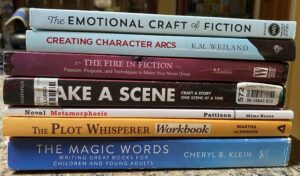
If you would like some craft books on this topic, try the seven book thesaurus collection by Angela Ackerman and Becca Puglisi (including The Emotional Thesaurus and The Urban Setting Thesaurus) and Strong Verbs Strong Voice: A quick reference to improve your writing and impress readers by Ann Everett.

Be Creative!

I am a sucker for exquisite descriptions. In the MG novel, CATERPILLAR SUMMER, the main character, Cat, spends the summer at her grandparents’ beach house on Gingerbread Island off the coast of North Carolina. Take a look at these gems that connect us with Cat’s personality as well as the setting of the book: A rainbow of candy, an ocean of worries, freckles polka-dotting his skin, a sky puffed with clouds, a breath of strings, a blizzard of birds, a whisper of voices, fingers of fog, a look that was all sunbeams, a wave of people crushed onto the sidewalk, the world swirled green and gray as tears popped in her eyes. Now come up with your own descriptions, relating them to the characters, themes, and settings in your story.


Don’t Rush!

Revising a book is hard work. After you’ve made your unique characters flounder and grow in an interesting setting with an action-packed plot that keeps your reader turning the page, it’s time to polish your writing until it sparkles and shines. The first thing to do is a search for words you overuse. For me, those are often: that, just, really, I think, and very. The technique here is simple: slash or replace. Another strategy is to edit the pages of your manuscript out of order. Create a number grid and randomly choose a page to edit for word choice only. Then color in that number in and move on to another, jumping around on the grid.

If you are a writer, you MUST BE a word nerd. There’s just no avoiding it! Are there techniques and resources you’ve found helpful in your writing practice?


Leave a Comment

Filed under craft advice, Revision process, Rondi Frieder, WORD NERD