Tag Archives: story ideas

Change of Scene (and genre)

It’s been a tough writing year for me. And by tough writing, I mean no writing.


Which isn’t actually true.


While my work on my middle grade fantasy novels stalled (basically completely) which makes me feel like I am not writing at all, I did start co-writing a series with one of my amazing critique partners, Samantha Cohoe. We’ve written two novels so far, including setting aside time, limiting distractions, and writing 30,000 words combined in only three days.


So my no writing, looks very much like being quite productive after all.


What are some of the not-so-secret secrets to our success?

  • Meeting genre-expectations: We’re writing mysteries with a light romance touch to it. That gives us a structure and a framework. We need a body. Someone to have actually done the deed. Other suspects who could have reasonably murdered our dearly departed character. A hot person of interest who our main character wants to get close to but something is keeping them apart. Knowing things we have to include to meet the expectations of reader in this genre give us a bunch of scene and character ideas. Which leads me to…
  • Bookends: We usually know roughly where the book will start but importantly, we know how it ends. We know the climax scene and the basics of how our main character will discover the true killer. But what to write?
  • A runway: Rather than calling it an outline, we start laying out the scenes of the book and developing a ‘runway’ – and once we have enough runway, just like at your local airport, we take off! Calling it a runway vs. an outline feels lighter, and also removes some of the pressure. And takes us out of a singularly linear approach. Because we runway…
  • Front to back and back to front: Our runway starts at the beginning-ish – and then usually somewhere around the middle, we hop around to our end scene (which as I said, we already know), and then we work back toward the middle again. Layering in, fleshing out, leading us to our destination, tightening and weaving as we go. But what’s the most important syllable in that sentence?
  • Collaboration: WE are writing a book. WE are brainstorming together. WE are counting on each other to get the thing done. Whichever one of us has the most energy helps motivate the other, and WE go back and forth on who is cheerleading who. And we have a built-in audience and readership – each other! Which also means we have more than one opinion to take into consideration, so it’s important that we decided…
  • We will not be too precious: We made an explicit agreement that we’re not going to be rigid in our thinking or in our demands. If something isn’t really crucially critically important to us, and the other person has a different opinion… we bend. We move on. We find a third option we can both dig. Something like that. There is basically no hill that we’re going to die on. And when the other person has a way to make a scene funnier, a line tighter – we take it. Take the edit. Make it better. Two heads are better than one.


This experiment/experience has been a real game changer for me. Having someone else count on my productivity keeps me to deadlines. Writing in a completely different genre has opened a brand new well of creativity.


Have you switched it up? What changes have you made that have inspired you and worked well for your writing?
 

6 Comments

Filed under Coral Jenrette

The Stories Hidden Inside You

By Rondi Sokoloff Frieder

At this year’s RMC-SCBWI Letters and Lines Conference, I attended an afternoon intensive entitled “Generating Ideas From Your Own Experience.” It was led by the multi-award-winning-Colorado-rock star-author, Andrea Wang https://andreaywang.com/, and was filled with useful tips and strategies. The goal of this workshop was to uncover important moments in our lives that could inspire the development of our next story, while also enhancing our current projects. For me, it did both!

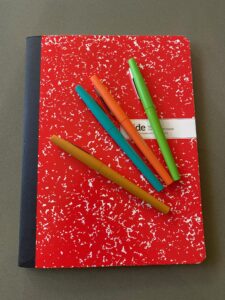
We began with lots of  writing exercises. They were quick – less than five minutes for each prompt – and hand-written in notebooks. (I also brought a set of thin colored markers to make the writing more fun.) Apparently, this fast-paced format was crucial to unlocking the most visceral of memories; experiences that had a dynamic emotional impact on our lives and lurked just below the surface. I was amazed at what I remembered. Detailed anecdotes that had been  buried inside me for years, even decades, were waiting to burst forth.

Many of the prompts Andrea used in the workshop came from the New York Times writing list “650 Prompts for Narrative and Personal Writing”: https://static01.nyt.com/images/blogs/learning/pdf/2016/650promptsnarrativewritingLearningNetwork.pdf. This list includes everything from Overcoming Adversity to Animals and Pets to Meals and Food and Friends and Family. It’s a fabulous resource for jump-starting your creativity.

So what gems did I uncover as I scribbled pages and pages of my memories in green, orange and turquoise? There were detailed descriptions of my family, my childhood neighborhood, the ins and outs of friendships over the years, favorite foods, games, family trips, toys, sports, hobbies, school experiences, and impactful teachers. Many memories focused on my mother who was the child of Hungarian-Jewish immigrants and a first-generation American. She was clearly determined to expose us to a myriad of experiences. These included a wide variety of sports, all the arts, warm family gatherings, musical holiday celebrations, delicious foods with a Hungarian twist, and a strong emphasis on doing well in school.

I also discovered hidden memories about summer camps I attended, concerts I went to, friendship issues, boyfriends, my biggest successes and failures, and why fall is my favorite season.  Details about broken bones, having my tonsils out, visiting my mother-in-law every week in a memory care facility for three years, and how upset I am about gun violence in this country came pouring out of me. There were also many stories that revolved around raising my two sons and two golden retrievers here in Colorado.

After each prompt, we took time to share what we had written. Some people felt comfortable reading their entire pieces aloud, while others shared a quick synopsis. One thing became obvious from the get-go. These untapped memories were deeply rooted inside us and filled with emotion. Some stories made us laugh, while others caused us  to tear up. And some were not for sharing at all. Not yet. The memories were too raw. But Andrea encouraged us to use these  emotional memories in our stories whenever possible. She told us how she used her own family stories to create two of her most recent books: WATERCRESS (Neal Porter Books) and THE MANY MEANINGS OF MEILAN (Kokila). Her honesty and vulnerability were  inspirational. But she also said  you don’t have to write an autobiography to utilize these memories. You can integrate them into your settings, your characters’ flaws and  problems, and your plot points. It’s the use of  the emotional component of your memories that counts. This is what will keep your reader turning the page.

For me, the sharing of our stories was the most powerful part of the workshop. Everyone was so passionate about what they had experienced. And  that clearly included me. Because the next day, a fellow attendee emailed me, suggesting  I consider using one of the stories I told as my next book idea. And guess what? I’ve already created a detailed outline and written three chapters! That story was in me all the time waiting to be told and I hadn’t even realized it.

So dig in, fellow writers. Mine your brain for memories and start working on your next project. You never know what you might discover.

Other places to find writing prompts:

https://blog.reedsy.com/creative-writing-prompts/

https://thinkwritten.com/365-creative-writing-prompts/

https://www.writtenwordmedia.com/500-writing-prompts-to-help-beat-writers-doubt/

https://www.writersdigest.com/prompts

https://thewritepractice.com/inspiration/writing-prompts/

2 Comments

Filed under 2022, Caldecott Medal, craft advice, Main character, Motivation, Revision process, Uncategorized

DISCOVERING THE ROOT OF OUR STORIES

My mom asked me to stay while she napped. “Take a nap, honey…on my bed.” I couldn’t refuse my 92-year-old mom. Plus, her air conditioning felt wonderful. We had just come back from being outside on a very muggy day. She quickly dozed off on her small couch. I sat close by on her twin bed and looked around her studio apartment. I was tempted to stretch out and nap, but I was too distracted.

I found myself studying all her favorite things – fragile figurines, throw pillows, antique lamps. Then, I honed in on the walls, studying decorative plates, framed art prints, framed photos of my parents wedding day… I disappeared into studying everything on her walls and atop her furniture. I felt a bit comforted. Afterall, I grew up surrounded by all these things. They were home. My mom was an incredibly talented decorator. Our home was beautiful inside. Every plate, print, figurine had a specific place. And a story. She bought most things at antique stores or from collectors out on farms. In a way, she had bought someone else’s “story” and then went on to create her own. I admit, I didn’t appreciate these things growing up. My chore was dusting them. But then I learned to negotiate with my brothers, so I could mow the lawn – and one of them was happy inside dusting away!

My mom let out an occasional snore as I tip-toed around her little apartment. I wanted to stand close and get a good look at things. I got a bit misty eyed, thinking about all the stories behind them. I was surrounded by story. Then, it hit me. Lots of these things have shown up in my fiction writing – in my character’s homes, in my themes, plots, etc. How could they not, I suppose… Afterall, they are still deep in my roots. These things. Each one holds so many stories. Each one holds part of my story. Each one.

Cards and letters: A red file next to her phone contains recent cards and letters from her kids. Growing up, she stored cards and letters in a mini wood trunk. I love having my characters write or receive letters. And I’m over the moon just imagining one of my characters opening a drawer, then discovering a bunch of letters. I get so excited about the “and then and then”! Especially when a letter holds a secret.

Framed photos: Many black-and-white photos decorate her walls; many feature her parents and grandparents. I never knew them. They were born in Poland, but my mom never told their stories. Oh my gosh! One of my characters is growing up in a Polish family. Even though I only saw my Polish relatives a few times a year (and they taught me how to polka), I never knew their origin stories, their roots. Perhaps, I have desired “finding” them in my writing. Actually, I have.

Shoes: Her brown leather lace-up shoes sit on the floor across from her couch. They have sat there ever since she started wearing a pair of white Reebok shoes. I always picture my character’s shoes, even if I don’t mention shoes in my story. The color, the brand, the style. I’m especially intrigued with why my character would choose a certain shoe.

Landline telephones: My mom has three landline phones, each within a few steps. In our teen years, my brothers and I were always vying for our one landline. All of my YA’s take place in the days of landlines. I prefer the challenge inherent in a landline, such as a family eavesdropping, everyone racing to the ringing phone…

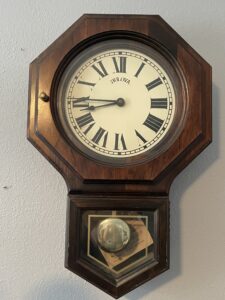
Clocks: There are four clocks spread throughout my mom’s. I remember the obnoxious sound of our cuckoo clock while the seven of us ate Sunday pot roast. Despite my struggle with chronology in writing, I thoroughly enjoy giving clocks a major role. Nothing like an alarm clock startling a character! By the way, my childhood kitchen clock hangs in my writer studio.

Here’s to the finding, discovering the root of our stories, where ‘er they come from! Children’s author E.E. Duncan summed it up best: “It’s interesting to look to ourselves and find those themes that recur in our writing and discover their roots.” Elizabeth is a member of my amazing critique group, Story Spinners. Her biographies and historical fiction explore how history affects everyday people. Her books include, Florence Sabin, Teacher, Scientist, Humanitarian; Felipe and Dolores Baca, Hispanic Pioneers; Ralph Carr, Defender of Japanese Americans; Helen Hunt Jackson, Colorado’s Literary Lady.

3 Comments

Filed under Karen McChesney