
Tag Archives: SCBWI

Highlights from the 2024 SCBWI Winter Conference

By Rondi Sokoloff Frieder

“Poetry inspires all other writing!” Joseph Coelho

“Go snoop in your protagonist’s bedroom.” Kate Messner

“Throw rocks at your characters!” Phil Bildner

“There’s always more to learn!” James Ransome

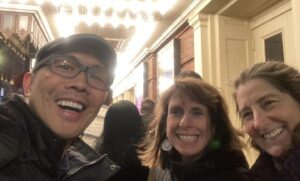
 I recently had the pleasure of attending the SCBWI WINTER CONFERENCE in New York with my RMC-SCBWI buddies, Susan Wroble and Stan Yan. Susan and Stan are the dynamic co-regional advisors for the Rocky Mountain Chapter and spending time with them made the weekend extra-special. We went to a Broadway play, strolled through Central Park, ate in charming restaurants, and regularly checked-in to discuss our sessions.
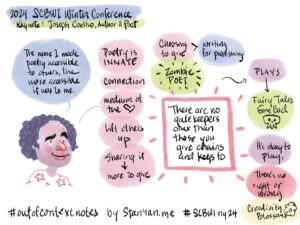
I’ve attended this conference before, but not in many years. I remembered being wowed by the inspirational keynote speakers, and blown-away by the impressive portfolio showcase. This year did not disappoint. Our opening speaker was the Children’s Poet Laureate from the United Kingdom, Joseph Coelho –  www.thepoetryofjosephcoelho.com. Joseph was extremely entertaining and drew us in with zany poetry prompts, rap writing, and tales of riding his bike through the countryside, collecting library cards (he has 213). His mission – to engage children in literacy. Here’s author/illustrator Stan Yan’s visual documentation of this presentation:
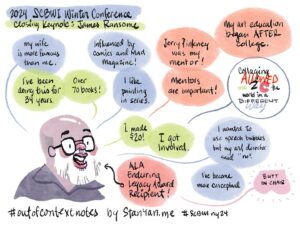
Our closing keynote was the award-winning illustrator (and sometimes author), James Ransome. James has published over 70 books for children, many with his wife, Lisa Cline Ransom. http://jamesransome.com. James’s vibrant use of color and innovative composition evokes an emotional response in the reader every time. His illustrations linger in your mind, long after you’ve turned the page. James’s passion for being a lifelong learner was infectious. He encouraged us to always take classes to hone our craft and told us to never stop creating.
But the highlight of the conference for me, were the “Creative Labs.” We all signed up for two, three-hour intensives in our genre – one on Saturday and one on Sunday.  In my case, these workshops focused on revising middle grade novels. My incredible teachers were Kate Messner, https://katemessner.com and Phil Bildner  https://philbildner.com.

In Kate’s REVISION HALF-MARATHON, she told us that “Revision is magical. You are shaping your manuscript into something TRUE!” She asked us to spend some time thinking about THEME. And once we figured out what that was, she suggested we post this in our workspace to remind us that theme must show up in every scene. She also set the timer and had us write about two things: “My novel is about… But underneath that, it’s really about…” I’ve done this exercise before and it is always enlightening.

Kate also talked about loglines and pitches and reminded us that we must write these in order to really know what our book is about. But the second part of the intensive, the heart of the workshop, involved snooping around in our main character’s bedroom! And man-oh- man, was this eye-opening. I thought I knew almost everything about my main character. But oooooh, there was so much more to discover, right in the most obvious place!

Coincidentally, the opening scene of my novel takes place in my protagonist’s bedroom. But after starting this exercise, I realized I didn’t have a detailed enough picture of what this room actually looked like. Kate asked us to consider the following: Does your MC have her own space or does she share? What’s in her closet and dresser? Are there books on a shelf? What are the titles? Stuffed animals? Collections of rocks, shells, baseball cards? Is she neat or messy? What kind of technology does she use? And my favorite… What is ON and UNDER her bed? Kate also had us make character circles, with inner circle friends vs. outer circle friends. Then she asked us how these circles changed throughout the course of the book – a very important component of most MG stories. Brilliant!

Kate loves charts and gave us a zillion ideas on how to make them. She suggested a chart to track important characters and themes in each chapter. A chart that monitors emotions and image systems. And finally, a chart that looked for the frequency of short sentences vs. long. She also suggested making a calendar and map of our setting. She even gave us chart paper to take home so we could start the work! This was a master class. I can’t wait to use some of these “magical tools to make something true!”

My second Creative Lab was with the dynamic writer and teacher, Phil Bildner. It was entitled “Breathing Life Back into Your Manuscript.” I had taken a class with Phil at another conference and I knew we were in for a treat. Phil’s session was extremely interactive. First, he had us working alone, then with one partner, and eventually three of us spent time creating a completely new story together! In the partner-exercise, we were asked to clean out our pockets; either in our clothing or from our purse or backpack. He asked us to use three of the found objects in a new scene in our novel. That’s when I literally struck gold. I found a gold candy wrapper that sparked an idea. Gold is now an image system that pops up throughout my novel.

Phil also had us reimagine an abandoned manuscript as a different genre. I scribbled down a variety of picture book ideas from a MG novel that has not sold. Phil also gave us a list of mentor texts to read and, more importantly, provided us with resources to combat the banned books movement: Authors Against Book Bans, Unite Against Book Bans, Book Riot, PEN America, We Need Diverse Books, and many more. He is passionate about this cause and inspired us all with his activism. Because if books didn’t matter, they wouldn’t be banned.

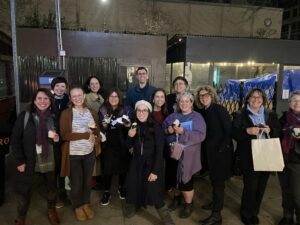
I also had the opportunity to have dinner “off-site” with the amazing Jewish Kidlit Mavens. I am in the Maven’s Facebook group, but hadn’t met these people in-person. Most of the authors/illustrators who attended were from the NY/NJ area. And what an impressive group – Liza Wiemer, Chana Stiefel, Ann Koffsky, Josh Levy, Kimberly Marcus, and Yevgenia Nayberg, to name a few. It was such a treat to spend the evening with these inspirational creators of books for children with Jewish content.
But the biggest takeaway for me was the strong sense of community we all felt by being together, in-person, with a common goal – to create the highest quality books possible for children. Oh, and one more thing… I had a very promising critique with an agent. Fingers crossed for a positive outcome!


4 Comments

Filed under Book Banning, James Ransome, Jewish Kidlit Mavens, Joseph Coelho, Kate Messner, Phil Bildner, SCBWI, SCBWI, STAN YAN, Susan Wroble, Uncategorized

Finding The YA in Learning


Murder. Secrets. Drugs. Gossip. Lies. Sexuality. Romance. Magic. Identity. Rumors. Breakups.

Hang out with a group of YA writers and you’ll likely hear these words, along with more provocative, dark, odd, edgy, far-out, intense, hilarious, eccentric, juicy, shocking topics. We love teens. We love big drama and conjuring a mess for our teen characters in current time or mystical worlds.

Other kid-lit writers often say we’re nuts for writing over 75,000 words. But we can’t get enough. We want to hold on to every word. No wonder our revisions can take years and years as we cut, trim, tighten hundreds of pages.

Thanks to my critique group, Story Spinners, I unexpectedly joined the YA writer “club” years ago after they nudged me to turn my coming-of-age short story into a YA novel. I was clueless and intimidated, but I couldn’t stop writing. I’m incredibly fortunate to be part of the SCBWI-Rocky Mountain Chapter’s YA community. And I’m in awe of how everyone cheers each other on at book launches and events by and for YA writers.

My fellow YA’ers and I adamantly long to be with our peers and find YA-only classes. No offense, picture book and middle grade writers. We adore you and your books! Just like our teen characters, we long to be belong; we want to be in a YA cluster. But, we’ll be the first to admit, we often feel like the misfits in writer land. Afterall, YA novels are a far cry from Middle Grade.

Perhaps that’s why our search for YA-only learning is constant and fierce. The past few months, for instance, several YA writers and I started researching YA-only workshops, courses, and other ways to amp up our learning.

Here’s what we have found so far:

Workshops/Courses:

Wordsmith Workshops https://www.wordsmithworkshops.com/

Vermont College of Fine Arts https://vcfa.edu/writing-novels-for-young-people-retreat/

Hugo House https://hugohouse.org/product/young-adult-fiction-workshop/

Writer’s Digest University https://www.writersonlineworkshops.com/courses/writing-the-young-adult-novel

UCLA Extension https://www.uclaextension.edu/writing-journalism/creative-writing/course/young-adult-novel-i-writing-x-4451

Tin House https://tinhouse.com/workshop/

From SCBWI:

YA Connect and Other Connects https://www.scbwi.org/regions/rmc/events

YA Connect is free and offered every other month by and for YA writers of all levels to learn and meet fellow YA writers. Most YA Connects are both in-person & Zoom.

Michelle Begley Mentorship – Due Oct. 31, 2023 https://www.scbwi.org/regions/rmc/RMC-mentorship-program

Weekly Podcast https://www.scbwi.org/podcasts

Most recent one featured Deborah Halverson, award-winning YA author, including Writing Young Adult Fiction For Dummies and Honk If You Hate Me

Monthly Virtual Events, hosted by chapters across the U.S. https://www.scbwi.org/regional-virtual-events

Coming soon:

Lighthouse Writers Workshop, Denver – YA workshops, gatherings https://lighthousewriters.org/

Of course, there are a lot more YA-only opportunities out there. Share your findings in the comments, please. Meanwhile, YA writers: Keep reaching out to find other YA’ers. And remember, teens can’t wait to read your stories – and drama!

2 Comments

Filed under 2023, Agents, craft advice, critique, Graphic Novels, Karen McChesney, Main character, Middle Grade, Motivation, Persistence, Revision process, RMC-SCBWI, Upcoming, What I am doing now

ACCOUNTABILITY: A WRITER’S BEST FRIEND

“I have to get back to work. Goodbye.”

That’s what I say if I’m talking to someone, and it’s time to show up in my studio and write. The time is blocked out on my calendar, like any meeting or appointment. I got the idea from a writer friend while sharing our routines – and how we show up to our writer job.

Oh, the tricks I play on myself! But, they work. Well, okay, not always – especially during this pandemic, when my teaching and personal schedule are topsy-turvy, and my self-motivation is wavering. But, I keep trying. While sipping morning coffee, I turn on my studio light and open the curtains, so my office shouts, “I’m ready and waiting”. I set my alarm for writing sessions. I put my cell phone in another room, so I can’t hear the buzz of incoming texts or calls (which are perfect distractions when I’m stuck on a scene that I’ve re-written a dozen times!).

Unfortunately, the demons of distraction and procrastination still like to hang out in my office. Ugh! Good news is, I know my own worst enemies really well. Gradually, I’m learning to negotiate with them, so, my favorite co-worker, accountability, can kick them out and pull up a chair!

Here’s what accountability and I have been up to – and what’s really working:

Setting a timer. I try to follow a rigid routine during my scheduled writing time: For writing, I set a timer for one hour, take a 10-15 minute break, repeat. For research, I set a timer for a maximum of 30 minutes.

Monday accountability group. Every Monday, I do an email check-in with a group of kid-lit writers. We submit our goals for the week and report briefly on progress made the previous week. Wow! Keeps me honest and realistic! In our brief format, we manage to celebrate, challenge, and remind each other to keep plugging away, and that it’s okay to take a break.

Text-writing. Once a week, I have a writing “date” with another children’s writer. We text a few minutes before our start time to share what we’re working on or what we want to accomplish. Usually, we do two 45-minute rounds. Then, we briefly check in. We’re always amazed at how much we get accomplished in such a short time.

SCBWI Rocky Mountain Chapter critique group. Once a month, my SCBWI critique group meets in person. We’re the Story Spinners and we’ve been meeting monthly for 20 years. We email our work in advance, then, when we meet, each writer has 20 minutes for their work to be critiqued. When members don’t submit work, they can use their time to update the group on projects, invite brainstorming or advice on a project, share notes from workshops/classes, or etc. They’ve helped me think through SO many critical bits and pieces, such as how to end a pb or write a hook for a YA synopsis, a book title, an angle for a nonfiction article, and the list goes on. We hold separate meetings, as needed, to critique a member’s full manuscript.

Story Spinners are my rocks! Without their passion, drive, support, professionalism, desire to learn, confidence, nudges, wisdom and wit, I would have given up on my projects a long time ago.

SCBWI British Isles North East critique group. While living short term in England (twice), I met weekly with the same critique group. Through email, we continue to: exchange same genre manuscripts for overall feedback, check in bimonthly on current projects. We’re considering holding FaceTime meetings, as needed. They, too, are my rocks, my support group!

Oops! My alarm is going off. I have to get back to work on revising my YA. Goodbye!


Writing is hard, hard, messy work. Going out and doing talks and signing books is all wonderful, but a writer has to return home and go back to work.   

Julia Alvarez, author of AFTERLIFE, BEFORE WE WERE FREE, ALREADY A BUTTERFLY


Leave a Comment

Filed under critique, Karen McChesney, Revision process, Uncategorized