By Susan Wroble
The Rocky Mountain Chapter of SCBWI is one of those truly great organizations, filled with people who willingly share their knowledge to support others. It was the reason I stepped in to volunteer for the chapter’s leadership team—I wanted to keep this organization going. In the nearly two years since then, one of the accomplishments I am happiest about is that we have created some Connect Groups to meet the specific needs of some of our members.
One of those newly created Connect Groups is specifically for nonfiction. The chapter has a strong and growing group of nonfiction creators, and this past year marked the birth of some noteworthy nonfiction that I wanted to bring to your attention. Not only are these great books for the kids in your life, but many should make it to your keeper shelves as both beloved treasures and mentor texts. 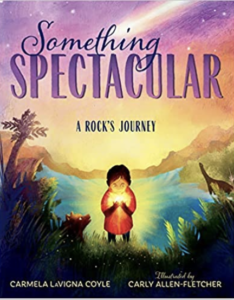
For many kids and adults, Carmela LaVigna Coyle is a rock star for her 20-year series PRINCESSES (starting with DO PRINCESSES WEAR HIKING BOOTS). But my personal favorite is her latest, SOMETHING SPECTACULAR: A ROCK’S JOURNEY (Muddy Boots, illustrated by Carly Allen-Fletcher). Structured as a timeline from about 272 million years to today, this story traces the geological journey of a rock through time, from the sediment on the bottom of a forgotten sea to a sandstone heart found and treasured by a young girl. Layered and lyrical, filled with onomatopoeia and alliteration, this book is a stunning read-aloud. And I’ve marveled at the way Carmela kept the young girl, who does not appear until the last page, central to the story. This book lives up to its name—it is truly spectacular!
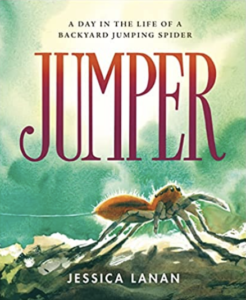 One of the favorite and most influential books of my childhood was BE NICE TO SPIDERS by Margaret Bloy Graham. When I saw RMC author and illustrator Jessica Lanan’s book, I knew it would be a book I would treasure. JUMPER: A DAY IN THE LIFE OF A BACKYARD JUMPING SPIDER (Roaring Book Press, 2023) draws readers in from the very first spread reaching out to ask them to imagine: “What if you were very small? Smaller than a cat or a dog, a bar of soap or a bottle cap. As small as a bean. What would your world be like?” The pages of backmatter are exceptional and include not only a glossary and life cycle and anatomy, but sections on how jumping spiders hear and see and feel—and walk on walls! Jessica’s illustrations, done in ink, watercolor, and gouache, shift back and forth from the perspective of Jumper to the perspective of a child. Both her text and her artwork invite comparisons.
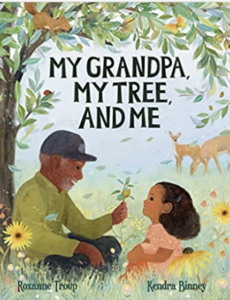 Roxanne Troup lives in Colorado now, but growing up in Missouri, her family (like everyone around) had a pecan tree in their yard. Roxanne’s book MY GRANDPA, MY TREE AND ME (Yeehoo Press, 2022; illustrated by Kendra Binney) flows between the care of a girl’s pecan tree and those in her grandfather’s pecan orchard. Set over the course of a year, the story is so quietly beautiful that it was only on the second reading that I realized it was one of the best examples of a compare and contrast book that I had seen. It’s now one of my favorite mentor texts for that structure. Teachers could use both MY GRANDPA, MY TREE AND ME and JUMPER for a fabulous lesson on two very different and very effective ways to contrast subjects.
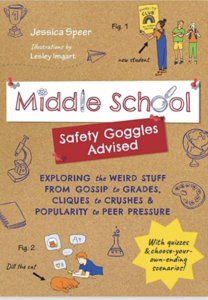 With a master’s degree in social sciences, author Jessica Speer has carved out a niche for her books that blends science and activities with true stories. In researching her latest book, MIDDLE SCHOOL: SAFETY GOGGLES ADVISED (Familius, illustrated by Lesley Imgart), Jessica spent time in conversation with a hundred middle schoolers, asking them what their greatest challenges were, and those top concerns became the chapters in her book. Coming out in August, Jessica has a book that most families with kids will need: THE PHONE BOOK: STAY SAFE, BE SMART AND MAKE THE WORLD BETTER WITH THE POWERFUL DEVICE IN YOUR HAND. For authors, her books are fabulous mentor texts, not only for engaging and interactive books, but for activities that can be included as resources either within a book or on websites.
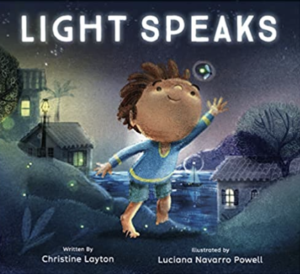 Christine Layton’s picture book LIGHT SPEAKS (Tilbury House, illustrated by Luciana Navarro Powell) is so gorgeous that it brought me near tears. Using spare, poetic text, she introduces the physical properties of light to very young listeners. As a former volunteer in the space section of Denver’s Museum of Nature and Science, I especially loved this spread: “Light tells the space between stars. It echoes off planets and moons—doppled, glowing and brilliant.” Christine’s brilliant backmatter takes each of those properties and explains them each in more detail.
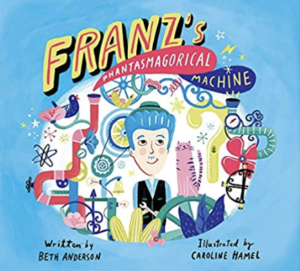 Beth Anderson had not one but THREE (!!!) books come out this past year. Beth is a master at picture book biographies and in finding the heart layer, that lens or angle or viewpoint that makes her subject matter and her book stand out. Her biography FRANZ’S PHANTASMOGORICAL MACHINE (Kids Can Press, Illustrated by Caroline Hamel), about the self-taught inventor Franz Gsellmann, celebrates the drive to build and create and invent—just for the sake of invention—and to not give up. Beth’s books are all so well-crafted that I find myself turning to them again and again for insights on language choice, structure, and most of all, heart.
I hope that you too find yourself drawn to this incredible list—for reading, for gifting, for learning the craft of nonfiction writing. Enjoy!