Tag Archives: Andrea Wang

Hosting a Writing Salon in Montreal!

About a month ago, my son Noah asked me if I’d be interested in teaching a writing class for his friends. He lives in Montreal, and my husband I would be visiting him over Memorial Day weekend. Noah has been hosting “salon-type” evenings at his apartment ever since the pandemic. Montreal had an eight o’clock curfew back then,  and in response to this, Noah and his extremely creative friends, began gathering in small groups for events at their apartments. They offered everything from jazz jams to yoga stretching to candle-making. And if the session ran past curfew, many of them unrolled their sleeping bags and spent the night.

I told him I’d be happy to teach a class. After all, I am a teacher and I write almost every day. But my expertise was in elementary education. And I write children’s books. I needed to create an activity that would appeal to a group of international thirty-somethings, many of whom work in the tech field.  Hmm…

I thought about the variety of writing workshops I’d attended over the years. Most of them focused on plotting tools, character arcs, and world building. These were great, but I needed something with more universal appeal. Something that might inspire poetry, song-writing, or journaling. I thought about the prompt intensive I took with Andrea Wang: (https://inthewritersweb.com/2022/12/the-stories-hidden-inside-you/) and the revision workshop with Kate Messner: (https://inthewritersweb.com/2024/03/highlights-from-the-2024-scbwi-winter-conference/). Both of these classes had us tapping into childhood memories to spark the stories within us.

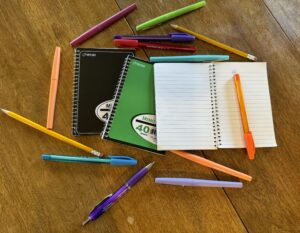
I went through my notes and came up with a variety of prompts, starting with childhood memories and moving to present day experiences. I asked my attendees to bring a blank notebook and their favorite writing implements. (I brought extra of both, knowing some people were rushing over from work to the event.) By 6:30, there were 17 people gathered in my son’s living room. They all settled in on couches, chairs, pillows, and the floor, and looked like they were ready to write.

The prompts would be five minutes in duration. I began by saying that some of the prompts would resonate, while others would not. I told them not to worry. This was not a school assignment. There would be no critique and no grades. I invited them to write poems, draw pictures, or make lists. I wanted them to enjoy themselves. I also told them the writing would get easier as we progressed.

We started with the question: “What is your earliest memory?” People stared at their notebooks. Others looked at the floor or the ceiling, while some got right to work. Eventually, the pens and pencils started moving. Everyone was slowly, but surely, getting into the flow. The teacher in me was thrilled to see my “students” scribbling away.

To be honest, an hour of writing by hand can be tedious. Some people were literally wiggling their fingers in between prompts to loosen up the muscles. I told them writing by hand was important for this fast-paced activity. It made it harder to edit and forced them to keep going. They understood this and before long, were immersed in their writing and flipping through pages in their notebooks. It was going well!

I had prepared twenty prompts and chose the following eleven because of our time constraints.

  1. Describe the house or apartment and neighborhood you grew up in. Use your senses.
  2. Tell us about a memorable family trip. Where did you go? Who was there? Include as many details as possible.
  3. Who was your first real friend growing up? What did you do together? Are you still in touch with this person?
  4. What is your favorite food and when was the last time you had it? Who prepared it?
  5. First crushes: Who was it? Give us details!
  6. Is there a story in your family that gets told over and over again? Tell us that story.
  7. Write about an amazing trip you’ve taken as an adult. Where did you go? Who was with you? Try to include all the five senses in your writing.
  8. Successes: Write about a time you achieved something extraordinary. How did it feel?
  9. Failures: Describe the most devastating failure or disappointment in your life. What happened and how did you handle it?
  10. What is the scariest thing that has ever happened to you? Write about it using lots of emotion.
  11. Think about the most hilarious thing that has ever happened in your life. Write about this now and try to reignite those feelings of fun, laughter, and joy.

This took up the full hour because 12×5=60 minutes! We had twenty minutes to share before the next session, which was being taught by my husband. Each person was invited to read what they had written or tell the story in their own words. Only one person felt uncomfortable doing this, but at the end, she came over and said this was one of the most powerful experiences she’s ever had. She had no idea these events and feelings were lurking inside her brain, waiting to burst forth.

Can you guess which prompts were the most popular? Earliest childhood memories, favorite foods, and first crushes were the winners. Two people even had the same favorite food story – a sweet, buttery, stuffed pastry from India. One person described a crush she had on a boy in kindergarten. Another spoke about how his mother sang to him every night before he went to bed. And one women described the house she lived in as a child, which was so vivid, I told her it would be the perfect setting for a middle grade novel.

As writers, we enjoy creating a compelling plot. We rejoice in finding the perfect verb to convey a feeling. And we love the challenge of imagining a setting with lots of sensory details. Did any of these attendees feel this way? As it turned out, the answer was a resounding yes. One person told me she was now inspired to take a writing class Another said he had no idea these memories would be so emotional for him. A third said he needed to do more prompts when he taught his adult writing class for immigrants. I was elated. Telling our stories is the universal human language.

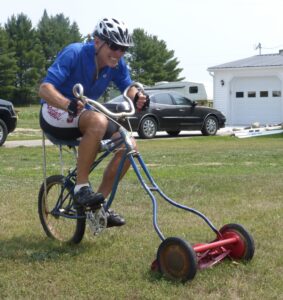
By the way, my husband’s class was about how to plan a multi-day bicycle trip. Perhaps when our “students” go on a bike trip, they’ll take some time to write about it!



6 Comments

Filed under Andrea Wang, craft advice, Kate Messner, Rondi Frieder, Uncategorized

JUST DO IT!

In the middle of March, I began sending my middle-grade time-travel novel out to agents. And as all experienced writers know, the best thing to do when you are waiting for query responses is to work on something else. My “something else” was an idea I got from a friend after we attended Andrea Wang’s intensive at the RMC-SCBWI Letters and Lines conference last September. (https://www.rondibooks.com/the-stories-hidden-inside-you/) But even though I had a “Beat Sheet” outline from Save the Cat for the Novel by Jessica Brody, I hadn’t written a single word of the story. Luckily, after an animated conversation with my friend and teacher, award-winning author Sarah Aronson (https://saraharonson.com/), I decided to sign up for her eight-week online Highlights class, JUST DO IT – Your Collaborative Support Group for Finishing Your Draft. Sarah would be co-teaching this class with the incredibly articulate and inspirational author and coach, Chris Tebbetts. (https://christebbetts.com/). It sounded like the perfect way to get this book started.

If you have ever done NANOWRIMO (The National Novel Writing Month-long challenge to write 50,000 words in 30 days) you know the joy of writing fast. Just Do It! has a similar premise. It focuses on a creating a daily writing practice with many extra goodies thrown in. The formal part of the class is a one hour Zoom on Wednesday nights where Sarah and Chris give informative presentations on craft. Only there is so much more. Whether you are working on a picture book or a young adult novel, there are writing sprint sessions every day at a variety of times, morning prompts, and inspirational quotes. There are accountability groups, Discord channels for discussion and sharing, and OPEN MIKES! We also received videos and slides and oodles of handouts. But the best part of these two months was being part of a supportive writing community. Our class had over fifty participants from across North America, two guest speakers, and many Highlights staff members coordinating logistics behind the scenes. I felt like I was at a two-month writing retreat without leaving my house.

So, you may ask, after weeks of diligently sitting  at my computer, did I finish my draft? Unfortunately, the answer is no. A variety of expected, and unexpected, life cycle events collided right smack in the middle of the eight weeks. However, I did write 24,000 words, which is probably half the book, right? And more importantly, I am now totally immersed in the world of my new story. I wake up every morning with character traits, plot twists, and image systems rolling around in my brain. And after my recent critique with Sarah, I am considering all kinds of possibilities. I am in the zone!

But there’s more. The virtual writing sprints will continue through the summer which should help me pound out the next 24,000 words. Also, my accountability group is planning to keep meeting on a regular basis. We are committed to cheering each other on to the finish line. But here is my biggest takeaway – the greatest change in my writing process: I am way much more comfortable with integrating the concepts of “discovery and play” into my drafting. I have also found the courage to silence my internal editor. (One person in my accountability group has named her IE and repeatedly tells her to stop talking. I now do the same thing and it is phenomenal.) I am finally accepting the fact that plot changes happen when your characters come to life on the page. And although my “Beat Sheet” has been dramatically modified, my themes are stronger and my main character’s true wants and needs are clearer to me. It’s funny, but along with me just doing it, my characters are just doing it, too! And I can’t wait to see what they do next.

If this sounds like something you might be interested in, another Just Do It! class is being offered by Sarah and Chris this fall. You can sign up here: https://www.highlightsfoundation.org/workshop/just-do-it-your-collaborative-support-group-for-finishing-your-draft-fall/


4 Comments

Filed under 2023, craft advice, Main character, Middle Grade, Motivation, Persistence, Revision process, Rondi Frieder, WORD NERD

The Stories Hidden Inside You

By Rondi Sokoloff Frieder

At this year’s RMC-SCBWI Letters and Lines Conference, I attended an afternoon intensive entitled “Generating Ideas From Your Own Experience.” It was led by the multi-award-winning-Colorado-rock star-author, Andrea Wang https://andreaywang.com/, and was filled with useful tips and strategies. The goal of this workshop was to uncover important moments in our lives that could inspire the development of our next story, while also enhancing our current projects. For me, it did both!

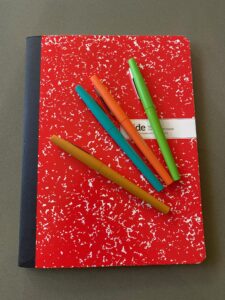
We began with lots of  writing exercises. They were quick – less than five minutes for each prompt – and hand-written in notebooks. (I also brought a set of thin colored markers to make the writing more fun.) Apparently, this fast-paced format was crucial to unlocking the most visceral of memories; experiences that had a dynamic emotional impact on our lives and lurked just below the surface. I was amazed at what I remembered. Detailed anecdotes that had been  buried inside me for years, even decades, were waiting to burst forth.

Many of the prompts Andrea used in the workshop came from the New York Times writing list “650 Prompts for Narrative and Personal Writing”: https://static01.nyt.com/images/blogs/learning/pdf/2016/650promptsnarrativewritingLearningNetwork.pdf. This list includes everything from Overcoming Adversity to Animals and Pets to Meals and Food and Friends and Family. It’s a fabulous resource for jump-starting your creativity.

So what gems did I uncover as I scribbled pages and pages of my memories in green, orange and turquoise? There were detailed descriptions of my family, my childhood neighborhood, the ins and outs of friendships over the years, favorite foods, games, family trips, toys, sports, hobbies, school experiences, and impactful teachers. Many memories focused on my mother who was the child of Hungarian-Jewish immigrants and a first-generation American. She was clearly determined to expose us to a myriad of experiences. These included a wide variety of sports, all the arts, warm family gatherings, musical holiday celebrations, delicious foods with a Hungarian twist, and a strong emphasis on doing well in school.

I also discovered hidden memories about summer camps I attended, concerts I went to, friendship issues, boyfriends, my biggest successes and failures, and why fall is my favorite season.  Details about broken bones, having my tonsils out, visiting my mother-in-law every week in a memory care facility for three years, and how upset I am about gun violence in this country came pouring out of me. There were also many stories that revolved around raising my two sons and two golden retrievers here in Colorado.

After each prompt, we took time to share what we had written. Some people felt comfortable reading their entire pieces aloud, while others shared a quick synopsis. One thing became obvious from the get-go. These untapped memories were deeply rooted inside us and filled with emotion. Some stories made us laugh, while others caused us  to tear up. And some were not for sharing at all. Not yet. The memories were too raw. But Andrea encouraged us to use these  emotional memories in our stories whenever possible. She told us how she used her own family stories to create two of her most recent books: WATERCRESS (Neal Porter Books) and THE MANY MEANINGS OF MEILAN (Kokila). Her honesty and vulnerability were  inspirational. But she also said  you don’t have to write an autobiography to utilize these memories. You can integrate them into your settings, your characters’ flaws and  problems, and your plot points. It’s the use of  the emotional component of your memories that counts. This is what will keep your reader turning the page.

For me, the sharing of our stories was the most powerful part of the workshop. Everyone was so passionate about what they had experienced. And  that clearly included me. Because the next day, a fellow attendee emailed me, suggesting  I consider using one of the stories I told as my next book idea. And guess what? I’ve already created a detailed outline and written three chapters! That story was in me all the time waiting to be told and I hadn’t even realized it.

So dig in, fellow writers. Mine your brain for memories and start working on your next project. You never know what you might discover.

Other places to find writing prompts:

https://blog.reedsy.com/creative-writing-prompts/

https://thinkwritten.com/365-creative-writing-prompts/

https://www.writtenwordmedia.com/500-writing-prompts-to-help-beat-writers-doubt/

https://www.writersdigest.com/prompts

https://thewritepractice.com/inspiration/writing-prompts/

2 Comments

Filed under 2022, Caldecott Medal, craft advice, Main character, Motivation, Revision process, Uncategorized