
Category Archives: What I am doing now

Finding The YA in Learning


Murder. Secrets. Drugs. Gossip. Lies. Sexuality. Romance. Magic. Identity. Rumors. Breakups.

Hang out with a group of YA writers and you’ll likely hear these words, along with more provocative, dark, odd, edgy, far-out, intense, hilarious, eccentric, juicy, shocking topics. We love teens. We love big drama and conjuring a mess for our teen characters in current time or mystical worlds.

Other kid-lit writers often say we’re nuts for writing over 75,000 words. But we can’t get enough. We want to hold on to every word. No wonder our revisions can take years and years as we cut, trim, tighten hundreds of pages.

Thanks to my critique group, Story Spinners, I unexpectedly joined the YA writer “club” years ago after they nudged me to turn my coming-of-age short story into a YA novel. I was clueless and intimidated, but I couldn’t stop writing. I’m incredibly fortunate to be part of the SCBWI-Rocky Mountain Chapter’s YA community. And I’m in awe of how everyone cheers each other on at book launches and events by and for YA writers.

My fellow YA’ers and I adamantly long to be with our peers and find YA-only classes. No offense, picture book and middle grade writers. We adore you and your books! Just like our teen characters, we long to be belong; we want to be in a YA cluster. But, we’ll be the first to admit, we often feel like the misfits in writer land. Afterall, YA novels are a far cry from Middle Grade.

Perhaps that’s why our search for YA-only learning is constant and fierce. The past few months, for instance, several YA writers and I started researching YA-only workshops, courses, and other ways to amp up our learning.

Here’s what we have found so far:

Workshops/Courses:

Wordsmith Workshops https://www.wordsmithworkshops.com/

Vermont College of Fine Arts https://vcfa.edu/writing-novels-for-young-people-retreat/

Hugo House https://hugohouse.org/product/young-adult-fiction-workshop/

Writer’s Digest University https://www.writersonlineworkshops.com/courses/writing-the-young-adult-novel

UCLA Extension https://www.uclaextension.edu/writing-journalism/creative-writing/course/young-adult-novel-i-writing-x-4451

Tin House https://tinhouse.com/workshop/

From SCBWI:

YA Connect and Other Connects https://www.scbwi.org/regions/rmc/events

YA Connect is free and offered every other month by and for YA writers of all levels to learn and meet fellow YA writers. Most YA Connects are both in-person & Zoom.

Michelle Begley Mentorship – Due Oct. 31, 2023 https://www.scbwi.org/regions/rmc/RMC-mentorship-program

Weekly Podcast https://www.scbwi.org/podcasts

Most recent one featured Deborah Halverson, award-winning YA author, including Writing Young Adult Fiction For Dummies and Honk If You Hate Me

Monthly Virtual Events, hosted by chapters across the U.S. https://www.scbwi.org/regional-virtual-events

Coming soon:

Lighthouse Writers Workshop, Denver – YA workshops, gatherings https://lighthousewriters.org/

Of course, there are a lot more YA-only opportunities out there. Share your findings in the comments, please. Meanwhile, YA writers: Keep reaching out to find other YA’ers. And remember, teens can’t wait to read your stories – and drama!

2 Comments

Filed under 2023, Agents, craft advice, critique, Graphic Novels, Karen McChesney, Main character, Middle Grade, Motivation, Persistence, Revision process, RMC-SCBWI, Upcoming, What I am doing now

QUERY, REVISE, REPEAT

If you glanced at my weekly calendar, you would see time blocks for Research Agents & Query and for Revise. In my weekly goals, I note the number of queries along with the number of pages that I plan to revise. Time blocking makes me show up. Of course, life gets in the way (and I let it!), but I’m proud to report that I have had better-than-ever attendance the past four months. I suspect it’s because sending out queries while deep in the messiness of revising keeps me on my creative toes. Doing both reminds me: I am a writer, I can do this.

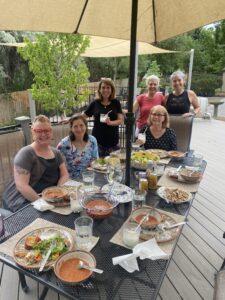
Every time I send off a query for my picture book, I feel a loud “YES!” in my writer bones. Yay, my story is out there. And so is my sweat. Each word contains years and years of being turned upside down and inside out. Eventually, I may have to revise my manuscript again. Ugh! I don’t think about that though. I’d rather celebrate that it’s done. For now, it feels great to finally send off 500 words that I care the world about.

Every time I finish revising pages of my YA novel, I feel a huge “I did it!” When a whimper of “I wish I got further” creeps in, I give myself a “you got this!” Yay, my revising is getting there, as I cut, re-arrange, rewrite and enjoy an occasional epiphany when I carve out a new scene or one sentence flows smooth and crisp. It feels great to be close to the finish line of 80,000 words that I think about day and night.

Querying and revising balance my writer mojo. They are yoga. Querying is me following my teacher’s specific instructions. Revising is me slowly sinking into the pose, adjusting my feet, tweaking the shape of my hand, remembering to breathe, and challenging myself to stretch longer, further till gradually, my body does something I never knew possible. Just like my characters do when I follow them. Just like my story flows when I remember to breathe!

Undoubtedly, querying is a refreshing change of pace and motivates me to stay in the revising trenches.

-It’s concrete and point-blank – a healthy break from the land of fiction.

-Researching agents keeps me tuned in to this crazy industry.

-Learning. Helps me update my package for my YA novel (logline, pitch, synopsis, etc.).

-Gives me a sense of completion amid day-after-day plowing through revision.

-Amps up my writer confidence.

Querying is baking. The don’t-deviate exactness of baking pushes me to diligently concentrate, the same way that I follow submission guidelines to a tee. I go to hyper focus mode to get everything right. Recently, for example, an agent’s instructions said to attach picture book manuscripts. I re-read that line several times. Because? All other agents have stated, NO attachments. I do the same when I bake. I re-read each step to make sure I use a teaspoon vs a tablespoon, baking soda vs baking powder, whisk in vs stir in… Like querying, reading baking instructions works my brain muscles. But, what a thrill to pull my cake out of the oven. It’s done. I feel that way after I send off another query. It’s done. Yes, a rejection is a cake gone wrong. It burns me. But, I get to bake another. I get to send out another query. Afterall, I must reach my goal.

Revising is cooking. I prefer cooking, because I get to invent, combine, add another spice and research (what’s a Lepiota mushroom?). I love revising recipes – cutting, adding, switching spices and ingredients… Just like revising my YA. Letting myself play and experiment keeps me energized. For instance, I’ve relied on freewriting dialogue to take my secondary characters from flat cardboard to three-dimensional humans. I’ve resorted to longhand to rewrite highly emotional scenes. My pen makes me slow down the rolling-boil action and grant my character a chance to sit on simmer. What a joy to sit with my characters! I feel that way when I finish cooking, especially a soup that’s simmered all day. Yes, some soups have no zing, just like so many of my sentences.  But, I always return to my writing recipe – Beat Sheets, notes and my synopsis – to stay on track. Then, it’s back to the keyboard. Afterall, I must reach my goal.

Juggling querying and revising doesn’t make this whole writing thing any easier. It’s such hard, hard work. Juggling feeds my creative longing and insatiable curiosity – and by gosh, it gives me hope!


Over time, juggling would come to seem slower.  You are doing it.  –Heather Wolf, juggler and author, Birding at The Bridge: In Search of Every Bird on the Brooklyn Waterfont


3 Comments

Filed under Agents, craft advice, critique, Karen McChesney, Main character, Motivation, Persistence, Picture Books, Revision process, What I am doing now

What I’m doing now: Wrestling With Feedback

By Rondi Sokoloff Frieder

“I love that part!”

“Really? It didn’t work for me.”

Last summer, I attended “The Whole Novel Workshop” on the idyllic campus of the Highlights Foundation in the Pocono Mountains of Pennsylvania. I brought along a middle-grade manuscript that had been revised numerous times, and got ready to make it sparkle and shine.

Before we got started, one of our faculty members gave us an introductory pep talk. “Just so you know,” she began. “All of you will have to rewrite your books. This is why you are here. But don’t worry, you can do it.” Most of us had to be thinking the same thing: “Maybe some people have to redo the entire thing, but my book is amazing. It just needs a few tweaks and a bit of trimming.” To this I now say, LOL!

Despite my overconfidence, I decided to open my mind to possibility. I listened to the suggestions of my Brain Trust partners and marveled at the insights of our well-published faculty. I threw myself into the writing exercises that revealed twists and turns I hadn’t considered. I reworked my plot. I played around with present vs past tense. And most importantly, I thought long and hard about the crucial themes in this story. What did my protagonist really want?

When I got home, I continued the work. I eliminated unnecessary characters (at least four), I changed the personalities of two of my secondaries, and enhanced components of the story that would make it funnier. Then, after months and months of revising, I gave this new draft to my always brilliant SCBWI critique group, The Story Spinners. My husband and son also volunteered to read the book, and I sent ten pages and a synopsis to an agent who was doing critiques at the RMC-SCBWI fall conference. The book was definitely stronger, but there were new elements that needed to be evaluated. I was too close to the story to know if they were working. While I waited for my readers to plow through the manuscript, I threw myself into another project.
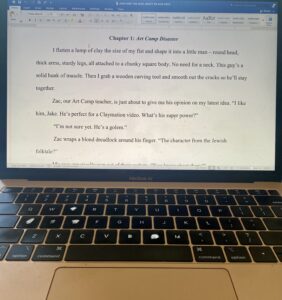
A month later, the feedback began to roll in. And while there was a great deal of consensus, my readers also had conflicting responses. This was when the “wrestling” part of the revision process set in. Who should I believe?

This is the nature of critique. Some comments will be subjective while others will be quite valid. Here’s the rule of thumb: if something in your manuscript is bothering three or four readers, you must consider making the changes. But, if you really want to keep this section in your book, you must make it stronger. For example, one of my critique partners loves when my main character hears his deceased great-grandfather’s voice in his head. But another reader said it didn’t add anything to the story and that I should cut it. I wrestled with the possibilities. Hmm, what to do? Well, I also love the voice of the great-grandfather. Only this feedback let me know that if I want it to stay in the book, I need to amp it up and make it a more integral part of the story.

There were also sections of the book that were flagged by a reader who had a particular expertise. My sporty son said one of the baseball scenes was unrealistic. Another said a parade would never be in the late afternoon. They both had very good points. I fixed both of these things immediately.

But the most important thing I did as I “wrestled with feedback” was to put the manuscript aside. I did not begin revising for two long weeks. I let my readers’ notes roam around in my subconscious and take shape. I also took a lot of deep breaths! Because getting feedback on your creative work can be extremely overwhelming and downright discouraging. Taking a break from the “noise” helped me get back to work with a more positive outlook. I was also more open to making the changes I was resistant to when I first heard them.

Eventually, I was ready to dig in. I pulled up the line edits and read each and every one. I considered all the possibilities and made choices. I finished the revision. Then I sent it off to one more trusted reader – a person who has not read the entire book. He will see it with fresh eyes. Some of his comments will resonate, some will not. I will wrestle with this. Because this is what writers do. We write, get feedback, and rewrite. And as the author who coached us at Highlights said, I CAN do this. And so can you.


6 Comments

Filed under 2022, craft advice, critique, Motivation, Revision process, Rondi Frieder, What I am doing now