Category Archives: Uncategorized

Teachers and Librarians and Authors, Oh My!

By Rondi Sokoloff Frieder

This past weekend, I had the privilege of running three incredible events for the Rocky Mountain Chapter of the Society of Children’s Book Writers and Illustrators. My position on our board of directors is called, “PAL Liaison,” which means I connect traditionally published authors and illustrators with teachers, librarians, booksellers, parents, and of course, children.

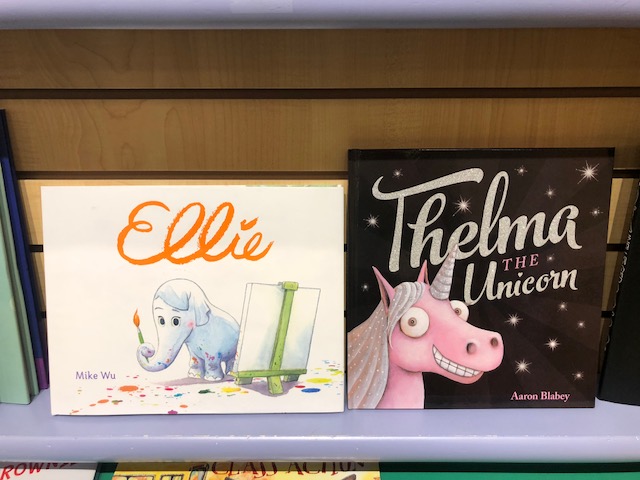
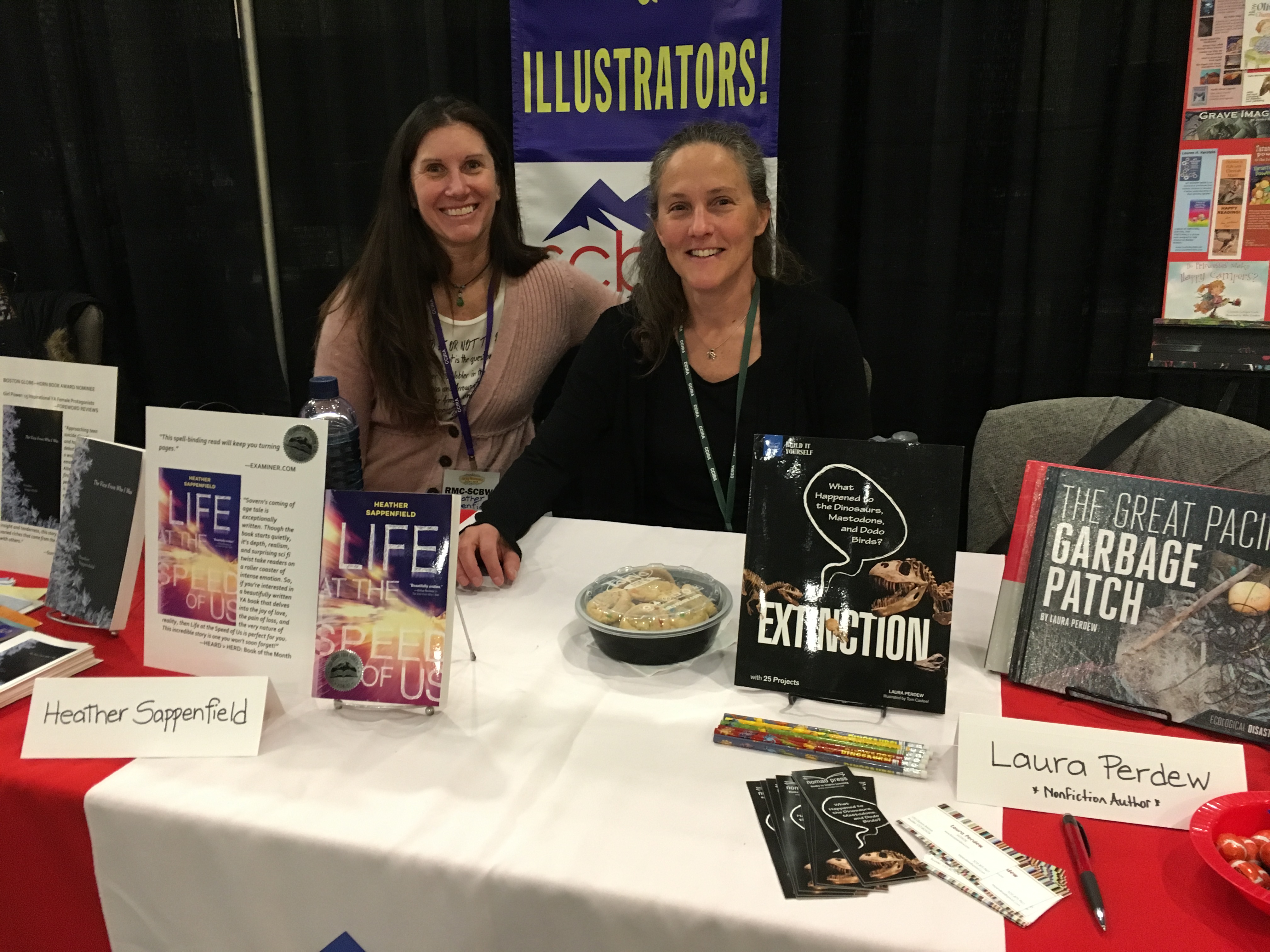
The first, and most elaborate event, was hosting a table in the Exhibits Hall at the annual Colorado Council of the International Reading Association (CCIRA) Conference at the Marriott DTC, on the outskirts of Denver, Colorado. With over 1500 teachers and librarians in attendance, you can imagine the buzz and excitement surrounding us. I arranged for twenty different authors and illustrators to join me in two-hour shifts where they showcased their books, met teachers and librarians, and gave away swag. Here are a few creative displays:        

It was a joy to see our SCBWI PAL (published and listed) members share their passion with the people who love their books. For many years, I attended this conference as one of those teachers. I met Kate DiCamillo, Will Hobbs, and Lois Lowry at this very same venue. I was totally star struck when I had the opportunity to be in the company of these literary rock stars! This weekend, I am happy to report that we had our own share of squeals and howls as teachers won door prizes, took photos with our authors and illustrators, and went away with pencils, hand-painted rocks, and gobs of stickers. Yippee!

My next program was leading a “Speed Dating” session with authors, illustrators, and educators. There were eleven stations set up around the room which enabled our authors and illustrators to spend quality “one-on-one” time with teachers and librarians. Some attendees wanted to know how to  write for children. Others were interested in learning more about using specific books in their classrooms. No two conversations were alike. This went on for eight minutes until it was time for the next date. The only problem I had was moving the participants on to the next chair. Everyone was so engaged and animated! At one point, the chatting became so loud, other conference attendees began poking their heads into our room to see what was going on. They smiled and nodded when they saw our rollicking book party! It was so much fun that one teacher asked if we could do this next year as an exclusive luncheon. It certainly is something to consider.


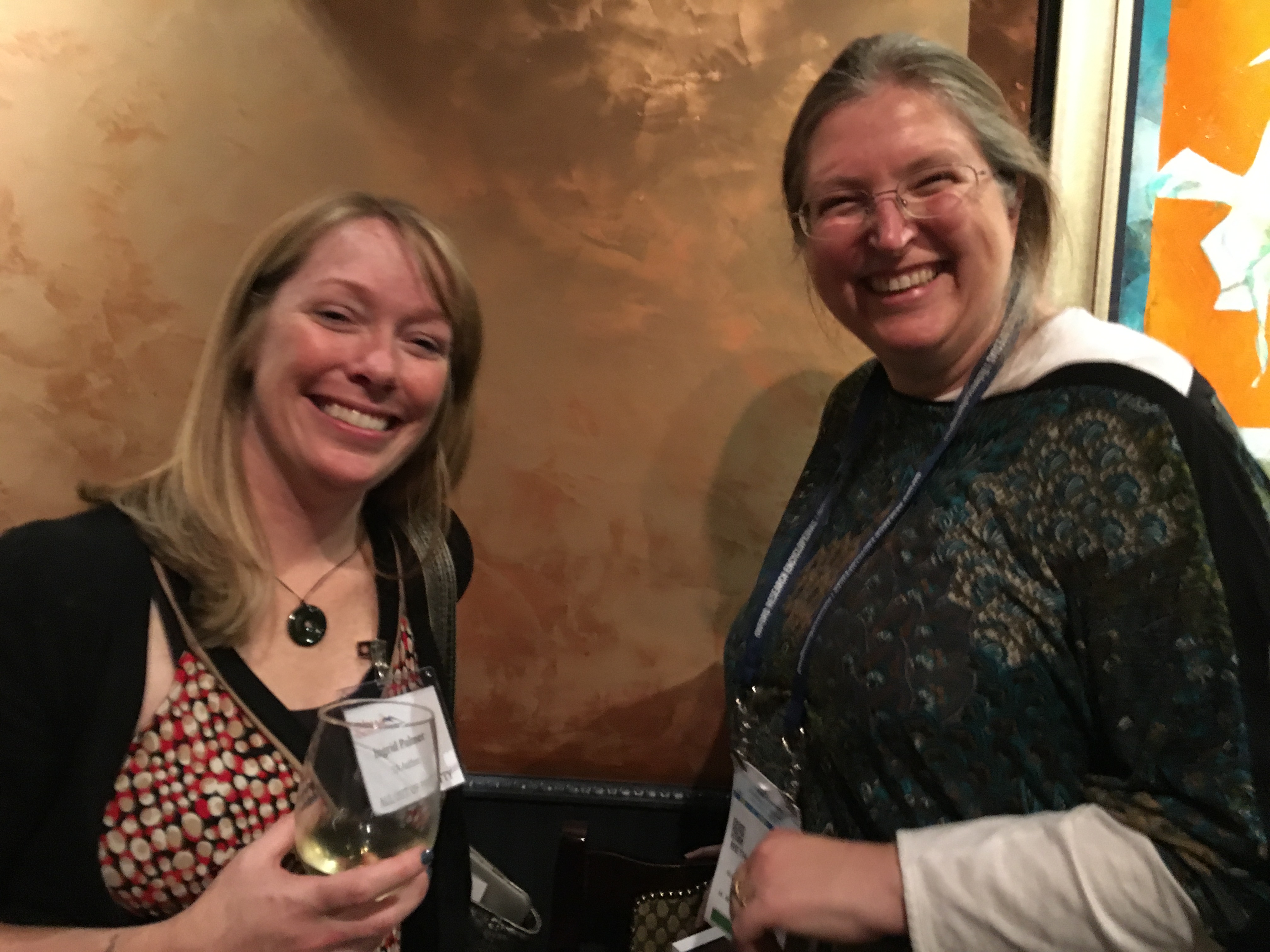
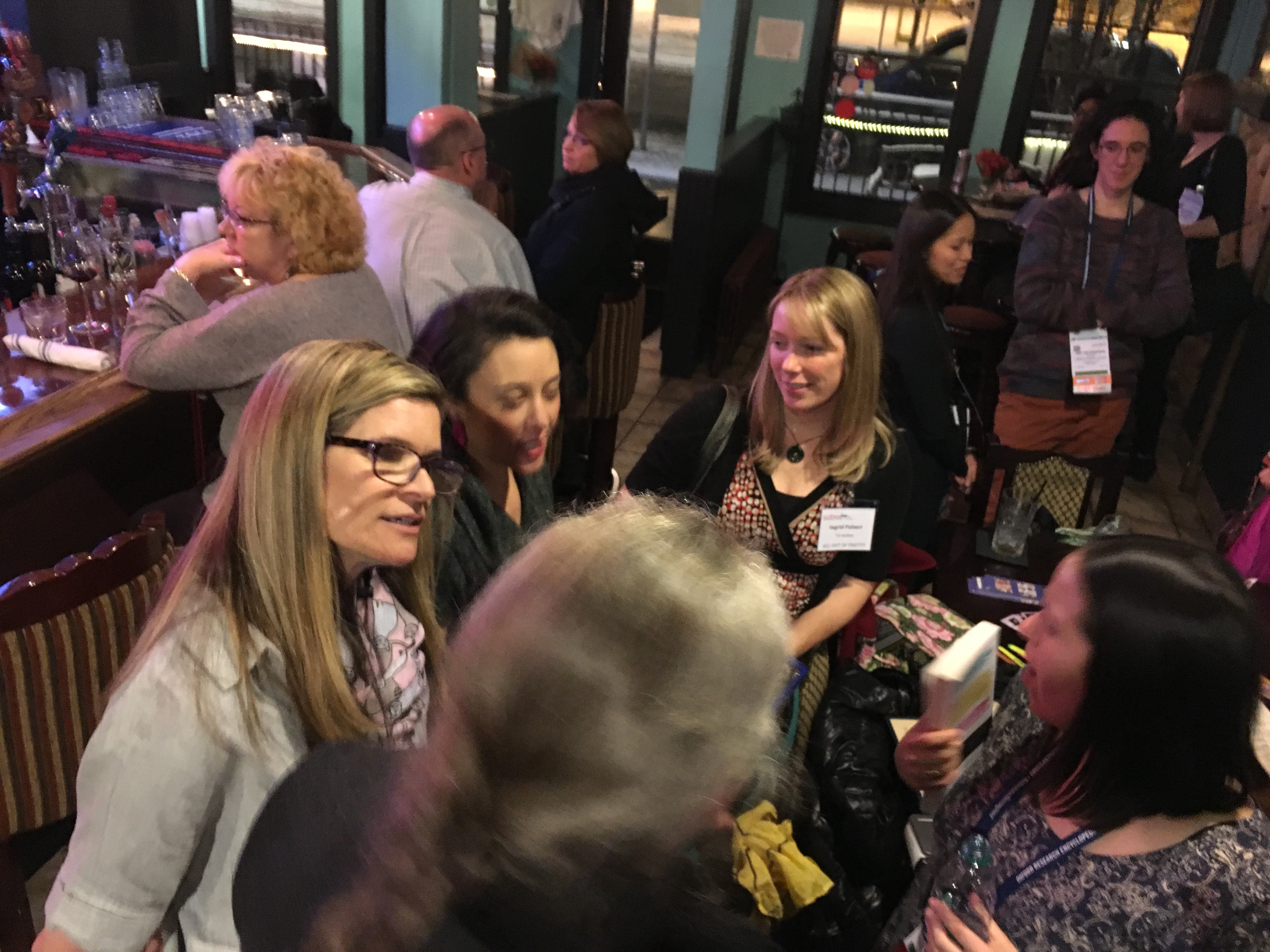
For my third act, I hosted a happy hour “meet and greet” in downtown Denver for authors and librarians. As luck would have it, the American Library Association (ALA) was holding its mid-winter conference at the Colorado Convention Center this same weekend. Despite frigid weather and blowing snow, a dozen of us made our way down to the Greedy Hamster on Saturday night for appetizers and drinks with a group of friendly YALSA (Young Adult Library Services Association) librarians from around the country. Many of our debut authors got to experience the thrill of giving away pre-released books to these lucky book lovers. Huzzah!


Connecting authors and illustrators with their adoring fans is definitely the best job in the world. I can’t wait for our next event!

4 Comments

Filed under Uncategorized

Writer’s Block…

It is a perfect day for writing.

I have characters impatient to move forward, ready to endure things getting a little worse before they get better. My plot is waiting to advance and my characters are growing and changing, all according to the outline that I hammered out months ago. Two people I created are literally trapped in a tree and the person they are hiding from is striding toward them. They need me.

So why can’t I write?

I keep trying, but every time I sit down to write, I come up blank. I write a sentence or two and it seems so… wrong somehow. I think back to the way the story flowed out of me in the beginning, the characters putting on their personalities like layers of clothes, filling out and surprising me with their actions and words. It was fun and exciting. I anticipated my writing time, eager to watch how the story I wanted to tell would find its way into the world.

But now, my frightened characters hide in the branches. I need to write the words get them out of this chapter and into the next. But there they wait, feeling confused and abandoned. I know them and they are very, very disappointed in me.

It turns out that I am not the first writer to experience a phenomenon known as writer’s block. Merriam-Webster defines writer’s block as “a psychological inhibition preventing a writer from proceeding with a piece.”

Looking for answers, I decided to survey what some of my favorite authors had to say about writer’s block. They provided interesting and sometimes contradictory advice, but I was buoyed by the wisdom that their words spoke to me.

  •  Hilary Mantel: “If you get stuck, get away from your desk. Take a walk, take a bath, go to sleep, make a pie, draw, listen to music, meditate, exercise; whatever you do, don’t just stick there scowling at the problem. Open a gap for them, create a space. Be patient.”
    • Lesson from Hilary: It’s okay to take a break and to wait for the right way to tell the story to come to me. Plus, it’s fine to find some time to bake that pie. Oh… and scowling does not help.
  • Orson Scott Card: “Writer’s block is my unconscious mind telling me that something I’ve just written is either unbelievable or unimportant to me, and I solve it by going back and reinventing some part of what I’ve already written so that when I write it again, it is believable and interesting to me. … [If] you haven’t solved the problem that caused your unconscious mind to rebel against the story, it still won’t work – for you or for the reader.”
    • Lesson from Orson Scott: I need to pay attention to what I have written and analyze if it feels true. If not, I’ll need to change it and make it both believable and interesting in order to move forward. My unconscious mind will be telling me things my conscious mind does not know.
  • Margaret Atwood: “If I waited for perfection, I would never write a word.”
    • Lesson from Margaret: My book is not going to arrive perfectly, so obsessing about each word or sentence is counterproductive. I can revise a bit as I go, but I can always go back and change everything if I wish. My first draft is just one part of the process and I need to get it down from beginning to end, then see about moving it closer to perfect.
  • Maya Angelou: “What I try to do is write. I may write for two weeks ‘the cat sat on the mat, that is that, not a rat.’ And it might be just the most boring and awful stuff. But I try. And then it’s as if the muse is convinced that I’m serious and says, ‘Okay. Okay. I’ll come.’”
    • Lesson from Maya: Some of what I write will be boring and awful. But that “the muse” is waiting and inspiration will come when I am ready for it…or when it is ready for me.
  • Jeffrey Deaver: “I’ve often said that there’s no such thing as writer’s block; the problem is idea block. When I find myself frozen… it’s usually because I’m trying to shoehorn an idea into the passage or story where it has no place.”
    • Lesson from Jeff: I need to trust the story and allow myself to veer from my plan if something isn’t quite right. I need to let go of some things, things that seemed important and essential at one time, and leave it out if it doesn’t belong any more.
  • Barbara Kingsolver: “Close the door. Write with no one looking over your shoulder. Don’t try to figure out what other people want to hear from you; figure out what you have to say. It’s the one and only thing you have to offer.”
    • Lesson from Barbara: I need to make sure that the book is my own, not what I think other people want the book to be. My book is historical fiction for children; I worry about making it marketable, politically correct, and always age appropriate. I need to set aside those worries for now and just tell the story.
  •  Mark Twain: “The secret of getting ahead is getting started. The secret of getting started is breaking your complex overwhelming tasks into small manageable tasks, and then starting on the first one.”
    • Lesson from Samuel: I shouldn’t be overwhelmed by the entirety of the book, but just move forward one incident at a time. If that is how he got that fence whitewashed and Huck to his own funeral, I can get those characters out of the tree.
  • Warren Ellis: “Writer’s block? This is when a writer cannot write? Then that person isn’t a writer anymore. I’m sorry, but the job is getting up in the fucking morning and writing.”
    • Lesson from Warren Ellis: I’ve never read anything by Warren Ellis, in fact I’ve never heard of Warren Ellis, but I appreciated what he had to say. I probably just need to get over myself and just write the @#$%$#ing book.

2 Comments

Filed under Uncategorized

12 x 12

Image result for 12 x 12 challenge logo

All last year I was busy taking classes for my LDE (Linguistically Diverse Educator) Certification for work. It was valuable because I was able to learn best practices that I could immediately apply in the classroom and the courses helped me to grow as an educator. It also meant I had to sacrifice time away from family, friends, and writing.

Starting the new year, I feel like a bear waking up from hibernation. While it was important for me to focus on school last year, now, I will have more time to do the things I enjoy. To help get back into the writing saddle, I’ve decided to take a writing challenge. I signed up for 12 x 12, with goal of writing 12 picture book drafts by the end of the year. It’s broken up into manageable chunks of writing one picture book draft each month.

Going to conferences, taking classes, and participating in online challenges and courses is a great way to help jump start motivation. It’s also a great way to hold yourself accountable and learn the craft of writing for children.

What classes, courses, or conferences (in person or online) have you found to be beneficial?

Leave a Comment

Filed under Uncategorized

Stretching My Writer Muscles, Literally

by Karen Deger McChesney

Lauren, my massage therapist: “Any areas that you want me to especially work on?”

Me: (Pointing to my triceps and forearms.) “Here and here. They’ve really been hurting.”

Lauren: “Have you been writing more?”

Her question surprised me. Lauren listened intensely as I rambled about revising, which I rarely do outside of writer circles. Then, she got her usual twinkle in her eye and briefly explained why my aches were from writing. My pride sunk. I wanted to hear that my aches were from my weightlifting or something else. Not writing! Unfair. Yes, my aches could be much worse. But, from writing? A year ago, I committed to increasing my weekly writing time – and now I have an achy-breaky upper body? Darn! As my mind melted into the land of massage, it made more sense. Like Natalie Goldberg says: “Writing is physical…like an athletic activity.”

After my massage, Lauren showed me stretches and mentioned that she works with writers (and how much she enjoys “them”). Wow! What a coincidence!

I recently interviewed Lauren about stretches for writers and to motivate myself to un-hunch and stretttcccchhhhh! Lauren has been a massage therapist and cranio-sacral practitioner (a hands-on therapy to enhance the body’s natural capacity for healing) for over 25 years, and she has taught yoga for 18 years to a wide variety of people in health clubs, yoga studios, senior centers, and other settings.

What ails writers? What do they come to you for?

Stiffness and pain in their neck, shoulders, low back and hamstring. I find that writers get so wrapped up in their writing, they go for hours without moving.

Name your top tips for writers:

1st, set a timer to go off every hour.

2nd, then, get out of your chair and stretch.

3rd, do gentle twists while you’re sitting.

Describe the correct way to sit at a computer:

Sit in a chair that allows your hips to be a little above your knees. Ideally, you want your body to be stacked, which means in alignment – your shoulder joints over your hip joints and your ears over your shoulders. Then, always be looking straight ahead at your screen, not down. If you’re not at a desk, put a pillow on your lap to lift up your laptop closer to eye level. Keep changing positions and trying different chairs.

How do we maintain good posture, especially when writing for hours and hours?

I tell my yoga students: imagine moving your right shoulder blade toward your left hip pocket and vice versa. This will open up your shoulders.

 What’s a good stretching sequence for writers?

 CHAIR TWIST: To the right, then left. Hold each side 15-30 seconds.


 WALL DOG: Hold 15-30 seconds.


EAGLE POSE: Left elbow over right, then vice versa. For maximum stretch, press elbows together.


Any other stretches to add to our sequence?

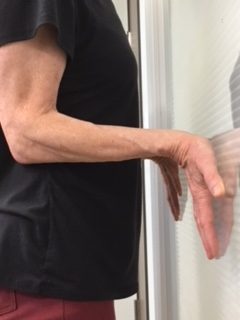
PALM AND WRIST STRETCH: Push both palms and all fingers into a wall simultaneously. Hold 15-30 seconds.


TRICEP STRETCH: Bend left arm over, touch fingertips on left shoulder, then right hand over head and touch left elbow. Vice versa. Hold each side 15-30 seconds.


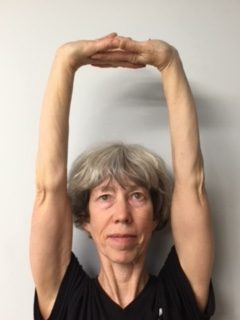
ARMS OVER HEAD: Hold 15-30 seconds.


What stretches should writers do while sitting?

1: CHAIR TWIST 

2: RUBBERBAND STRETCH:

Wrap rubberband around outside of fingertips.

 Then, spread thumb and fingers out. Hold 10-15 seconds.


Are there any other aches that you’ve noticed in writers?

When they’re into a really intense session (and feeling a lot of emotion) or writing for extremely long periods, they often clench their jaw. This can cause neck issues and pain. Try this: Move the tip of your tongue to the middle of the roof of your mouth. Hold for 10-20 seconds.

Your words of wisdom?

Experiment and do stretches that feel best for you.

What is your current yoga class schedule?

7-8am Wednesdays – Living Yoga Studio, Denver; 8:30-9:30am Fridays – Sol Center for Radiant Living, Georgetown.

Special thanks to Lauren Hess for her time and commitment to writers. For more information about her massage therapy and yoga class schedules, contact Lauren at lhmoscow@hotmail.com.
1 Comment

by | December 6, 2017 · 3:04 pm

A Year of Logging

By Rondi Sokoloff Frieder

Last October, when the leaves were turning raspberry red, lemon yellow, and orange orange, I embarked on a serious mission to make myself feel more like a real writer. (www.inthewritersweb.com, Nov. 2016.) Although I took my writing seriously, it didn’t seem like I was doing enough. Like you, I spent my time setting yearly goals, working on a variety of manuscripts, submitting to agents for feedback, participating in writing/critique groups, taking classes, and going to conferences. I read blogs and books on craft. I wrote articles like this one.

But despite this dedication, I still had no offers of representation or publication to show for myself. I had gotten very close with a few agents and editors, but that golden ticket still eluded me. And, I had reached a crossroads – give up on the whole shebang or amp up my life as a writer. Obviously, I chose the second option. (First sign of being a real writer!) Now I needed a new way to prove to myself that I was getting closer; that I was doing everything possible to increase my odds.

So I came up with an idea. I decided to keep a daily log of everything I did that related to my life as a writer. As a teacher, I loved leafing through my over-stuffed lesson plan books to see how much I had accomplished with my students. There were scribbles in the corners of cramped daily squares and tattered pieces of paper shoved in between the pages. Everyday had been a whirlwind of accomplishments!

Only with writing, planning out my week in advance often went awry. On some days, it seemed like I got very little done. I’d spend hours rewriting one chapter when I thought I’d be able to do four. Or I’d plan to do a small bit of research, get caught up in the subject matter and read articles on the topic for an entire morning. Finally, it came to me out of the clear blue – a totally different approach to this problem. I would log about what I did after I did it, not before. This way, I wouldn’t be disappointed if I didn’t accomplish what I thought I should have.

I got to work. I bought a large calendar/daytimer/notebook. Then, at the end of each day, I jotted down whatever I did to further my life as a writer. And, after a year of doing this, here’s what I discovered:


  1. I was doing a lot. Seeing months of squares filled in with writing activities convinced me that I was doing all sorts of things to further my life as a writer. I included everything from working on my novels and going to conferences to doing research and reading books in my genre.
  2. I developed a habit. According to many experts, it takes at least 21 days to develop a new habit. And for most of us, it’s longer. By writing in my log every day for an entire year, I made being a writer a conscious part of every day.
  3. Reading counts. You must read to write. I made sure to log about the books I read, both in and out of my genre and on craft. Then I entered the titles onto my Goodreads page. I also included blogs, articles, and emails to my writing colleagues.
  4. Rewriting is very time-consuming. By writing down exactly what I did each day, I could see how long it was taking me to revise my novel. A looonnnngggg time. There was one week when I worked on my first page for five days in a row!
  5. I am part of a writing community. I saw how often I met with other writers, both individually and in groups. I included in-person writing groups, conferences and classes, as well as online blogs, workshops, emails, and texts. It was A LOT!!!
  6. I am improving my craft. I recorded all the classes I took, conferences I attended, books I read on craft, and the ways I was implementing changes into my manuscripts. So important.
  7. I took on more of a leadership role in the RMC-SCBWI. My board position as Exhibits Coordinator turned into the PAL LIAISON this year. Being involved at this level makes me feel more professional and has also has introduced me to an inspirational group of writers!

At a recent writers conference, I was thrilled to share a lunch table with renowned editor, and author of THE MAGIC WORDS, Cheryl Klein. When Cheryl asked if I wrote every day, I told her about my writing log. She liked the concept and said that a daily writing practice is the key to getting published. So maybe I’m on my way!

But here’s the main thing I discovered by keeping the log… getting published is only one part of living a writer’s life. It’s an extremely important part of the journey, but the things I wrote down in my log squares, … those are the things that make me a “real” writer. And here’s the surprising takeaway – I don’t feel the need to continue logging. A year of doing this has served its purpose. I am living the life of a writer. And I have a notebook full of scribbled-in boxes to prove it.


2 Comments

Filed under Uncategorized

On the Road to Find My Story

Each fall, my good friend Martha and I choose a theme to explore and then we read all we can about the topic. Then, come summer, we take a trip to further explore all that we have learned. These yearly “theme trips” provide inspiration for my writing.

It began with our “12-year-old Boy Tour of England.” Martha and I made our pre-teen sons read and research, then took them to England. We did everything 12-year-old boys would want to do: torture chambers, hedge mazes, knight and castles, Jack-the-Ripper, Sherlock Holmes and Stonehenge. Those boys, now young adults, will always remember the combination of focused reading and exploring. They knew more about the places we visited than the tour guides. Young Alex said to me at the time, “It’s really better in person because it makes it real!”

Since then, Martha and I have “made it real” on our yearly theme trips. We went to New York City to explore the theme of “Immigration,” visiting the Lower East Side tenements and Ellis Island. The “Civil Rights Tour” took us on the Selma to Montgomery Trail, to a Birmingham Baptist church and to a Memphis balcony. A “Native American” theme sent us to the Wounded Knee site on the Pine Ridge Indian Reservation and to the Crazy Horse Monument in South Dakota. Over the last decade we have done many other trips- “Jane Austen” in the English countryside, “Prehistoric Peoples of the Southwest” in Colorado and New Mexico and “Abraham Lincoln” in Springfield, Illinois and Washington DC.

The trips help me to direct my reading and provide me with a thought provoking topic for the year. I start my preparations with nonfiction- reading encyclopedia articles and books, then I move on to primary source materials. My favorite part of preparing for a trip is reading any relevant adult, middle grade, and children’s fiction I can find. I focus on the way the authors integrate historical details and how they portray culture and place into their books. All this allows me to get the most out of the trip and to understand how to improve my own writing.

I’ve just returned from our “Underground Railroad” trip that we chose for our theme this year. We were inspired by a family story about one of my abolitionist Quaker ancestors who harbored freedom seekers escaping slavery. We went to the small town of Vandalia, Michigan for “Underground Railroad Days” and to Detroit’s sites that memorialize the dangerous journey from slavery to freedom. This year’s trip focused on those who helped strangers and broke the law of the land because it was the right thing to do. Michigan, as I learned, was an abolitionist hotbed and the crossroads of secret pathways that led to Canada and freedom.

It was a sobering topic. The realities of our nation’s shameful history of slavery are painful to explore indepth. I learned more about the inhumane conditions that made enslaved people risk finding a path to freedom. The people who helped them were heroic. Much of the story of the underground railroad will be forever hidden, because it was secret and dangerous. But some stories remain and are important to understanding our collective history.

When I am on one of our trips, I look for the stories that are hiding below the surface and have particular resonance for me. I note details that I could never know from just reading—the feeling of standing where a historical event took place, the details of the landscape, and the atmosphere that surrounds a place.

I never know if the topic I have learned about during the year will find a place in my writing. Sometimes, our yearly theme is just for me and satisfies my own curiosity about the world. I understand more about our world and its complexities. My compassion for others grows as a result of pursuing a deep and connected understanding of a topic. Other times, I discover a story that needs a voice and a storyteller. I try to imagine the story that will help a young person understand more about a time and place. This is when I find inspiration and focus for my writing for children.

1 Comment

Filed under Uncategorized

Subscribe!

We are trying to update our subscriber function on this blog. Please fill out the information to the right and let’s see what happens. Hopefully, you will receive our updates every two weeks!

Thanks for subscribing!

The Story Spinners

Leave a Comment

Filed under Uncategorized

A Summer of Sequels

As a kindergarten teacher, I am gearing up to go back to school in a couple of weeks. In preparation, one of the items on my to-do list was hit the bookstore to find some good reads. When I arrived, I felt like I struck gold because I found a few of my favorite titles came out with sequels and they did not disappoint. One great thing about reading books from the same author is the ability to compare and contrast. I think my little ones will be entertained and delighted to compare these titles! Caution: spoiler alert!

Mother Bruce/Hotel Bruce

Good ole grumpy Bruce the bear is back with a whole new problem. He returns from migration (with his geese from the original story) only to find mice have transformed his house into a hotel. You gotta love Bruce because in the end, he may just be a giant teddy bear at heart who can find room for a few visitors to stay.

If You Ever Wanted to Bring an Alligator to School DON’T!/ If You Ever Want to Bring a Piano to the Beach DON’T!/ If You Ever Want to Bring a Circus to the Library DON’T!

These stories have an If You Give a Mouse a Cookie, feel. The charming alligator lover is back to show readers why you shouldn’t bring a circus to the library (they are for sitting quiet and reading)! And why its a bad idea to take a piano to the beach (when your mom asks you what you want to bring, she means a frisbee or a shovel)!

What Do You Do with an Idea?/What Do You Do with a Problem?

If you thought ideas made you nervous, wait until a problem comes along. Just like ideas, you can’t ignore problem because they grow (and unlike ideas, you don’t want that to happen). But when you tackle a problem, you may find it really isn’t so scary after all.

I love to get my kindergarten class excited about reading. The best tool in my toolbox for this task is a great book to share. What are some of your favorite picture books?

Leave a Comment

Filed under Uncategorized

It’s The Dog’s Fault

By Rondi Sokoloff Frieder

I am not a morning person. I hit snooze when the alarm goes off and pull the covers over my head for five extra minutes of luxurious, dreamy sleep. I’ve always been this way. In elementary school, I was  the last one out the door. On some days, my dad would actually leave and go pick up the rest of the carpool before coming back to get me. In high school, I did my homework in front of the television with the late night talk show hosts as company. And in college, I was known for writing papers long after my housemates were in bed. I wasn’t much for the infamous “all-nighter,” but it did happen now and then.

Years later, when I entered the work-world as a teacher, I needed to make changes. I had to get up early. My first job required taking a bus and two trains (the red and green lines in Boston) to my school, setting up for the day, meeting with colleagues, and greeting students, all before 8:00 am. And when I became a mom, well, that’s another story. Late nights and early mornings were a way of life.

But now, I am retired from teaching and my children are long gone. I can create my own schedule, the one I was born to live – go to bed at 11:00 p.m. (after Stephen Colbert’s monologue) and get up at 7:00 a.m. to meet my walking group by 7:15. It’s the perfect life. Except that my fourteen-year-old dog has decided to get up at sunrise. Every single morning.

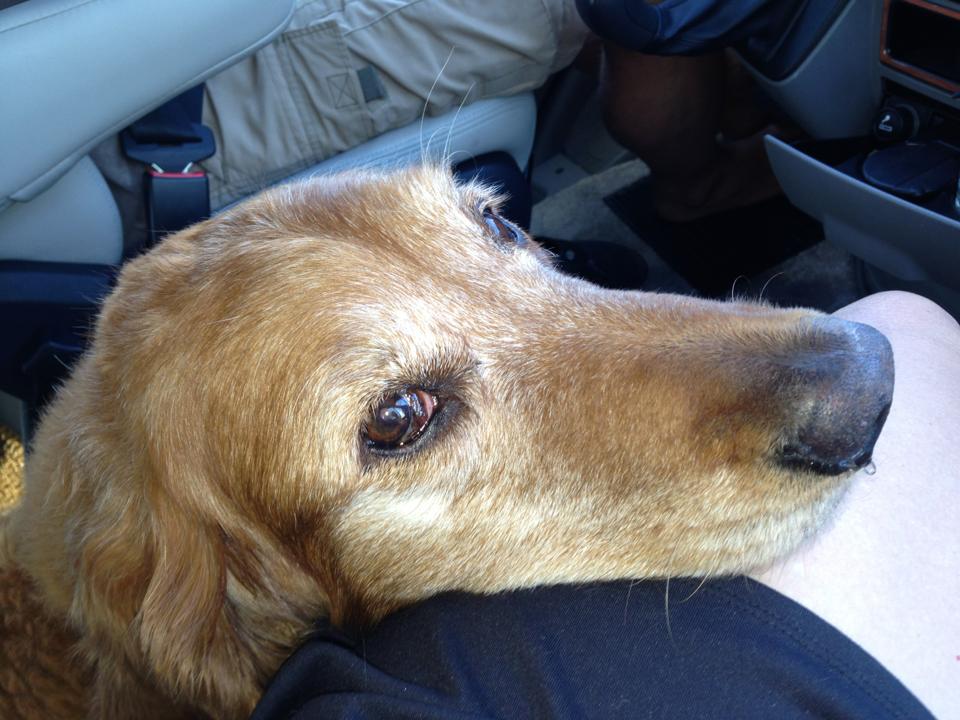
I love this dog. She’s the dearest, friendliest, loviest, golden retriever you could ever imagine. Her name is Berni and everyone adores her. Especially me. But lately, this devoted ball of orange fur is getting up at 5:13 am. Okay, well sometimes it’s more like 5:29. But still, it is VERY EARLY. And for some reason, she only comes to my side of the bed. She totally ignores my husband (who is snoring loudly and doesn’t hear a thing) and waits for me to wake up. And, being the good mommy that I am, I get up, give her a cup of food, and let her outside to do her business. Only this dog is not interested in a quick run to the bathroom. She is WIDE AWAKE. She sniffs the grass, goes hunting for rabbits or squirrels or chipmunks or voles or whatever wildlife is also up at this ridiculous hour.

She wasn’t always like this. For most of her life, she lived by our schedule. But lately, as she approaches 100 (in people years), she’s up with the roosters. Like a farm dog, or an insomniac. Mostly she’s hungry, famished, in fact. And those yummy fish and potato dog food nuggets are calling her name. So, I go to the bathroom. I go outside. I watch her wander in the yard. I let her back in. And guess what? Now, I am wide awake, too. And it is only 5:45 am.

It was during one of these early morning strolls, when I was pulling weeds in the yard while Berni sniffed wildflowers, that I came to a big realization. This is the time of day when many highly successful and productive writers slink down to their studios and crank out a ton of pages. I don’t know about you, but I’ve read scads of articles, and heard many speeches, by authors who insist that they do their very best work before the sun is up. And every time I hear this, I say to myself, “MUST BE NICE, BUT I WILL NEVER be one of those people.” I envied those industrious authors, but knew that early morning writing was not for me. Until now.

Because here I am at my computer writing this blog. And it is only 5:48 in the morning. It’s the dog’s fault, of course. But guess what? I kinda like this time of day. It’s quiet and I actually am clear-thinking and more efficient. I’m writing faster and better and there are very few distractions. It’s too early to run the laundry (wouldn’t want to wake up that sleeping husband) and there’s nobody to call. And here’s the clincher, there are no new emails to read since I checked the night before.

Who would have thought I would become one of those early morning writers? Not I, said the little red hen and everyone else in the world who knows me. So thank you, sweet Berni. Thank you for nudging me with your big wet nose and breathing in my face at the crack of dawn so I could get up and… write!

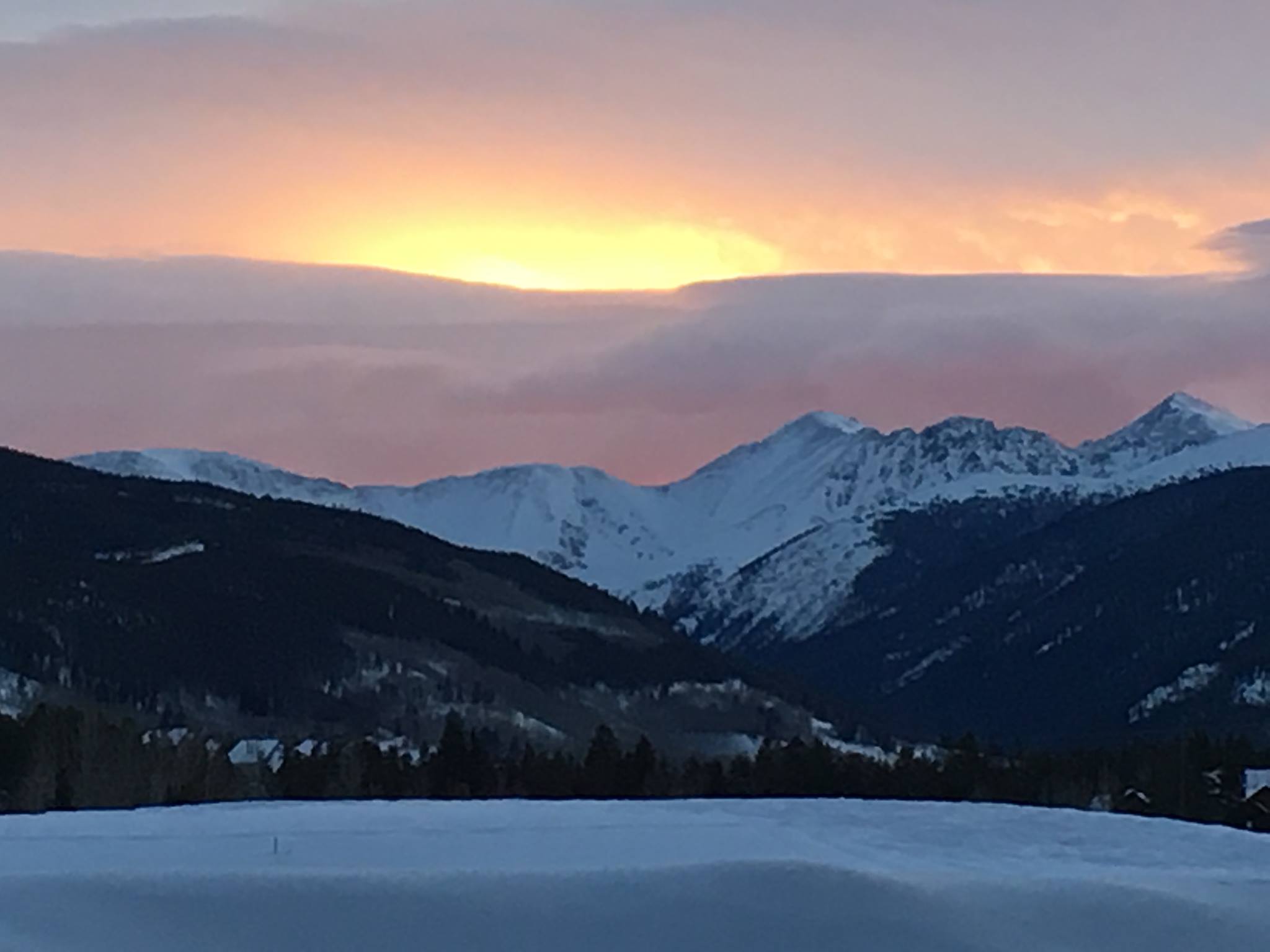
It’s a good thing I love coffee. And afternoon naps. And beautiful sunrises.

3 Comments

Filed under Uncategorized

Still wondering after all these years…

Reading the Sunday Chicago Tribune was an all-day affair in our house. By dinner time, sections of the paper were scattered everywhere – on the kitchen and dining room tables, the living room floor, on beds…

I remember my brothers and me racing out the front door to the bottom of our driveway to get the paper. The first one to get the paper was the first to get to read the comics.

I could never get enough of Andy Capp, Archie, Beetle Bailey, Broom-Hilda, Cathy, Brenda Starr, Blondie, Funky Winkerbean, Peanuts… All week, I quoted the characters and re-told their stories at the dinner table, at school….and wondered, what would happen next. Now, it seems crazy to wait an entire week to find out what’ll happen next. But, I fell in love with all the guessing, predicting, and wondering.

In less than a hundred words, each comic strip provoked me, entertained me, and mystified me. Oh, and the artwork! I was completely fascinated by the colors of the characters clothes, hats, shoes, everything.

My family didn’t discuss what we read in the Sunday paper. We just read and went about our business. It was a rather quiet day. As a teen, I couldn’t wait to read the editorial pages. The letters to the editor were my favorite. I always tried to picture the writers, where they lived, how they dressed… Sometimes, I imagined meeting them.

I don’t remember us reading books, other than occasionally skimming through a set of Encyclopedia Britannica that collected dust on our basement shelf. To me, reading was what I did all day at school, for homework and well, something that I had to do.

My parents didn’t read us bedtime stories. Actually, I never thought of story as being contained in a book. But, looking back, I always knew story. It filled our two-story house.

Story was what my brothers and me passed around the dinner table every night. It was the entrée. My brothers reenacted scenes from The Marx Brothers and Star Wars; I delighted in laughing, making up stories, imitating teachers and telling what happened in school. I clearly knew story was something you make up, can’t wait to tell – and that it gets better every time you tell it, especially when my brothers would chime in, add on, and we’d just keep going, weaving our tales. No one ever said “stop” or “stay focused” or “don’t do that”. We just let it rip. It was a loud feast of one “and then, and then” after another; it was what we did naturally.

On a recent visit with one of my brothers, we told stories for hours. You know, the kind that make you laugh till your stomach hurts. I lost track of time. We let it rip. It felt just right; it was dang fun! I didn’t want our storytelling to end.

I think it’s why I write and keep revising. I don’t want it to end. I’m still in love with all the guessing, wondering, and still mystified by the art of writing.

How about you? Why do you write or do other art?


“I never thought Cathy would get married.” –Cathy Guisewite, author of the comic strip, Cathy.


Leave a Comment

Filed under Uncategorized