
Category Archives: Revision process

“JUST DO IT AGAIN!”

I’m so happy to be here with YOU!

Finally… I’m meeting you in person!

I can’t believe it’s been over two years!

 In April of 2023, I started a two-month online class through the Highlights Foundation called “JUST DO IT!” led by the amazing Sarah Aronson and Chris Tebbetts. (To read more about this, check out my post: https://www.rondibooks.com/just-do-it/.) The goal of this course was to be part of a collaborative support group to finish our draftsThere were weekly meetings on Zoom that provided us with tools to do this, as well as inspirational talks by Chris and Sarah, and the occasional guest speaker. We were also encouraged to participate in weekly word sprints by joining an accountability group. Needless to say, everyone in this group was determined to “get it done.”

And many of us did. I wrote 24,000 words. I didn’t finish my draft, but I made a lot of progress. I also amped up my writing practice, connected with kindred spirits, and wrote half a middle grade novel. But how was I going to finish the second half? The workshop was over. My daily support group and accountability team were gone. After speaking to other class members who felt the same way, we decided to keep going.
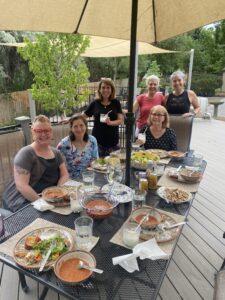
Luckily for us, Dale Marie Bryan (a fellow “Just Do It!” participant and now my dearest friend) kept us on task. Dale organized morning writing sprints, afternoon writing sprints, once a month read-alouds and a goal-setting googledoc. The read-alouds not only helped us revise, it also enabled us to truly get to know each other’s work.

Chris and Sarah attended many of these sessions and often wrote and read right alongside us. They also offered more “Just Do It!” classes and continue to host inexpensive monthly online sprints. (For more information about these, message Chris on FB.) We also invited the next group of “Just Do It” graduates to join us for sprints and read-alouds. And after two years of meeting online on a regular basis, we have definitely bonded. So much so, that when Chris asked if any of us would like to attend a writing retreat at the Highlights campus, fourteen of us said  ABSOLUTELY YES!

At first, I didn’t think I could go. It’s quite a shlepp from Colorado to Honesdale. But the stars aligned. I was already going to NY the week before for my niece’s bridal shower. After spending a few extra days visiting family and friends, I rented a car and drove to Pennsylvania.

Spending time at the Highlights campus is always magical. Just ask anyone who’s been there. With the idyllic wooded setting, the cozy cabins, and the delicious farm-to-table cuisine, you can’t go wrong. This was my third time. However, the other two workshops I attended were mostly with people I didn’t know. It took a few days to connect and build trust. Gathering with the “Just Do It!” crew was a totally different experience.
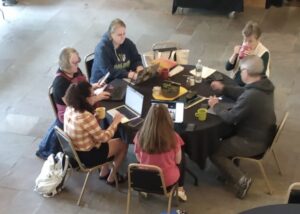


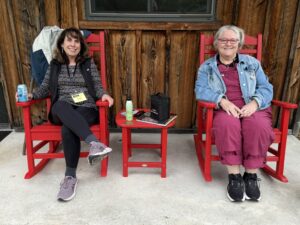
The minute I arrived, I felt like I was at a family reunion. Or a getaway with camp or college friends I hadn’t seen in a long time. There were hugs and exclamations of glee. And after the initial thrill of finally being together in-person, we immediately got to work. Because that’s what we do when we’re together – WE WORK ON OUR STORIES!

And there was more. Sarah offered inspirational talks and morning yoga. Author/illustrator Daria Peoples joined us and did an art exploration. Chris asked if we’d like to workshop our manuscripts “theater-style” in the evenings. This entailed printing out 500-1000 words of a manuscript that contained a great deal of dialogue. We made multiple copies, highlighted (pun intended) individual parts and passed out the “scripts.” After an initial reading, people were assigned a role and got up and acted out the scene. Wowwy kazowwy! We were able to see our work in a totally different way. Some scenes needed more movement, heightened action, deeper emotion. Others needed a bit more description or a transition or two. We were all mesmerized by this exercise. We gasped at the dramatic pieces and laughed hysterically at the humorous ones. What a great editing tool! If you’d like to participate in one Chris’ future workshops, check out this link:https://www.theatercampforwriters.com/
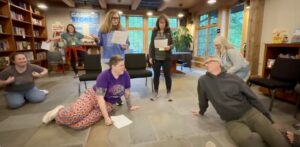
I have to say, except for bidding farewell to the ridiculous number of ticks that had recently burst onto the scene, it was sad to leave. Sort of.  We were heading home, but we also knew we’d be seeing each other again online the following week. Because the “Just Do It!” community is unstoppable!
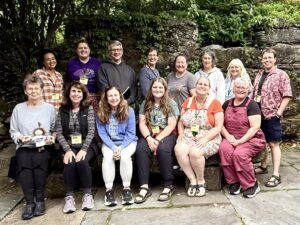
If you’d like to take Chris and Sarah’s class, the next one starts in October. https://www.highlightsfoundation.org/workshop/just-do-it-your-collaborative-support-group-for-finishing-your-draft-fall/.

And by the way… I did finish my manuscript. Stay tuned!



1 Comment

Filed under craft advice, critique, Motivation, REVISION, Revision process, Rondi Frieder, Uncategorized

Auditioning: Putting My Pages Out There

The timer went off. I had just finished a productive 50-minute revising session. But then… my break turned into being online too long. I disappeared into the SCBWI website, reading all about upcoming webinars. Yes, I was procrastinating. Yes, I was hoping a super power would finish editing a chunk of my young adult novel. It was due to my young adult novel exchange partner in five days.

Just as I was about to close the website, one webinar jumped out at me. It cheered, “Sign up. Now! Don’t think. Do it.” The webinar featured an agent giving live feedback on the first 10 pages. Ten pages? Wow! Rare, I thought. And curious. One seat was left. It was mid-day. The pages were due at 5pm the next day.

“Nope, too late,” I thought. “Besides, my manuscript isn’t query ready.” Meanwhile, my neuro divergent brain was full speed ahead, doing a jig and high on a possible challenge. I quickly googled the agent’s website and Manuscript Wish List. I got goosebumps. She was seeking the themes steeped in my YA novel.

Minutes later, I was registered. Plus, I paid extra ($25) for the agent’s post webinar detailed critique of my first 50 pages. What an adrenalin rush! What a perfect way to put my pages out there. An audition of sorts.

The spontaneity was energizing. This wasn’t the first time that I had jumped and registered last minute for a pitch or contest. Perhaps, the stars simply align that way for me.

Unfortunately, in this instance, there was one problem. A big problem. I had not looked at the first five chapters of my YA novel in months. Many months. I had been hyper focused on cutting, editing and polishing the last act. Yikes!

I immediately hunkered into my editing cave. The good news, it was easy to cut and edit, because I had moved parts from the beginning to the second and third acts. The bad news, it was very challenging to re-figure the first chapter. It no longer fit, as a result of my final revision. I felt stuck and overwhelmed. If only it made sense to start with chapter two. But, I needed a set up. Ugh.

I re-read the Beat Sheets (from SAVE THE CAT! BEAT SHEET WORKBOOK by Jamie Nash) that I had done and re-done for this novel. I re-read the first act. I handwrote notes; did free writes of possible first pages. Geesh. Was I really going back to the drawing board? Insane! I couldn’t delay; couldn’t stop. I had a deadline.

Fast forward. The webinar was an incredible experience. Each attendee’s first five pages appeared on screen, while the facilitator read them aloud. The agent devoted six minutes to each work, giving succinct, insightful, thought-provoking feedback aloud that she had prepared in advance. Everyone listened. No interactions, discussions, questions. I loved the meditative, deep thinking mood – and generous quiet time to soak up the sound of our prose and a professional’s reaction.

Of course, I was nervous and full of “I should have changed this, cut that…” But it was too late. It was un-polished. It didn’t matter. My work was out there. The curtains were wide open. An audition.

Lesson learned: Put my pages out there before I’m ready to query. The webinar pushed me outside the “I have to” box. I have to have a full manuscript ready before I…  Ever since, it has felt liberating and reassuring to keep entering pages in a contest, online sessions, etc. Intimidating? You bet! But these auditions keep me moving forward and believing in my novel. Best of all, they give me a reality check.

By the way, the agent’s detailed ($25) feedback was a huge perk. Pages of positives, keen insightful suggestions, along with discerning questions. I have added her to my To Query spreadsheet.

Here’s to auditioning your work in progress! Why wait? Give these opportunities a try and look for more. Congratulate yourself on putting your pages out there.

Webinars: SCBWI Regional Virtual Events https://www.scbwi.org/regional-virtual-events

March contests for YA novel excerpts: (Winners are assigned to an editor or mentor that coaches you to a polished manuscript.)

#RevPit 2024 Annual Contest  https://reviseresub.com/annual-contest

First Page Prize   https://www.firstpagesprize.com/

Gutsy Great Novelist  https://gutsygreatnovelist.com/chapter-one-prize/

Uncharted Novel Excerpt Contest  https://www.unchartedmag.com/uncharted-magazine-novel-excerpt-prize-judged-by-keshe-chow/


There’s no time like the present. –MG and YA acclaimed author, Victoria Hanley


2 Comments

Filed under 2023, Agents, craft advice, critique, Karen McChesney, Literacy Program, Main character, Middle Grade, Motivation, Persistence, Revision process, RMC-SCBWI, Upcoming

Finding The YA in Learning


Murder. Secrets. Drugs. Gossip. Lies. Sexuality. Romance. Magic. Identity. Rumors. Breakups.

Hang out with a group of YA writers and you’ll likely hear these words, along with more provocative, dark, odd, edgy, far-out, intense, hilarious, eccentric, juicy, shocking topics. We love teens. We love big drama and conjuring a mess for our teen characters in current time or mystical worlds.

Other kid-lit writers often say we’re nuts for writing over 75,000 words. But we can’t get enough. We want to hold on to every word. No wonder our revisions can take years and years as we cut, trim, tighten hundreds of pages.

Thanks to my critique group, Story Spinners, I unexpectedly joined the YA writer “club” years ago after they nudged me to turn my coming-of-age short story into a YA novel. I was clueless and intimidated, but I couldn’t stop writing. I’m incredibly fortunate to be part of the SCBWI-Rocky Mountain Chapter’s YA community. And I’m in awe of how everyone cheers each other on at book launches and events by and for YA writers.

My fellow YA’ers and I adamantly long to be with our peers and find YA-only classes. No offense, picture book and middle grade writers. We adore you and your books! Just like our teen characters, we long to be belong; we want to be in a YA cluster. But, we’ll be the first to admit, we often feel like the misfits in writer land. Afterall, YA novels are a far cry from Middle Grade.

Perhaps that’s why our search for YA-only learning is constant and fierce. The past few months, for instance, several YA writers and I started researching YA-only workshops, courses, and other ways to amp up our learning.

Here’s what we have found so far:

Workshops/Courses:

Wordsmith Workshops https://www.wordsmithworkshops.com/

Vermont College of Fine Arts https://vcfa.edu/writing-novels-for-young-people-retreat/

Hugo House https://hugohouse.org/product/young-adult-fiction-workshop/

Writer’s Digest University https://www.writersonlineworkshops.com/courses/writing-the-young-adult-novel

UCLA Extension https://www.uclaextension.edu/writing-journalism/creative-writing/course/young-adult-novel-i-writing-x-4451

Tin House https://tinhouse.com/workshop/

From SCBWI:

YA Connect and Other Connects https://www.scbwi.org/regions/rmc/events

YA Connect is free and offered every other month by and for YA writers of all levels to learn and meet fellow YA writers. Most YA Connects are both in-person & Zoom.

Michelle Begley Mentorship – Due Oct. 31, 2023 https://www.scbwi.org/regions/rmc/RMC-mentorship-program

Weekly Podcast https://www.scbwi.org/podcasts

Most recent one featured Deborah Halverson, award-winning YA author, including Writing Young Adult Fiction For Dummies and Honk If You Hate Me

Monthly Virtual Events, hosted by chapters across the U.S. https://www.scbwi.org/regional-virtual-events

Coming soon:

Lighthouse Writers Workshop, Denver – YA workshops, gatherings https://lighthousewriters.org/

Of course, there are a lot more YA-only opportunities out there. Share your findings in the comments, please. Meanwhile, YA writers: Keep reaching out to find other YA’ers. And remember, teens can’t wait to read your stories – and drama!

2 Comments

Filed under 2023, Agents, craft advice, critique, Graphic Novels, Karen McChesney, Main character, Middle Grade, Motivation, Persistence, Revision process, RMC-SCBWI, Upcoming, What I am doing now

Go Writers, Go!

It was a writer’s dream. That’s how I felt at the recent grand opening of Lighthouse Writers Workshop new building. I was with over 500 other writers in the stunning, custom-built, cozy three-story building designed just for writers. Just for writers!


“We want this to be your home,” said Co-Founder and Director Michael Henry. And, we want it to be a place where writers of all ages, levels, backgrounds, genres come “hang out and write,” added Andrea Dupree, Co-Founder and Program Director.

What could be better? That night, when I left this writer’s paradise, I was riding high. High on great gratitude.

Gratitude for:

-living in a city that has invested in Lighthouse and writers

-living in a state with an incredibly supportive kid-lit writer community

-getting to teach youth at Lighthouse

-my awesome writer critique group, Story Spinners

-SCBWI-RMC

-my writing groups: Young Adult writers, NaNo writers

-my Monday accountability group

-my super supportive husband and friends

-my manuscript exchange partners

-my two late aunts who modeled creative follow-your-dreams living

Wow, I have been incredibly fortunate to have many, many cheerleaders on this crazy journey of querying picture books and revising young adult novels. At the grand opening, one author-speaker reminded, “writers need other writers, create your community.” I am immensely proud that I have created my writer community. And it keeps growing! I have great cheerleaders. Best of all, they have shown me how to be a cheerleader; they have inspired me to make time and show up for other writers.

In that spirit, I decided to share some of my favorite cheers from other writers. I keep them in a notebook and glance at them often, especially when I get a bad case of imposter syndrome. These words give me courage; remind me to have fun; renew my “I can do this.”

May these comments cheer you on, too.

For imposter syndrome: Before writing, take a few minutes to jot down what you’re thinking. Your doubts, your insecurities. Spit ‘em out! Then, write your goal for your session, such as word count, number of pages. At the end of your session, write down what you did.

 Congrats on doing the hard work on your YA. It’ll pay off. Sometimes you just have to plough through the hard stuff.

What an achievement! I am so proud and inspired by your achievement of finishing another revision.

Did you sign on yet for film rights for your book?!!!! I can picture it as a movie.

You hooked me with your pitch. I want to read it!

You sound very clear on your intentions for your YA. Get your story out there!

Hip, hip hooray! I know you’re passionate about this story and I applaud you for sticking with it. This is very hard work!

Aim to send 100 queries. I got my agent on query 101.

It doesn’t matter how long it takes you to finish. What’s most important is that you are staying with the hard work.

Here’s to being cheerleaders and having cheerleaders. Go writers, go!

Lighthouse Writers Workshop is the largest literary center in the Rocky Mountain West. They offer writing instruction, workshops, events, and support for writers of kid-lit, fiction, nonfiction, poetry, and many other genres. New location: 3844 York St., Denver CO 80205. For more information: Lighthouse Writers Workshop |


4 Comments

Filed under 2023, Agents, craft advice, critique, Karen McChesney, Literacy Program, Motivation, PBParty, Persistence, Picture Books, Revision process, RMC-SCBWI

JUST DO IT!

In the middle of March, I began sending my middle-grade time-travel novel out to agents. And as all experienced writers know, the best thing to do when you are waiting for query responses is to work on something else. My “something else” was an idea I got from a friend after we attended Andrea Wang’s intensive at the RMC-SCBWI Letters and Lines conference last September. (https://www.rondibooks.com/the-stories-hidden-inside-you/) But even though I had a “Beat Sheet” outline from Save the Cat for the Novel by Jessica Brody, I hadn’t written a single word of the story. Luckily, after an animated conversation with my friend and teacher, award-winning author Sarah Aronson (https://saraharonson.com/), I decided to sign up for her eight-week online Highlights class, JUST DO IT – Your Collaborative Support Group for Finishing Your Draft. Sarah would be co-teaching this class with the incredibly articulate and inspirational author and coach, Chris Tebbetts. (https://christebbetts.com/). It sounded like the perfect way to get this book started.

If you have ever done NANOWRIMO (The National Novel Writing Month-long challenge to write 50,000 words in 30 days) you know the joy of writing fast. Just Do It! has a similar premise. It focuses on a creating a daily writing practice with many extra goodies thrown in. The formal part of the class is a one hour Zoom on Wednesday nights where Sarah and Chris give informative presentations on craft. Only there is so much more. Whether you are working on a picture book or a young adult novel, there are writing sprint sessions every day at a variety of times, morning prompts, and inspirational quotes. There are accountability groups, Discord channels for discussion and sharing, and OPEN MIKES! We also received videos and slides and oodles of handouts. But the best part of these two months was being part of a supportive writing community. Our class had over fifty participants from across North America, two guest speakers, and many Highlights staff members coordinating logistics behind the scenes. I felt like I was at a two-month writing retreat without leaving my house.

So, you may ask, after weeks of diligently sitting  at my computer, did I finish my draft? Unfortunately, the answer is no. A variety of expected, and unexpected, life cycle events collided right smack in the middle of the eight weeks. However, I did write 24,000 words, which is probably half the book, right? And more importantly, I am now totally immersed in the world of my new story. I wake up every morning with character traits, plot twists, and image systems rolling around in my brain. And after my recent critique with Sarah, I am considering all kinds of possibilities. I am in the zone!

But there’s more. The virtual writing sprints will continue through the summer which should help me pound out the next 24,000 words. Also, my accountability group is planning to keep meeting on a regular basis. We are committed to cheering each other on to the finish line. But here is my biggest takeaway – the greatest change in my writing process: I am way much more comfortable with integrating the concepts of “discovery and play” into my drafting. I have also found the courage to silence my internal editor. (One person in my accountability group has named her IE and repeatedly tells her to stop talking. I now do the same thing and it is phenomenal.) I am finally accepting the fact that plot changes happen when your characters come to life on the page. And although my “Beat Sheet” has been dramatically modified, my themes are stronger and my main character’s true wants and needs are clearer to me. It’s funny, but along with me just doing it, my characters are just doing it, too! And I can’t wait to see what they do next.

If this sounds like something you might be interested in, another Just Do It! class is being offered by Sarah and Chris this fall. You can sign up here: https://www.highlightsfoundation.org/workshop/just-do-it-your-collaborative-support-group-for-finishing-your-draft-fall/


4 Comments

Filed under 2023, craft advice, Main character, Middle Grade, Motivation, Persistence, Revision process, Rondi Frieder, WORD NERD

QUERY, REVISE, REPEAT

If you glanced at my weekly calendar, you would see time blocks for Research Agents & Query and for Revise. In my weekly goals, I note the number of queries along with the number of pages that I plan to revise. Time blocking makes me show up. Of course, life gets in the way (and I let it!), but I’m proud to report that I have had better-than-ever attendance the past four months. I suspect it’s because sending out queries while deep in the messiness of revising keeps me on my creative toes. Doing both reminds me: I am a writer, I can do this.

Every time I send off a query for my picture book, I feel a loud “YES!” in my writer bones. Yay, my story is out there. And so is my sweat. Each word contains years and years of being turned upside down and inside out. Eventually, I may have to revise my manuscript again. Ugh! I don’t think about that though. I’d rather celebrate that it’s done. For now, it feels great to finally send off 500 words that I care the world about.

Every time I finish revising pages of my YA novel, I feel a huge “I did it!” When a whimper of “I wish I got further” creeps in, I give myself a “you got this!” Yay, my revising is getting there, as I cut, re-arrange, rewrite and enjoy an occasional epiphany when I carve out a new scene or one sentence flows smooth and crisp. It feels great to be close to the finish line of 80,000 words that I think about day and night.

Querying and revising balance my writer mojo. They are yoga. Querying is me following my teacher’s specific instructions. Revising is me slowly sinking into the pose, adjusting my feet, tweaking the shape of my hand, remembering to breathe, and challenging myself to stretch longer, further till gradually, my body does something I never knew possible. Just like my characters do when I follow them. Just like my story flows when I remember to breathe!

Undoubtedly, querying is a refreshing change of pace and motivates me to stay in the revising trenches.

-It’s concrete and point-blank – a healthy break from the land of fiction.

-Researching agents keeps me tuned in to this crazy industry.

-Learning. Helps me update my package for my YA novel (logline, pitch, synopsis, etc.).

-Gives me a sense of completion amid day-after-day plowing through revision.

-Amps up my writer confidence.

Querying is baking. The don’t-deviate exactness of baking pushes me to diligently concentrate, the same way that I follow submission guidelines to a tee. I go to hyper focus mode to get everything right. Recently, for example, an agent’s instructions said to attach picture book manuscripts. I re-read that line several times. Because? All other agents have stated, NO attachments. I do the same when I bake. I re-read each step to make sure I use a teaspoon vs a tablespoon, baking soda vs baking powder, whisk in vs stir in… Like querying, reading baking instructions works my brain muscles. But, what a thrill to pull my cake out of the oven. It’s done. I feel that way after I send off another query. It’s done. Yes, a rejection is a cake gone wrong. It burns me. But, I get to bake another. I get to send out another query. Afterall, I must reach my goal.

Revising is cooking. I prefer cooking, because I get to invent, combine, add another spice and research (what’s a Lepiota mushroom?). I love revising recipes – cutting, adding, switching spices and ingredients… Just like revising my YA. Letting myself play and experiment keeps me energized. For instance, I’ve relied on freewriting dialogue to take my secondary characters from flat cardboard to three-dimensional humans. I’ve resorted to longhand to rewrite highly emotional scenes. My pen makes me slow down the rolling-boil action and grant my character a chance to sit on simmer. What a joy to sit with my characters! I feel that way when I finish cooking, especially a soup that’s simmered all day. Yes, some soups have no zing, just like so many of my sentences.  But, I always return to my writing recipe – Beat Sheets, notes and my synopsis – to stay on track. Then, it’s back to the keyboard. Afterall, I must reach my goal.

Juggling querying and revising doesn’t make this whole writing thing any easier. It’s such hard, hard work. Juggling feeds my creative longing and insatiable curiosity – and by gosh, it gives me hope!


Over time, juggling would come to seem slower.  You are doing it.  –Heather Wolf, juggler and author, Birding at The Bridge: In Search of Every Bird on the Brooklyn Waterfont


3 Comments

Filed under Agents, craft advice, critique, Karen McChesney, Main character, Motivation, Persistence, Picture Books, Revision process, What I am doing now

ODE TO REVISION

Revision.

You make me crazy!

“Explain,” you say.

You’re akin to blisters, pests, chores, and petty necessaries.

I have sweat and steamed over you,

rehashing plots, revamping chapters, recasting characters.

“Your point?” you ask.

Now, I am a fanatical, fervored writer

glued to my written mess.

Revision,

others warned

you would be a storm, thorns, and bricks on my brain!

“Why stay?” you say.

For those spectacular moments

when my story flows smooth as syrup

and sparks fill me,

singing “you can do this!”

And suddenly,

I’m a dancer, a bird, a shooting star, a perfect snowflake…

“Follow your characters,” you declare.

Exciting when I let them get into grand muck,

but then, I’m stuck in another written mess.

I breathe, cuss,

resume re-doing:

reorganizing scenes,

recalibrating action,

reconditioning description and dialogue.

Again.

Repeat.

Again.

Insane.

But my hope is refueled.

Alas, my main character has a new coat of conviction and chutzpah.

I can’t let her down.

Revision,

you’re a wild renovation that I can’t fully resolve.

“Congrats!” you say. “Resolving is for readers.”

Revision,

you wake me to characters in chaos,

off stowing secrets and lies.

Please give me a shortcut!

“Butt in chair,” you remind.

Revision,

my thick-skinned constant,

you make me crazy,

but I’ll keep my seat on your train,

wrecks and all.

Thank you.

Much obliged.

Appreciate you.


5 Comments

Filed under craft advice, critique, Karen McChesney, Main character, Motivation, Picture Books, Revision process, RMC-SCBWI

The Stories Hidden Inside You

By Rondi Sokoloff Frieder

At this year’s RMC-SCBWI Letters and Lines Conference, I attended an afternoon intensive entitled “Generating Ideas From Your Own Experience.” It was led by the multi-award-winning-Colorado-rock star-author, Andrea Wang https://andreaywang.com/, and was filled with useful tips and strategies. The goal of this workshop was to uncover important moments in our lives that could inspire the development of our next story, while also enhancing our current projects. For me, it did both!

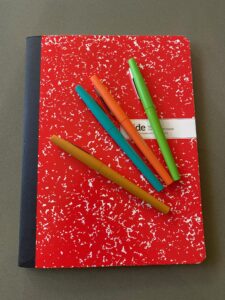
We began with lots of  writing exercises. They were quick – less than five minutes for each prompt – and hand-written in notebooks. (I also brought a set of thin colored markers to make the writing more fun.) Apparently, this fast-paced format was crucial to unlocking the most visceral of memories; experiences that had a dynamic emotional impact on our lives and lurked just below the surface. I was amazed at what I remembered. Detailed anecdotes that had been  buried inside me for years, even decades, were waiting to burst forth.

Many of the prompts Andrea used in the workshop came from the New York Times writing list “650 Prompts for Narrative and Personal Writing”: https://static01.nyt.com/images/blogs/learning/pdf/2016/650promptsnarrativewritingLearningNetwork.pdf. This list includes everything from Overcoming Adversity to Animals and Pets to Meals and Food and Friends and Family. It’s a fabulous resource for jump-starting your creativity.

So what gems did I uncover as I scribbled pages and pages of my memories in green, orange and turquoise? There were detailed descriptions of my family, my childhood neighborhood, the ins and outs of friendships over the years, favorite foods, games, family trips, toys, sports, hobbies, school experiences, and impactful teachers. Many memories focused on my mother who was the child of Hungarian-Jewish immigrants and a first-generation American. She was clearly determined to expose us to a myriad of experiences. These included a wide variety of sports, all the arts, warm family gatherings, musical holiday celebrations, delicious foods with a Hungarian twist, and a strong emphasis on doing well in school.

I also discovered hidden memories about summer camps I attended, concerts I went to, friendship issues, boyfriends, my biggest successes and failures, and why fall is my favorite season.  Details about broken bones, having my tonsils out, visiting my mother-in-law every week in a memory care facility for three years, and how upset I am about gun violence in this country came pouring out of me. There were also many stories that revolved around raising my two sons and two golden retrievers here in Colorado.

After each prompt, we took time to share what we had written. Some people felt comfortable reading their entire pieces aloud, while others shared a quick synopsis. One thing became obvious from the get-go. These untapped memories were deeply rooted inside us and filled with emotion. Some stories made us laugh, while others caused us  to tear up. And some were not for sharing at all. Not yet. The memories were too raw. But Andrea encouraged us to use these  emotional memories in our stories whenever possible. She told us how she used her own family stories to create two of her most recent books: WATERCRESS (Neal Porter Books) and THE MANY MEANINGS OF MEILAN (Kokila). Her honesty and vulnerability were  inspirational. But she also said  you don’t have to write an autobiography to utilize these memories. You can integrate them into your settings, your characters’ flaws and  problems, and your plot points. It’s the use of  the emotional component of your memories that counts. This is what will keep your reader turning the page.

For me, the sharing of our stories was the most powerful part of the workshop. Everyone was so passionate about what they had experienced. And  that clearly included me. Because the next day, a fellow attendee emailed me, suggesting  I consider using one of the stories I told as my next book idea. And guess what? I’ve already created a detailed outline and written three chapters! That story was in me all the time waiting to be told and I hadn’t even realized it.

So dig in, fellow writers. Mine your brain for memories and start working on your next project. You never know what you might discover.

Other places to find writing prompts:

https://blog.reedsy.com/creative-writing-prompts/

https://thinkwritten.com/365-creative-writing-prompts/

https://www.writtenwordmedia.com/500-writing-prompts-to-help-beat-writers-doubt/

https://www.writersdigest.com/prompts

https://thewritepractice.com/inspiration/writing-prompts/

2 Comments

Filed under 2022, Caldecott Medal, craft advice, Main character, Motivation, Revision process, Uncategorized

What I’m doing now: Wrestling With Feedback

By Rondi Sokoloff Frieder

“I love that part!”

“Really? It didn’t work for me.”

Last summer, I attended “The Whole Novel Workshop” on the idyllic campus of the Highlights Foundation in the Pocono Mountains of Pennsylvania. I brought along a middle-grade manuscript that had been revised numerous times, and got ready to make it sparkle and shine.

Before we got started, one of our faculty members gave us an introductory pep talk. “Just so you know,” she began. “All of you will have to rewrite your books. This is why you are here. But don’t worry, you can do it.” Most of us had to be thinking the same thing: “Maybe some people have to redo the entire thing, but my book is amazing. It just needs a few tweaks and a bit of trimming.” To this I now say, LOL!

Despite my overconfidence, I decided to open my mind to possibility. I listened to the suggestions of my Brain Trust partners and marveled at the insights of our well-published faculty. I threw myself into the writing exercises that revealed twists and turns I hadn’t considered. I reworked my plot. I played around with present vs past tense. And most importantly, I thought long and hard about the crucial themes in this story. What did my protagonist really want?

When I got home, I continued the work. I eliminated unnecessary characters (at least four), I changed the personalities of two of my secondaries, and enhanced components of the story that would make it funnier. Then, after months and months of revising, I gave this new draft to my always brilliant SCBWI critique group, The Story Spinners. My husband and son also volunteered to read the book, and I sent ten pages and a synopsis to an agent who was doing critiques at the RMC-SCBWI fall conference. The book was definitely stronger, but there were new elements that needed to be evaluated. I was too close to the story to know if they were working. While I waited for my readers to plow through the manuscript, I threw myself into another project.
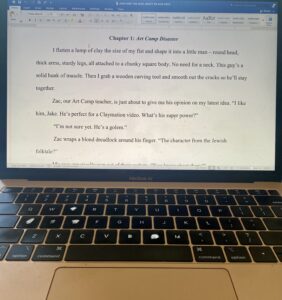

A month later, the feedback began to roll in. And while there was a great deal of consensus, my readers also had conflicting responses. This was when the “wrestling” part of the revision process set in. Who should I believe?

This is the nature of critique. Some comments will be subjective while others will be quite valid. Here’s the rule of thumb: if something in your manuscript is bothering three or four readers, you must consider making the changes. But, if you really want to keep this section in your book, you must make it stronger. For example, one of my critique partners loves when my main character hears his deceased great-grandfather’s voice in his head. But another reader said it didn’t add anything to the story and that I should cut it. I wrestled with the possibilities. Hmm, what to do? Well, I also love the voice of the great-grandfather. Only this feedback let me know that if I want it to stay in the book, I need to amp it up and make it a more integral part of the story.

There were also sections of the book that were flagged by a reader who had a particular expertise. My sporty son said one of the baseball scenes was unrealistic. Another said a parade would never be in the late afternoon. They both had very good points. I fixed both of these things immediately.

But the most important thing I did as I “wrestled with feedback” was to put the manuscript aside. I did not begin revising for two long weeks. I let my readers’ notes roam around in my subconscious and take shape. I also took a lot of deep breaths! Because getting feedback on your creative work can be extremely overwhelming and downright discouraging. Taking a break from the “noise” helped me get back to work with a more positive outlook. I was also more open to making the changes I was resistant to when I first heard them.

Eventually, I was ready to dig in. I pulled up the line edits and read each and every one. I considered all the possibilities and made choices. I finished the revision. Then I sent it off to one more trusted reader – a person who has not read the entire book. He will see it with fresh eyes. Some of his comments will resonate, some will not. I will wrestle with this. Because this is what writers do. We write, get feedback, and rewrite. And as the author who coached us at Highlights said, I CAN do this. And so can you.


6 Comments

Filed under 2022, craft advice, critique, Motivation, Revision process, Rondi Frieder, What I am doing now

Revising OUT LOUD!

By Rondi Sokoloff Frieder

Ever since I made the decision to become a serious writer, members of my family have asked me to edit their writing projects. I have said yes to college essays, business presentations, and even a Master’s thesis. But before I ever agree to do this, I always require the writer use one important self-editing tool – they must read their work out loud! They can read it alone in a quiet room or give a dramatic performance for the dog. It doesn’t matter, as long as they do it. This may sound like a common revision strategy to those of you who have been writing for a long time. But believe me, many people skip this step.

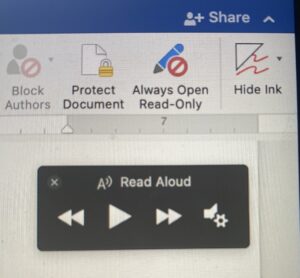
You can begin by reading whatever you have written out loud to yourself. It’s amazing how helpful this is, particularly for creating snappy dialogue and getting rid of repetitive words. You should also record yourself using the Voice Memo app on your phone and then listen back. I use this for first pages and sections with high tension. If you are writing a picture book, listening to yourself read the manuscript  will give you a good sense of rhythm, flow, and word choice.

It is also helpful to have someone from your critique group read your story out loud to you. This will help you hear how easily the book can be read by a parent, teacher, or child. But if you are writing something longer, you may want to have your computer read to you.

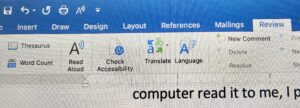
That’s right, your computer can read!  If you use “Microsoft Word,” this tool can be found in the “Review” section. Just click on “Review” and look for the “Read Aloud” icon in the top menu bar. Most versions allow you to adjust the speed and gender of the voice. I must warn you though, the voice of this reader is quite flat. There will be no emotion expressed, except for a slight shift when the computer comes to a question mark. If this monotone voice annoys you, there are other programs that have more versatility. My son recently bought one called Speechify. Speechify gives you the choice of a variety of voices and accents and has a much more human tone.

Despite its lack of intonation, I find the Microsoft Word “Read Aloud” feature surprisingly helpful. My middle grade novels range from 40,000 to 60,000 words. It would be almost impossible to have another person read an entire book out loud to me. And when you read to yourself, you miss things. Your brain is ahead of your voice and you are much more focused on plot, rather than word choice and repetition. I just finished having my computer read my latest WIP  before sending the manuscript out to my critique group.


Here’s what happened:

  1. I eliminated 4,000 words. Seriously, 4,000!!!! Many were words I used too much throughout the manuscript, or used too many times on a page. The biggest culprits were: I mean, that, you know, today, right, around, about, on, up, down, back, really, but, pull, nod, smile.
  2. I got rid of unnecessary sentences. One of my worst habits is saying something is going to happen and then have it happen. The actual action is almost always enough.
  3. I got rid of entire paragraphs that DID NOT move the story forward. These were often over-descriptions of a setting or character, or a conversation that went on for too long.
  4. I omitted adjectives, especially colors, sizes of things, and over-descriptions of food.
  5. I tightened up punctuation,  eliminating and adding commas, and getting rid of exclamation points!!!!

I also added things:

  1. I enhanced emotional reactions to action, but made sure they were not overly physical.
  2. I added details that clarified information for the reader. Sometimes, these things were in my mind, but not on the page.
  3. I made sure that changes to the story were consistent throughout the manuscript, especially when I eliminated characters.
  4. I added small words that I had accidentally left out, particularly a, the, in, on, to.
  5. This story used to be in past tense, but I switched it to present. When the computer read it to me, I picked up on places I missed making the changes!

As you probably know, this is not the final version of my book. I will be getting another round of feedback from my critique partners in early July.  And after I review their comments, and input the suggestions that resonate, the dog and I will settle back into my studio and have that Microsoft Word lady read the book to me again . OUT LOUD, OF COURSE!

Authors note: I used the “Read Aloud” feature for this blog!

9 Comments

Filed under 2022, Computer tricks, craft advice, critique, Revision process, Rondi Frieder, WORD NERD