
Category Archives: Picture Books

RESEARCHING AGENTS: LEARNING AND MORE LEARNING!

Research, research, research. I have been doing lots lately. I’m in search of agents to query. This isn’t my first time. But yay me! After years of practice, I have become a quick-study combing through online resources: Manuscript Wish List (MSWL), QueryTracker, PublishersMarketplace, AgentQuery, Reedsy Marketplace, agent websites, interviews with agents, etc. Researching agents is being a detective – double-checking information; sleuthing for key words and phrases to find ones that fit the theme, plot, voice and vibe of my picture book and young adult novel; and running through agent’s social media posts.

One thing has stayed the same. It’s very tedious work. Very!! And there is no short cut. But I am always learning, especially when I see unfamiliar words and phrases on MSWL Some I need to know; others pique my curiosity. So, I thought I would share my latest “glossary.”

AYKB – Stands for “As you know, Bob…,” a technique writers often use to reveal important background information without taking readers out of the story.

BAME – Stands for Black, Asian, Minority Ethnic (writers).

Complex dynamics – Can mean complex characters or dynamic relationships between characters. When creating “complex dynamics,” here are tips for creating your characters: Find out what matters to them. Free write, play with characters to understand their complexities. Explore their backstory. Use characters’ surroundings to develop them.

Dark academia – Set in an elite school with old, crumbling gothic architecture, a dark library, eerie common rooms. Students wear uniforms and enjoy discussing art, literature, philosophy. Typically, there is one group of students that set themselves apart – by choice or through prejudice. Recommend: THE RAVENS (series) by Kass Morgan.

Dead genres – In the words of an agent, “I want the genres everyone says are dead. There is absolutely still room for ‘dead’ genres.”

DEAI – Stands for Diversity, Equity, Accessibility, and Inclusion.

Epistolary novel – Fiction written in the form of letters or other documents, such as emails, journal entries, texts, etc. Recommend: YOURS FROM THE TOWER by Sally Nicholls

Escapism – Stories with big characters, high stakes, and ideally, a happy ending. Recommend: DRAGONFRUIT by Makiia Lucier.

Fabulism –Stories that have fantastical elements entwined with the everyday perfectly ordinary – and don’t explain why. Recommend: THE ASTONISHING COLOR OF EVER AFTER by Emily X.R. Pan.

HEA – Stands for Happily Ever After.

Head hopping – When a writer hops between different characters’ perspectives (“heads”) within the same scene.

Intersectionality – Describes the way people’s social identities can overlap. Coined by Columbia law professor Kimberle Crenshaw: “It’s basically a lens, a prism, for seeing the way in which various forms of inequality often operate together and exacerbate each other.”

LitRPG – Stands for Literary Role-Playing Games, a genre combining the conventions of computer role-playing games with science fiction and fantasy novels. Recommend: Clan Dominance: The Sleepless Ones 1 by Dem Mikhailov.

Lower YA – category of young adult fiction aimed at ages 11-13. Typical elements: 1) Likeable protagonist with hints of heavy family topics/issues. 2) Mostly happy, resolution filled ending. 3) High school setting and first love type romance. Recommend: LUCKY IN LOVE by Kasie West.

Middle YA – category of YA aimed at ages 14-16. Typical elements: 1) Traumatic protagonist backstory. 2) Protagonists have a clear identity outside of their family. 3) More diverse, dynamic supporting characters. 4) Romantic relationships with more intimacy and meaning. Recommend: THE NAMES THEY GAVE US by Emery Lord.

Upper YA – category of YA aimed at ages 17+. Typical elements: 1) Protagonist out of high school or close to graduating; navigating post high school life; could be living on own. 2) Deeper introspection of protagonist’s flaws, strengths, wants. 3) Higher stakes and consequences for protagonist’s actions, decisions. 3) Romantic relationships with physical intimacy and/or focusing on long term. Recommend: THE REAPPEARNCE OF RACHEL PRICE by Holly Jackson.

Message novels – The author has a specific agenda – a message. Written to specifically promote an idea or concept.

Mirrors, windows and sliding glass doors – Dr. Rudine Sims Bishop, known for her groundbreaking research and advocacy for diversity and representation in children’s books, pioneered the concept that all readers must experience “seeing” themselves (mirrors), different perspectives (windows) and “stepping into” the experiences of others (sliding glass doors).

Selkies – Mythological creatures from Scottish folklore. They shapeshift between seal and human forms by removing or putting on their seal skin. Recommend: TIDES by Betsy Cornwell, SEVEN TEARS INTO THE SEA by Terri Farley.


Mind-boggling? Sure is. Every phase of writing is mind-boggling. But I keep soaking up support, like the recent advice from one of my author-mentors: “Work hard, work harder. What comes will come.”


5 Comments

Filed under Agents, Karen McChesney, Main character, Marketing, Motivation, Persistence, Picture Books

Storytime, Early Literacy, and Bells. Oh My!

Most of us have heard of the Caldecott and Newbery medals – children’s book awards that have been around for, well, a VERY long time. But have you heard of the CLEL Bells? No? Take a seat, I’ve got a story to tell.

I’ve been a librarian, as of this summer, for 25 years. And in those 25 years, my job has changed quite a bit – in good ways and bad. But one incredibly satisfying way in which it’s changed is in the way children’s librarians view their work. While we still work hard to connect children with the right book at the right time, and help them grow a love of reading through storytime, we recognize now that our work goes beyond that. And a big reason for that shift in thinking came with the advent of Every Child Ready to Read.

Every Child Ready to Read (ECRR) is a framework created in the mid-2000s in a partnership between the Public Library Association and the Association of Library Service to Children (both divisions of the American Library Association). Using the most current research available at the time, it focused on how libraries could (and did) empower parents and caregivers to help their children get ready to learn to read later on. It helped librarians understand how the activities we did every day in our storytimes helped build early literacy skills, and gave us the language to talk to caregivers about these skills and how to encourage them at home.

It was a shift that wasn’t easy for some librarians. Storytime had always been about THE BOOKS, primarily. And while reading stories continued, now many of us were incorporating early literacy “tips” into our programs that explained more of the WHY we do what we do in storytimes: Why songs and movement were important learning tools along with books. Why we ask questions as we read stories. Why we don’t expect the children to sit quietly the whole time. How all of these things are building language skills and vocabulary knowledge and brain connections. Breaking this “fourth wall” and speaking directly to the parents was hard for many, but most of us practiced and got used to it. Because we know, WE KNOW, that this is important. The work we do was, and is, helping children get ready to read.

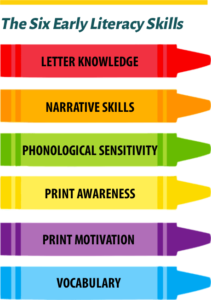
The first iteration of ECRR described six skills that young children needed to develop in order to make learning to read easier. They were:

  • Print motivation – loving books and reading, and therefore being motivated to learn to read;
  • Print awareness – understanding that print is all around us and is used for many purposes (in books, on signs, lists, letters,
    etc); knowing how print works (in English we read left to right, top to bottom);
  • Narrative skills – understanding how stories work (beginning, middle and end) and being able to tell stories and retell/describe events and make predictions;
  • Vocabulary – knowing lots of words!
  • Letter Knowledge – recognizing letters and knowing their names and sounds;
  • Phonological Awareness – being able to hear and play with the smaller sounds that make up words, like letter sounds and rhymes.

The second iteration, recognizing feedback from a lot of librarians that said that sharing terms like “phonological awareness” with parents felt… inauthentic (read: a little too highfalutin’) when we were trying to let parents know the simple benefits of singing with one’s child, turned the six skills into 5 practices that librarians could encourage caregivers to do with their children at home to build early literacy skills – all of which are things we do in storytime. The 5 practices are:

  • READ. Seems obvious, doesn’t it? But really, there is nothing better for building a future reader than reading or sharing books with them.
  • TALK. Recent research has shown how vital conversations are to growing a young child’s brain. They are learning language, how to communicate, vocabulary, social-emotional skills, and so much more.
  • SING. Not only does singing promote phonological awareness, but it also develops memory skills and grows vocabulary and language.
  • WRITE. Here it doesn’t mean just working with crayons and pencils and words. It means growing fine motor skills that allow us to hold a crayon or pencil. It means understanding that writing is used for more than just books, it’s also used to communicate in lists, signs, letters, and more.
  • PLAY. Children learn best through play, and that includes learning skills they can use when later reading – like building their imaginations, background knowledge about the world, and vocabulary.

One outgrowth of this shift was the creation of Colorado Libraries for Early Literacy (CLEL) which I had the good fortune to be involved with from its inception. Born in 2008, this organization, sponsored by the Colorado State Library, seeks to support libraries and librarians across Colorado in our work with young children and families. The organization has grown by leaps and bounds and now includes an annual conference attended by librarians many parts of the country.
One of the things CLEL realized in our early years is that nobody was recognizing books that were particularly good at supporting early literacy skills growth. As the center of storytime remains the book, CLEL wanted to create an award that would do just that. And the CLEL Bell Awards were born.

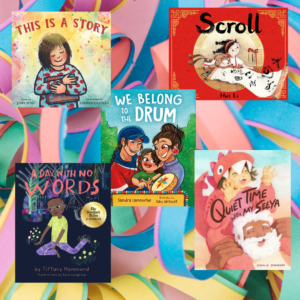
The CLEL Bells are an “annual recognition of five high-quality picture books that provide excellent support of early literacy development in young children.” There is one for each of the 5 practices above – READ, TALK, SING, WRITE and PLAY. Additionally, the committee creates an activity sheet to go along with each book to extend the learning. And without further ado, the 2024 winners, announced just a couple of weeks ago, are:

READ: This is a Story by John Schu and Lauren Castillo

TALK: A Day With No Words by Tiffany Hammond and by Kate Cosgrove

WRITE: Scroll by Hui Li

SING: We Belong to the Drum by Sandra Lamouche and Azby Whitecalf

PLAY: Quiet Time With My Seeya by Dinale Dabarera

The award has been in existence 10 years and all of the past winners are listed on the website, along with their activity sheets. In the first year the award committee, which I got to be a part of, also selected 25 “Silver Bell” awards to recognize 5 books in each practice category published in the prior 25 years.

Go check out these amazing picture books – and share with your little ones!

2 Comments

Filed under Awards, Best Books, Early Literacy, Mary Kuehner, Picture Books

Is that REALLY what’s happening? Unreliable Narrators in Picture Books.

I realized recently that two of my manuscripts have unreliable narrators. One is a “voice over”-type style, describing what’s (not actually) happening in the action on the page, and one is also omniscient but instead describing a character incorrectly. That character happens to be a potato, but that’s neither here nor there.

It got me thinking about this type of story and what other picture books have unreliable narrators. I really gravitate toward this kind of storytelling, because it’s often funny and can make for a great read-aloud. Kids LOVE correcting the reader and having the opportunity to feel like, for once, they know more than the adult.

An unreliable narrator can be an omniscient voice, but it can also be a character in the story – main protagonist or not. They can be unreliable for malicious or devious reasons, for silly reasons, or simply because they’re just wrong or don’t know any better. The thing they all have in common is that they cannot be trusted to give the full, correct picture of what’s happening.

So, without further ado, here are some of my favorite picture books with unreliable narrators:

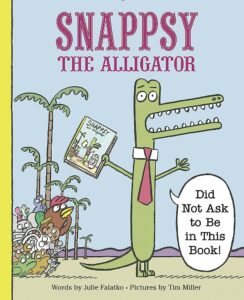
Cover image of the picture book Snappsy the Alligator Did Not Ask to Be In This book, an aggrieved alligator holding a copy of the same book with a chicken looking on.

Snappsy the Alligator Did Not Ask to Be In This Book by Julie Falatko and Tim Miller

An unreliable narrator (a chicken) follows Snappsy around describing things that Snappsy is decidedly NOT doing – like hunting defenseless bunnies or buying snacks for a party. Snappsy gets more and  more exasperated as he just wants to live his life, quietly.

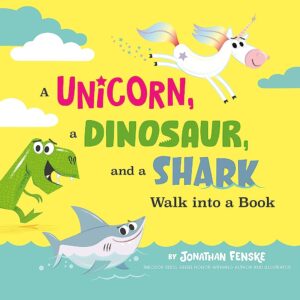
A Unicorn, a Dinosaur and a Shark Walk Into a Book by Jonathan Fenske Cover of the picture book A Unicorn, a Dinosaur and a Shark Walk Into a Book. Yellow with cartoon images of the three main characters.

No, it’s not the start of a joke, although the book is seriously funny. The narrator tries to get the three creatures to make this the BEST BOOK EVER (I mean, c’mon, what’s better than a UNICORN, a DINOSAUR and a SHARK in one book) but they won’t do what that narrator asks. How will the narrator convince them?

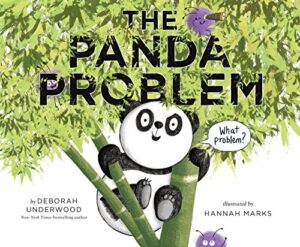
Cover for the picture book The Panda Problem featuring a friendly panda perched in a bamboo stand.The Panda Problem by Deborah Underwood and Hannah Marks
As the narrator explains to us right at the start, every good story has a problem. And, in this book, they insist, the panda is the one with the problem. Panda begs to differ. The narrator insists that the story must have a problem, though, so panda tries to invent some.

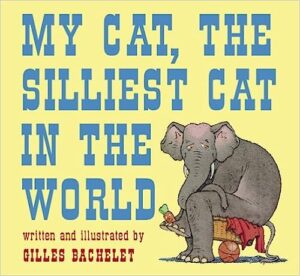
My Cat, the Silliest Cat in the World by Gilles BacheletCover of the picture book My Cat, the Silliest Cat in the World. The cat is actually an elephant.

The unseen narrator describes their silly cat, which, as one can clearly see from the book’s cover, looks suspiciously like an elephant.

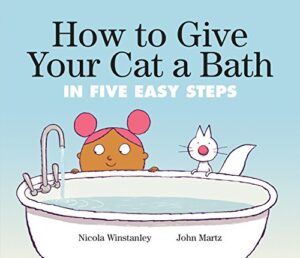
Cover of the picture book How to Give Your Cat a Bath in Five Easy Steps. A girl with afro puffs and a white cat look over the edge of a bathtub filled with water. How to Give Your Cat a Bath in 5 Easy Steps by Nicola Winstanley and John Martz

Anyone who has a cat knows there’s nothing easy about giving a cat a bath. Yet, the narrator insists it can be done, while the hapless child becomes increasingly frustrated as she tries, and fails, to get her cat into the bath.

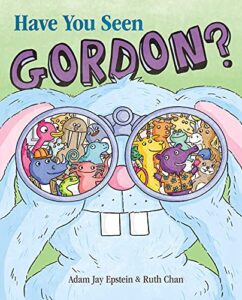
Cover for the picture book Have You Seen Gordon? A rabbit looks through binoculars and we see a crowd reflected in them.

Have You Seen Gordon? by Adam Jay Epstein and Ruth Chan

So, okay, this is cheating a little because in this story the narrator isn’t unreliable as much as the main character, Gordon, is uncooperative. This is ostensibly a seek-and-find book, but Gordon refuses to make himself hard to find. He prefers to stand out.

These are just a few of the picture books with unreliable narrators that are in the world. Which ones do you love? Sound off in the comments so we’ve all got a great list!

3 Comments

Filed under Mary Kuehner, Picture Books, Uncategorized

Go Writers, Go!

It was a writer’s dream. That’s how I felt at the recent grand opening of Lighthouse Writers Workshop new building. I was with over 500 other writers in the stunning, custom-built, cozy three-story building designed just for writers. Just for writers!
“We want this to be your home,” said Co-Founder and Director Michael Henry. And, we want it to be a place where writers of all ages, levels, backgrounds, genres come “hang out and write,” added Andrea Dupree, Co-Founder and Program Director.

What could be better? That night, when I left this writer’s paradise, I was riding high. High on great gratitude.

Gratitude for:

-living in a city that has invested in Lighthouse and writers

-living in a state with an incredibly supportive kid-lit writer community

-getting to teach youth at Lighthouse

-my awesome writer critique group, Story Spinners

-SCBWI-RMC

-my writing groups: Young Adult writers, NaNo writers

-my Monday accountability group

-my super supportive husband and friends

-my manuscript exchange partners

-my two late aunts who modeled creative follow-your-dreams living

Wow, I have been incredibly fortunate to have many, many cheerleaders on this crazy journey of querying picture books and revising young adult novels. At the grand opening, one author-speaker reminded, “writers need other writers, create your community.” I am immensely proud that I have created my writer community. And it keeps growing! I have great cheerleaders. Best of all, they have shown me how to be a cheerleader; they have inspired me to make time and show up for other writers.

In that spirit, I decided to share some of my favorite cheers from other writers. I keep them in a notebook and glance at them often, especially when I get a bad case of imposter syndrome. These words give me courage; remind me to have fun; renew my “I can do this.”

May these comments cheer you on, too.

For imposter syndrome: Before writing, take a few minutes to jot down what you’re thinking. Your doubts, your insecurities. Spit ‘em out! Then, write your goal for your session, such as word count, number of pages. At the end of your session, write down what you did.

 Congrats on doing the hard work on your YA. It’ll pay off. Sometimes you just have to plough through the hard stuff.

What an achievement! I am so proud and inspired by your achievement of finishing another revision.

Did you sign on yet for film rights for your book?!!!! I can picture it as a movie.

You hooked me with your pitch. I want to read it!

You sound very clear on your intentions for your YA. Get your story out there!

Hip, hip hooray! I know you’re passionate about this story and I applaud you for sticking with it. This is very hard work!

Aim to send 100 queries. I got my agent on query 101.

It doesn’t matter how long it takes you to finish. What’s most important is that you are staying with the hard work.

Here’s to being cheerleaders and having cheerleaders. Go writers, go!

Lighthouse Writers Workshop is the largest literary center in the Rocky Mountain West. They offer writing instruction, workshops, events, and support for writers of kid-lit, fiction, nonfiction, poetry, and many other genres. New location: 3844 York St., Denver CO 80205. For more information: Lighthouse Writers Workshop |


4 Comments

Filed under 2023, Agents, craft advice, critique, Karen McChesney, Literacy Program, Motivation, PBParty, Persistence, Picture Books, Revision process, RMC-SCBWI

QUERY, REVISE, REPEAT

If you glanced at my weekly calendar, you would see time blocks for Research Agents & Query and for Revise. In my weekly goals, I note the number of queries along with the number of pages that I plan to revise. Time blocking makes me show up. Of course, life gets in the way (and I let it!), but I’m proud to report that I have had better-than-ever attendance the past four months. I suspect it’s because sending out queries while deep in the messiness of revising keeps me on my creative toes. Doing both reminds me: I am a writer, I can do this.
Every time I send off a query for my picture book, I feel a loud “YES!” in my writer bones. Yay, my story is out there. And so is my sweat. Each word contains years and years of being turned upside down and inside out. Eventually, I may have to revise my manuscript again. Ugh! I don’t think about that though. I’d rather celebrate that it’s done. For now, it feels great to finally send off 500 words that I care the world about.

Every time I finish revising pages of my YA novel, I feel a huge “I did it!” When a whimper of “I wish I got further” creeps in, I give myself a “you got this!” Yay, my revising is getting there, as I cut, re-arrange, rewrite and enjoy an occasional epiphany when I carve out a new scene or one sentence flows smooth and crisp. It feels great to be close to the finish line of 80,000 words that I think about day and night.

Querying and revising balance my writer mojo. They are yoga. Querying is me following my teacher’s specific instructions. Revising is me slowly sinking into the pose, adjusting my feet, tweaking the shape of my hand, remembering to breathe, and challenging myself to stretch longer, further till gradually, my body does something I never knew possible. Just like my characters do when I follow them. Just like my story flows when I remember to breathe!

Undoubtedly, querying is a refreshing change of pace and motivates me to stay in the revising trenches.

-It’s concrete and point-blank – a healthy break from the land of fiction.

-Researching agents keeps me tuned in to this crazy industry.

-Learning. Helps me update my package for my YA novel (logline, pitch, synopsis, etc.).

-Gives me a sense of completion amid day-after-day plowing through revision.

-Amps up my writer confidence.

Querying is baking. The don’t-deviate exactness of baking pushes me to diligently concentrate, the same way that I follow submission guidelines to a tee. I go to hyper focus mode to get everything right. Recently, for example, an agent’s instructions said to attach picture book manuscripts. I re-read that line several times. Because? All other agents have stated, NO attachments. I do the same when I bake. I re-read each step to make sure I use a teaspoon vs a tablespoon, baking soda vs baking powder, whisk in vs stir in… Like querying, reading baking instructions works my brain muscles. But, what a thrill to pull my cake out of the oven. It’s done. I feel that way after I send off another query. It’s done. Yes, a rejection is a cake gone wrong. It burns me. But, I get to bake another. I get to send out another query. Afterall, I must reach my goal.

Revising is cooking. I prefer cooking, because I get to invent, combine, add another spice and research (what’s a Lepiota mushroom?). I love revising recipes – cutting, adding, switching spices and ingredients… Just like revising my YA. Letting myself play and experiment keeps me energized. For instance, I’ve relied on freewriting dialogue to take my secondary characters from flat cardboard to three-dimensional humans. I’ve resorted to longhand to rewrite highly emotional scenes. My pen makes me slow down the rolling-boil action and grant my character a chance to sit on simmer. What a joy to sit with my characters! I feel that way when I finish cooking, especially a soup that’s simmered all day. Yes, some soups have no zing, just like so many of my sentences.  But, I always return to my writing recipe – Beat Sheets, notes and my synopsis – to stay on track. Then, it’s back to the keyboard. Afterall, I must reach my goal.

Juggling querying and revising doesn’t make this whole writing thing any easier. It’s such hard, hard work. Juggling feeds my creative longing and insatiable curiosity – and by gosh, it gives me hope!


Over time, juggling would come to seem slower.  You are doing it.  –Heather Wolf, juggler and author, Birding at The Bridge: In Search of Every Bird on the Brooklyn Waterfont


3 Comments

Filed under Agents, craft advice, critique, Karen McChesney, Main character, Motivation, Persistence, Picture Books, Revision process, What I am doing now

My Best of 2022-ish.

Hello friends! Last year I put together a post of some of the picture books I was looking forward to in 2022. There were a LOT of them. Well, now that the year has ended, I thought I’d follow through with some of my favorites of the year… and a half. Yes, some of these came out in 2021 but most were 2022, and I read them all in 2022. Since I read PBs AND other books for kids, I thought I’d include some of my fave early readers, graphic novels and middle grade books as well. This list is by no means exhaustive – while I WANT to read everything on my TBR or every new PB that comes out, I miss A LOT. Time, friends, is fleeting. 

PICTURE BOOKS:

Anzu the Great Kaiju by Benson Shum. Are you familiar with Kaiju? Think Godzilla. But this little guy, rather than being scary, is quite sweet. 

Bathe the Cat by Alice B, McGinty and David Roberts. A family, some chores, and a naughty cat with access to the refrigerator alphabet magnets. 

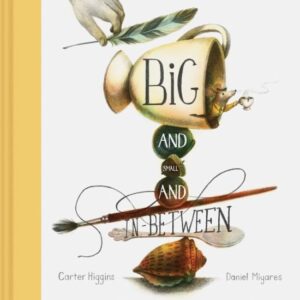
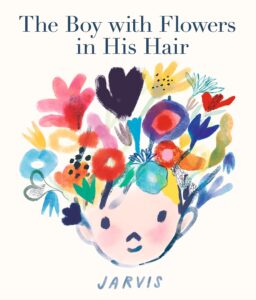
Cover of the picture book The Boy With Flowers in His Hair by Jarvis. The head of a boy with flowers growing from it is shown on a plain white background. Big and Small and In-Between by Carter Higgins and Daniel Miyares. I could spend hours with this book. So much to ponder, and gorgeous illustrations. Would make a great writing prompt book! 
The Boy With Flowers in his Hair by Jarvis. Simple, quiet, and loving. A boy with (really) flowers in his hair begins to lose them. His best friend comes up with a solution to support him until they grow back. 

Color the Sky by David Elliot and Evan Turk. Birds, rhyme, and flowing color. 

Don’t Eat Bees: Life Lessons from Chip the Dog by Dev Petty and Mike Boldt. Chip the Dog knows what’s up. This is hilarious and will resonate with dog owners everywhere. 

Dress-Up Day by Blanca Gomez. Gomez’s illustrations remind me of Christian Robinson so I therefore love them. A little girl misses dress-up day in her classroom so decides to wear her costume the following day – with surprising results. 

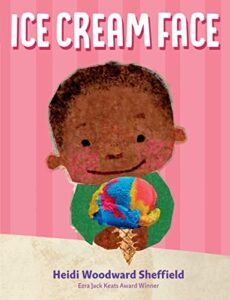
Cover of the picture book Ice Cream Face by Heidi Woodward Sheffield. Illustration of an African-American boy holding an ice cream cone in front of a pink background.Everybody in the Red Brick Building by Anne Wynter and  Oge Mora. Everyone is awakened by a series of noises in the red brick building. 

A Grand Day by Jean Reidy and Samantha Cotterill. An ode to a day with the grandparents. 

Ice Cream Face by Heidi  Woodward Sheffield. A boy experiences many emotions while waiting in line to get ice cream. 

I’m Hungry!/¡Tengo Hambre! by Angela Dominguez. Dominguez writes THE BEST simple, toddler-friendly bilingual stories. A Spanish-speaking tiny dino communicates with an English-speaking bird in order to get something to eat. 

It’s So Quiet: A Not Quite Going-to-Bed Book by Sherri Duskey Rinker and Tony Fucile. Mouse can’t sleep because it’s TOO quiet. Well, not for long! 

Like by Annie Barrows and Leo Espinoza. We are more alike (and still different) than we think.

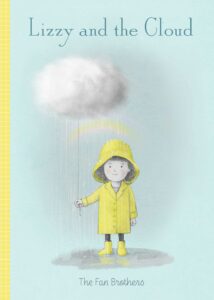
Cover of the picture book Lizzy and the Cloud by the Fan Brothers. A girl in a yellow rain slicker stands holding a floating cloud on a leash.

Lizzy and the Cloud by the Fan Brothers. A little girl buys a pet cloud in the park – the have lots of fun, until the cloud outgrows her.

Miguel’s Community Garden by JaNay Brown-Wood and Samara Hardy. Book 2 in the garden series! Great for building background knowledge. Help Miguel find the sunflowers in his garden by comparing what we know about sunflowers to the things that we find growing!

Read Island by Nicole Magistro and Alice Feagan. Take a magical trip to the land of stories!

Swim, Jim by Kaz Windness. Jim is an alligator, so he should not be afraid to swim, right? Well, he’s NOT afraid of swimming. He’s afraid of SINKING. Will he find a way to overcome his fear?

Where is Bina Bear? by Mike Curato. This warmed my introvert’s heart. Bina Bear wants to be at the party to support her friend, but also… she doesn’t want to be there.

Wonder Walkers by Micha Archer. Take a walk and wonder about the world around.

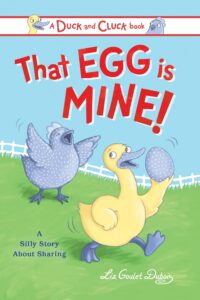
EARLY READER:Cover of the book That Egg Is Mine! by Liz Goulet Dubois. A blue chicken chases a yellow duck who is holding a spotted egg.

Duck and Cluck: This Egg is Mine! by Liz Goulet Dubois. Sadly, Goulet Dubois passed away this year, not long after her debut early reader was released. This is a fun, sweet story about two friends fighting over an egg they find. Perfect for those just finding their reading feet. Is that a thing?

GRAPHIC NOVELS:

The Aquanaut by Dan Santat. A girl who lost her father at sea is visited by a mysterious… creature? Are they bringing her a message from her dad?

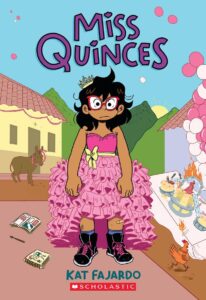
Cover of the graphic novel Miss Quinces by Kat Fajardo. A disheveled girl wearing a fluffy pink dress and combat boots.

Garlic and the Vampire by Bree Paulsen. An anthropomorphized garlic, who lives in a vegetable town overseen by a witch, makes a dangerous trek to visit a vampire who has moved into a nearby castle. No, it’s not scary at all – it’s sweet.

Miss Quinces by Kat Fajardo. Sue would rather spend the summer at comics camp with her friends than have a quinceañera party. But her mom has different ideas – she will be spending the summer in Honduras visiting extended family and yes, she WILL have a quinceañera. Can Sue and her mom compromise?

The Tryout by Christina Soontornvat and Joanna Cacao. Can Christina make it on to the cheerleading squad – and survive her first year in middle school? Based on the author’s experience.

MIDDLE GRADE:

[It became clear to me as I put together this list that I mostly gravitate toward stories with adventure, magic, mystery and kids finding out they are not who they thought they were. Plus school stories.]

Amari and the Great Game by B. B. Alston. The second in the series. Not quite as good, but only because I loved the worldbuilding of the first and of course that didn’t need to happen this time. But still excellent, fun, and suspenseful.

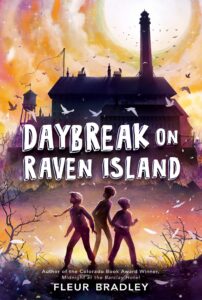
Cover of the middle grade novel Daybreak on Raven Island by Fleur Bradley. An old prison building is seen in silhouette with three silhouetted children standing in front of it. The sun is just coming over the horizon. Daybreak on Raven Island by Fleur Bradley. If you want a suspenseful, atmospheric, spooky story this is for you! Three kids get stuck on an island overnight – an island that just happens to be home to a long-abandoned prison that harbors a LOT of secrets.
A Duet for Home by Karina Yan Glaser. A girl, her mother and her sister move into an apartment in a shelter for houseless families. There she meets other kids like her, some who are new and some who’ve lived there for years. What will they do when the city decides to shut the shelter down?

Falling Short by Ernesto Cisneros. Isaac and Marco couldn’t be more different – one is tall and athletic, the other short and academic. This year, though, they each want to achieve what the other has, for different reasons. Luckily, they have each other.

Hana Hsu and the Ghost Crab Nation by Sylvia Liu. Hana loves to build bots and can’t wait to join Start Up and be connected to the whole world through a neural net. But when her classmates begin to get sick, she finds out being connected to everything might not be the dream she thought it was.

Hide and Geek by T. P. Jagger. Four friends try and solve the final puzzle of a local toymaker in order to save their town.

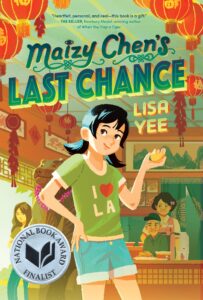
Cover of the middle grade book Maizy Chen's Last Chance by Lisa Yee. A young Asian-American girl wearing an I heart LA tshirt is holding a fortune cookie.

Hither and Nigh by Ellen Potter. A missing brother and a mysterious magic teacher. Are they connected? Nell’s going to find out.

Jennifer Chan is Not Alone by Tae Keller. One of the most compelling school stories I’ve ever read – about bullying and when it’s time NOT tofollow the crowd.

Maizy Chen’s Last Chance by Lisa Yee. Maizy and her mom spend the summer helping her grandparents out at the Minnesota restaurant they’ve had for years. Through an act of racist vandalism, Maizy begins to learn about her family’s history and secrets.

Onyeka and the Academy of the Sun by Tolá Okagwu. Onyeka’s hair is magical! That leads her to be enrolled in the Academy of the Sun where she discovers things are NOT as they seem.

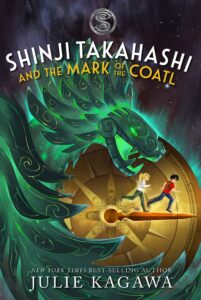
Cover of the middle grade book Shinji Takahashi and the Mark of the Coatl by Julie Kagawa. A large green coatl chases two children who are running across a compass. Shinji Takahasi and the Mark of the Coatl by Julie Kagawa. This reads like an Indiana Jones adventure – but with kids as the heroes.
Sisterhood of Sleuths by Jennifer Chambliss Bertman. For fans of Nancy Drew! While trying to uncover the truth about a photograph she finds, Maizy learns her grandmother might have been connected with the original author(s) of the series.

Sofia Acosta Makes a Scene by Emma Otheguy. Sofia’s family is all about ballet, and Sofia wants to be, too, but her real talent lies somewhere else.

Team Chu and the Battle of Blackwood Arena by Julie C. Dao. Two siblings are competitive about everything, especially laser tag. But when they discover a ghost within the game at the new arena, they have to work together to figure out what’s going on!

Those Kids from Fawn Creek by Erin Entrada Kelly. I will read anything and everything Entrada Kelly writes. This is, in my opinion, one of her best. It will surprise you.

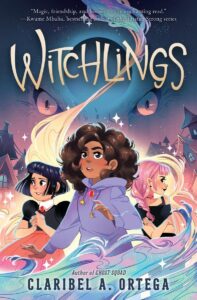
Cover of the middle grade book Witchlings by Claribel Ortega. Three girls look fearful standing in front of a menacing pair of eyes.Undercover Latina by Aya De Leon. Andrea comes from a family of spies, and is tasked with going undercover to befriend the son of a suspected white supremacist terrorist.

Valentina Salazar is Not a Monster Hunter by Zoraida Córdova. Valentina’s family gave up monster protecting (NOT hunting) when her father was killed. But now Valentina must convince them to join her on a quest to protect a magical egg that could wreak havoc on the whole world.

Witchlings by Claribel Ortega. Seven Salazar can’t wait to be placed in the coven of her dreams (with her best friend) and begin learning magic. When she’s not placed in a coven, and instead becomes a “spare,” she must take on an impossible task to prove herself worthy.

Happy reading, friends!

5 Comments

Filed under Best Books, Book Review, Early Readers, Graphic Novels, Mary Kuehner, Middle Grade, Picture Books

ODE TO REVISION

Revision.

You make me crazy!

“Explain,” you say.

You’re akin to blisters, pests, chores, and petty necessaries.

I have sweat and steamed over you,

rehashing plots, revamping chapters, recasting characters.

“Your point?” you ask.

Now, I am a fanatical, fervored writer

glued to my written mess.

Revision,

others warned

you would be a storm, thorns, and bricks on my brain!

“Why stay?” you say.

For those spectacular moments

when my story flows smooth as syrup

and sparks fill me,

singing “you can do this!”

And suddenly,

I’m a dancer, a bird, a shooting star, a perfect snowflake…

“Follow your characters,” you declare.

Exciting when I let them get into grand muck,

but then, I’m stuck in another written mess.

I breathe, cuss,

resume re-doing:

reorganizing scenes,

recalibrating action,

reconditioning description and dialogue.

Again.

Repeat.

Again.

Insane.

But my hope is refueled.

Alas, my main character has a new coat of conviction and chutzpah.

I can’t let her down.

Revision,

you’re a wild renovation that I can’t fully resolve.

“Congrats!” you say. “Resolving is for readers.”

Revision,

you wake me to characters in chaos,

off stowing secrets and lies.

Please give me a shortcut!

“Butt in chair,” you remind.

Revision,

my thick-skinned constant,

you make me crazy,

but I’ll keep my seat on your train,

wrecks and all.

Thank you.

Much obliged.

Appreciate you.


5 Comments

Filed under craft advice, critique, Karen McChesney, Main character, Motivation, Picture Books, Revision process, RMC-SCBWI

The Secret Agent Files: Notes about Agenting

By Susan Wroble

“Why,” asked a woman near me, “is it so very hard now to find agents who want to represent picture books? I can find plenty of agents for Middle Grade and YA, even for graphic novels and author/illustrator books. But finding one to come to our conference that represent author-only picture books is getting really tough.”

It was a great question, and was addressed to an industry panel during the Regional Team meeting of the Society of Children’s Book Writers and Editors in New York in October. Our chapter has the same problem. We have lots of members who write picture books, but finding agents who would be good fits for our conferences and who are also open to picture book submissions is hard.

The answer, of course, was money. Stacey Barney is an Associate Publisher at Nancy Paulson Books, an imprint of Penguin Random House. She explained that picture books simply make less money than other formats for everyone involved, including the agents. It doesn’t mean that you can’t find an agent for a picture book. It does mean—like so much else in this industry—that it takes persistence.

Writers often talk about their “training books,” the first books they wrote when they were learning the process. Almost always, those books are languishing in some file, never having made it to print. But Stacey talked about an entirely different set of training books as she explained the publisher’s ‘Rule of Three.’ “You start by buying a book you love,” she explained, “and you build up a good rapport with the author. By the time you get to their third book, you have established the author in this industry. The first and second books are like a training camp. They won’t be break-out best-sellers. With the third, the author has arrived.” That means that an author’s beloved debut novel—the one that finally made it to print after writing a few others—is, for the publisher, just the first of the training books. For me, that comment explained a lot about agents’ and publishers’ desires to help build a career, not publish one book.

A week later, I attended an agent panel put on virtually by SCBWI Metro New York that provided additional insights into the author/agent relationship. One question asked of each of the three agents (Saba Sulaiman at Talcott Notch, Linda Camacho at Galt & Zacher, and Eve Adler at Red Fox Literary) was how they got their clients. Surprisingly, meeting someone in person at a conference was low on each list. However, the majority of clients came in through the query inbox. The catch is that many agents are closed, with the only way to submit through attending a conference or workshop. So those conferences and events remain an essential way to reach agents.

Given that, it may seem that cost is a barrier to entry, but that isn’t necessarily true. The panel I attended was free. More than five hundred people signed up. And each of the agents who presented has opened their submissions to all attendees at the panel if they have works that fit.

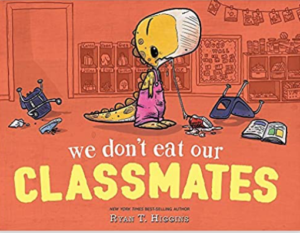
The panel’s moderator was Harold Underdown, Executive Editor at Kane Press and creator of The Purple Crayon website, a gold mine of information on children’s publishing. Harold asked the agents about recent developments in the industry, and the answer was fascinating… they recommended leaning into the weird. Specifically, they noted that neat genre categories are blurring. Saba Sulaiman noted that “there is a thirst for stories that blur genre, like a horror comedy. We want the weird!” Linda Camacho backed this up, saying that “there is a need for escapism, and a thirst for horror and for romance. Blurring genres tends to provide more avenues for creativity.” As an example of blurred genre in picture books, Saba recommended looking at Ryan T. Higgins We Don’t Eat Our Classmates. “It’s a totally unexpected dinosaur book, that funny, sweet, cute and is also a first day of kindergarten book.”
Harold also asked about tips and best practices in terms of searching for an agent. Some of the best resources are agency websites, SCBWI’s Essential Guide, Manuscript Wishlist, and Query Tracker. In addition, Saba recommended getting a short-term subscription ($25 for one month) or a limited subscription ($10 for a day) to Publisher’s Marketplace.  And then, she suggested, pay attention to the pitches. “It’s a great way to learn how to pitch a book.”

And that may be a great way to land one of those elusive agents!

3 Comments

Filed under 2022, Agents, Harold Underdown, Picture Books, RMC-SCBWI, Saba Sulaiman, Stacey Barney, Susan Wroble

Writing Alone, But Together

I’m done. No, not with my revising. Darn it. But, even better, at least from my birds-eye view: I’m done trying to feel like a writer and I am darn giddy to report that I no longer imagine suppose-to’s, like cozying up my studio or writing at coffee shops. No more! For the past few years, I have been a writer; I have kept my behind in a chair. Yes, I still slug through, mumble ugh, write total crap… Doesn’t matter. I am writing!

I know I’m not the only writer who has tried to feel like one. Maybe I’m growing up as a writer. Hear ye! Finally. Oh, I have a long, long way to learn. But I am saving a lot of time – getting right to writing, instead of fussing with lighting candles (great if helps you!). Now, I arrive at one of my favorite writing spots – my studio or kitchen table – and do my quick set-up: cups of java and water to left of laptop, paper and pen to right, blanket o’er my lap, timer set. By the way, my red-black plaid blanket is full of childhood stories from when I would use it to build forts, watch tv, trick ‘n tease with my brothers.

A brief trip back to those days… I always needed complete quiet to do my homework. I vividly, fondly recall high school nights – my brother Jim at one end of our long Formica kitchen table, me at the other. We read, took notes and penned essays in silence, while our dad was at his second job, our mom and youngest brother sound asleep, our oldest brothers away at college. Even though Jim was a quick study, whipping through homework while jotting social plans, he always checked in with me. It was as if he knew the exact moment I got restless, started daydreaming. “How ya doing, kid?” he would say. Whether I grumbled frustration or not a word, he would smirk, jump up and open the fridge. Message: Let’s take a break together.

Together. Today, I still need complete quiet when I write (and lotsa jumping up, taking breaks!) and to be with other writers. I prefer writing alone, but together. So, that’s what I’ve created for myself – being with other writers, being held accountable. Every week, I get and give plenty of “how ya doing?” check in’s and everyone is a-okay with a short answer or not a word. We’re sticking together.

Here’s my list of formal and informal sessions that keep my behind in my chair. There are plenty more, including for writers who prefer chatting, music, dogs barking, prompts… You go! My sessions – with strangers or writer friends – guarantee someone is at the other end of “the table” and we’re together writing in silence. And, I get to stay in my favorite spot! May you, too, find your table and whoever you need at the other end.

Virtual Sessions: Writers from across the globe, including many U.S. SCBWI members.

Writers’ Hour https://writershour.com/

3 times daily Monday-Friday

The Chicago Writers Circle meetup.com/The-Chicago-Writer-s-Circle

1 time daily Sunday-Saturday

My (Private) Writing Session:

Text Partner: I write with a long-time writer friend minimum twice weekly. We text at start and end. Revs my creativity and writing!

My Accountability:

  • Monday Morning E-mail: I exchange weekly goals and accomplishments with other children’s writers. Keeps me honest, nudges me.
  • YA Accountability Partner: Email and phone call meetings. Motivating!
  • Story Spinner SCBWI Critique Group: We meet twice monthly for feedback on manuscripts, query letters, ideas, outlines, research, etc. Can’t imagine writing without them!!
  • SCBWI British Isles Group: E-mail check ins. Inspiring!


I am writing the success of my every breath.
–Mahogany L. Browne, award-winning author of CHLORINE SKY and other YA novels, board books

I have never heard a more eloquent silence.

–Laurie Halse Anderson, award-winning author of SPEAK and other YA novels, picture books

3 Comments

Filed under 2022, craft advice, critique, Karen McChesney, Picture Books, Revision process, RMC-SCBWI

2022 Picture Books To Look Forward To – According to Me.

Hello friends!

In my non-writing life I’m a librarian and recently I had the opportunity to share with patrons some picture books I think will be standouts in 2022. I thought I would share those same picture books with you you! Some disclaimers first:

  • These are books a) I think will be big sellers and/or b) look cool or important to me. HIGHLY subjective.
  • I’ve only actually READ a few of them, so my assessment is based on the past successes/work of the authors and illustrators, the covers, and publisher summaries.
  • Most, if not all, of these will be published in the first half of 2022.
  • I’m sure I missed a lot of great books because while I looked at several sources it’s impossible to know EVERYTHING that is coming out in 2022. Also I only had 20 minutes for my part of the presentation so I definitely had to be selective. There were more on my list.

So, without further ado, my picks. Add yours in the comments!

BOARD BOOKS (Ages birth – 2)

  • I’m Up and I’m Still Up by Antoinette Portis 
    • Companion books about a baby who is… you guessed it, awake. With repeating words and shapes, this will be a regular read-aloud.
  • Puppy Dog, Puppy Dog What Can You See? by Amelia Hepworth and Pintachan 
    • You can’t go wrong with an interactive lift-the-flap! For babies and toddlers, this will be a sure hit. Ask the question and then look at the hints to guess before lifting the flap to see if you’re right. Includes a mirror at the end to even further involve your little one in the story! Others in the series are Ladybug, Little Hen, and Elephant 
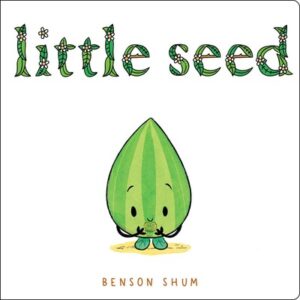
  • Little Seed by Benson Shum 
    • How cute is this? Little seed wants to hug the whole world! How do you hug a panda? An armadillo? 
  • My Nap/Mi Siesta and My Party/Mi Fiesta by Raúl the Third and Elaine Bay 
    • From the team behind the ¡Vamos! books we have this bilingual board book series featuring their character Coco Rocha who is, yes, a cockroach.  
  • First Morning Sun by Aimee Reed and Jing Jing Tsong 
    • Sharing your child’s milestones with rhyming text and beautiful illustrations. 
  • Boop the Snoot by Ashlyn Anstee 
    • What kid doesn’t want to be invited to “boop the snoot” of various animals? I might get a copy of this for myself, it looks so cute.  
  • Baby Bug by Wednesday Kirwan 
    • Baby bug explores the natural world and learns how to wiggle, roll and splash from her creepy crawly friends. The thick,dark outlines on the pictures make this a great book to share with babies under 1 whose eyesight is still developing!  

BOOKS FOR TODDLERS (Ages 1 – 4)

  • Little Pups in Big Trucks by Bob Shea and Brian Won (Adurable series) 
    • This is a new series by two book creators I love, Bob Shea and Brian Won. These puppies are just beginning puppy school. But when their teacher is stuck under some rocks, they’ll have to use everything they’ve just learned to help her!  
  • How To Say Hello to a Worm by Kari Percival 
    • The subtitle for this book is “a first guide to outside.” And that’s just what it is – a guide for littles on engaging with nature.  
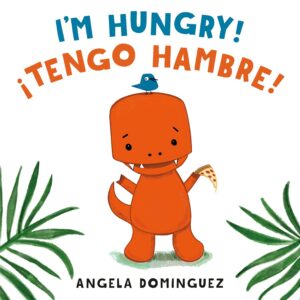
  • I’m Hungry/Tengo Hambre by Angela Dominguez 
    • Another great bilingual title from Angela Dominguez that seamlessly blends the two languages. Dinosaur is hungry, and bird is trying to figure out what he wants to eat.  
  • Little Cat Hide and Seek Emotions by Audrey Bouquet 
    • This looks like a sweet and fun way for children to learn the names for different emotions – which goes a long way toward easing their frustration when they don’t have the words to tell you how they feel.  
  • Big Green Garage by Jen Arena and Mike Dutton
    • The book advertises “15! Satisfying!  Novelty! Elements! And that is enough to pull any child in. Flaps to lift, gears to turn, tabs to pull and levers to… lever?  

FAVORITE AUTHORS/ILLUSTRATORS (All ages but mostly 3+)

  • Endlessly Ever After by Laurel Snyder & Dan Santat 
    • Fractured Fairy Tale! Choose-your-own-adventure! What’s not to love? 
  • The Blur by Minh Le and Dan Santat 
    • The team behind Drawn Together brings you a new superhero: THE BLUR. This child is able to do everything with supersonic speed, including growing up. Parents, sound familiar?  
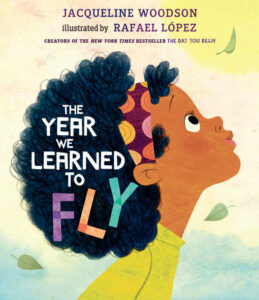
  • The Year We Learned to Fly by Jacqueline Woodson & Rafael López 
    • From the team behind The Day You Begin! Two children hear from their grandparents how their ancestors used their “brilliant and beautiful minds” to show their strength and resiliance. The children then follow suit, using their imaginations to overcome boredom dream of what might be.
  • Somewhere in the Bayou by Jarret & Jerome Pumphrey 
    • By the authors of the award winning Old Truck and last year’s Old Boat. A group of swamp critters discover that the log they’re using to travel across the pond isn’t a log after all.  
  • Hey Bruce! By Ryan T. Higgins 
    • Another title in the super-popular Bruce series! In this outing, readers follow the geese’s instructions to make Bruce do whatever they want. It’s interactive! 
  • Creepy Crayon by Aaron Reynolds and Peter Brown 
    • First we had creepy carrots, then a creepy pair of underwear, and now a crayon gets creepy! The first two in the series were super popular, so there’s no doubt this one will be too.  
  • Everything Will Be Okay by Anna Dewdney and Judy Schachner 
    • Little Bunny is having a bad day. In this rhyming story, Bunny finds some good in a day that starts out with a lot of bad. From the author of the Llama Llama books and illustrator of Skippyjon Jones.  
  • Believe in Yourself: What We learned from Arthur by Marc Brown 
    • For your nostalgia needs, Marc Brown has brought back his beloved character Arthur on his 25th anniversary. Filled with quotations and life lessons – this will be a popular book for graduation gifts!  
  • Llama Llama Back to School by Anna Dewdney and Reed Duncan 
    • While Anna Dewdney sadly passed away, this popular series (also now a Netflix show) continues.
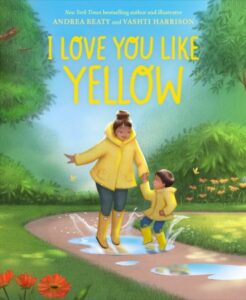
  • I Love You Like Yellow by Andrea Beaty and Vashti Harrison 
    • Andrea Beaty wrote the Ada Twist, Scientist series and Vashti Harrison wrote and illustrated the Little Leaders series – both New York Times bestsellers. This rhyming book celebrates unconditional love.  
  • Love You By Heart by Peter H. Reynolds 
    • Peter H. Reynolds is the author/illustrator of the “Creatology” series that includes The Dot and Ish and other bestselling books. This celebration of love will be a popular gift book.  

NEW AND NOTABLE (All ages but mostly 3+)

  • I Forgive Alex by Kerascoet 
    • From the team behind  I Walk With Vanessa. A boy named Alex upsets a friend and must ask for forgiveness. Wordless.
  • Being a Dog: A Tail of Mindfulness by Maria Gianferrari and Pete Oswald 
    • Enjoy the day with a child and their dog and follow the cues to bark, wag and sniff along. Backmatter includes a mindfulness walk you can take with your little one.  
  •  Beauty Woke by NoNiequa Ramos and Paola Escobar 
    • A puerto rican girl feels great about her heritage and how she looks but later starts doubting as she grows older and sees how people who look like her are treated. Her community helps her find that pride again! 
  • A is for Bee: An Alphabet Book in Translation by Ellen Heck 
    • How language is similar and different around the world.
  • Powwow Day by Traci Sorell and Madelyn Goodnight 
    • Traci Sorrell is one of the most well-known Native American (Cherokee, to be exact) authors writing picture books today! River feels the healing power of her community as she recovers from illness and wonders if she’ll ever dance in the Powwow again. 
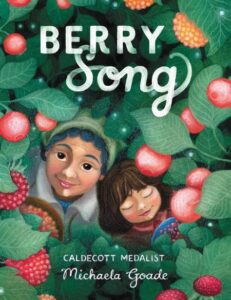
  • Berry Song by Micaela Goode 
    • Micaela Goade won a Caldecott medal for illustrating We Are Water Protectors, but this is the first book she’s written AND illustrated. A grandmother and granddaughter gather gifts from the earth: salmon, herring eggs, and so many kinds of berries, and express their gratitude for these gifts.  
  • Kindergarten, Where Kindness Matters Every Day by Vera Ahiyya (the Tutu Teacher) and Joey Chou 
    • Vera Ahiyya gained fame during the pandemic for her Instagram content as The Tutu Teacher. This is her first picture book, and it’s about the ways we show kindness to each other from the point of view of new kindergarteners.  
  • See You Someday Soon by Pat Zietlow Miller and Suzy Lee 
    • Pat Zietlow Miller has FIVE picture books coming out this year! I chose this one to share because I love Suzy Lee’s illustrations and the topic is especially timely – that those we love, even though they’re far away, are never far from our hearts.  
  • I Love You Because I Love You by Muon Thi Van and Jessica Love 
    • A call-and-response celebration of love featuring diverse families 
  • Blue by Nana Ekua Brew-Hammond and Daniel Minter 
    • You didn’t think anyone could create a WHOLE picture book about a color? Well, these two did!  And it sounds really cool! How did ancient Afghan painters make blue? When did blue become a mainstream, and not-expensive-to-create color? 
  • Big and Small and In-Between by Carter Higgins and Daniel Miyares 
    • Billed as YOU ARE (NOT) SMALL meets THE QUIET BOOK. It makes the concept of size personal. 
  • Daddy Speaks Love by Leah Henderson and E.B. Lewis 
    • Celebrates fathers, especially Black fathers, and how they guide and influence their children. With illustrations by the iconic watercolorist E.B. Lewis.  
  • Shapes: My first pop-up by Matthew Reinhart and Ekaterina Trukhan 
    • Matthew Reinhart is the KING of amazing pop-up books. This one is for toddlers and is a companion to a similar book about colors! 
  • Baby, Sleepy Baby by Atinuke and Angela Brooksbank 
    • I LOVE the partnership between Atinuke and Angela Brooksbank. They’ve created some of my favorite books, especially B is for Baby. This book is a lullaby based on a song Atinuke’s father used to sing to her in Nigeria.  

HUMOR (All Ages but mostly 3+)

  • No Bunnies Here by Tammi Sauer & Ross Burach 
    • A bear comes looking for some bunnies, so, thinking bear’s intent is to eat them, a bunny attempts to convince bear that there are NO BUNNIES HERE. A story about assumptions! Hilarious.  
  • My Parents Won’t Stop Talking! By Emma Hunsinger and Tille Walden 
    • A common lament! A girl’s trip to the park is ruined when her parents meet friends and then WON’T STOP TALKING to them!  
  • Don’t Eat Bees: Life Lessons from Chip the Dog by Dev Petty and Mike Boldt 
    • Seems like an obvious thing to do, right? But still, it happens. Chip gives us hilarious life lessons only a dog could have learned. From the author/illustrator team behind I Don’t Want to Be a Frog.  
  • Goodnight Butterfly by Ross Burach 
    • From the author/illustrator of The Very Impatient Caterpillar and The Little Caterpillar that Could. Butterfly is restless and can’t sleep, but he uses some mindfulness techniques to calm down and drift off.  
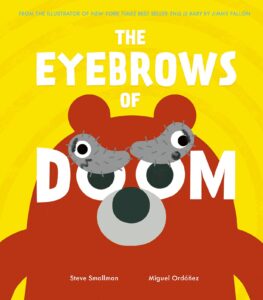
  • Eyebrows of Doom by Steve Smallman and Miguel Ordoñez 
    • Just the title makes me laugh. Bear finds a pair of slugs covered in fuzz while cleaning his cave. They inspire him to do unkind things. The eyebrows next find a young girl who does an equally unkind thing. This continues until they get a surprise at the zoo.  
  • Slug In Love by Rachel Bright and Nadia Shireen 
    • Continuing the slug theme, we have Slug in Love! Doug the Slug needs a hug. But who will hug a slug? Will he find love? 
  • Counting To Bananas by Carrie Tillotson and Estrela Lourenço 
    • This is a counting book, but Banana can’t WAIT for its turn to be counted! A MOSTLY rhyming book.  

SEQUELS (All ages but mostly 3+ 

  • Queen of Kindergarten by Derrick Barnes and Vanessa Brantley-Newton 
    • From the author/illustrator team behind the King of Kindergarten we have this companion title. This girl  is READY to rock Kindergarten.  
  • Pretty Perfect Kittycorn by Shannon Hale & LeUyen Pham 
    • The sequel to one of my favorites of last year, Itty Bitty Kittycorn. In this story, Unicorn worries that he’s not as perfect as everyone thinks he is and maybe kitty won’t be his friend anymore. A common worry for kids (and some adults like me). 
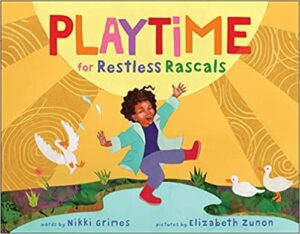
  • Playtime for Restless Rascals by Nikki Grimes and Elizabeth Zunon 
    • This follows the same pattern as their previous books Bedtime for Sweet Creatures and Off to See the Sea. This outing celebrates the bond between parent and child and the play, which is the “work of childhood” according to Mr. Rogers (and he was right).  
  • Amy Wu and the Warm Welcome by Kat Zhang and Charlene Chua 
    • The series started with Amy Wu and the Perfect Bao and continued with Amy Wu and the Patchwork Dragon. Now Amy Wu tries to make a new classmate from China feel welcome by inviting him to her dumpling party!  

COLORADO AUTHORS AND ILLUSTRATORS (All ages but mostly 3+)

I feel like I should preface this section by saying that this is by NO MEANS an exhaustive list of the amazing books being created by Colorado authors and illustrators. These folks just happen to be more on my radar (as they’re my friends, and, in one case, a work colleague). Also, I’m focusing on traditional publishing here. If you’re a Colorado author with a book coming out in 2022, please add it in the comments! I didn’t exclude you on purpose, I promise!

  • A Grand Day by Jean Reidy and Samantha Cotterill 
    • Celebrates the bond between grandparent and grandchild. 
  • Me and You in a Book Made for Two by Jean Reidy and Joey Chou
    • The sequel to What Will You Do in a Book About You? which was a popular graduation gift. 
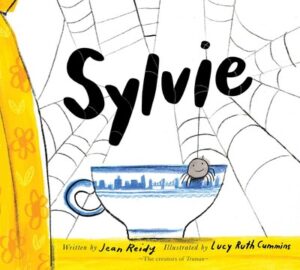
  • Sylvie by Jean Reidy and Lucy Ruth Cummins 
    • The team behind the beloved turtle Truman! Sylvie the Spider keeps watch over her people in the apartment building where she lives, out of sight. But when something seems off, Sylvie must decide whether or not to step into the spotlight to fix things. Truman even makes an appearance! 
  • Swim, Jim by Kaz Windness 
    • Jim is a crocodile, and afraid to swim. Can he find a way to learn, but on his own terms?  
  • Her Name was Mary Katherine: The Only Woman Whose Name is on the Declaration of Independence by Ella Schwartz and Dow Phumiruk  
    • Mary Katherine Goddard, a businesswoman and newspaper publisher ,stepped up and printed the Declaration of Independence so that it could be widely distributed. And she added her name at the bottom as a printing credit!  
  • Yes We Will: Asian Americans Who Shaped This Country by Kelly Yang and Dow Phumiruk 
    • Kelly Yang is a New York Times best selling author and Dow is one of several notable Asian-American illustrators to work on this book. 
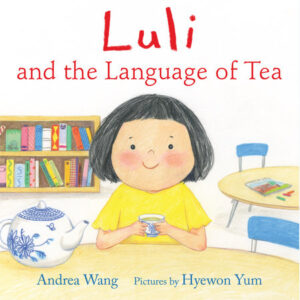
  • Luli and the Language of Tea by Andrea Wang and Hyewon Yum 
    • Luli makes friends in her ESL class by sharing a cup of tea, something familiar to all the kids in the class, no matter what their home language is. 
  • Strut, Baby, Strut by Amika Kroll and Ebony Glenn 
    • A celebration of girls as they grow up! 

Happy reading!

7 Comments

Filed under 2022, Mary Kuehner, Picture Books, Upcoming