Category Archives: Partners in Literacy

The Power of a Reading Buddy

By Susan Wroble

Seven years ago, our pup Nella was recruited for a job.
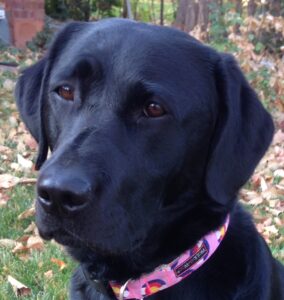
Nella, a black lab mix bred by Canine Companions.

Julie Neitz Wielga directs Partners in Literacy, a non-profit that creates communities of readers in schools. She matches up each student with an adult reading buddy, and the two meet weekly to read and discuss carefully chosen books. It a powerful—and highly successful—model for developing literacy.

But one student needed more.

Julie had worked with Rob in 4th and 5th grades, and he was going into 6th in a combined elementary/middle school. Rob was the type of kid who was always out of his seat, always bouncing up to get water or wander the halls, always heading off to talk to teachers instead of the other students. The type of brilliant kid who fails classes. The type of kid who doesn’t read because he can’t sit still. For this student, a regular reading buddy hadn’t been enough.

Julie thought that a dog might be the key. She knew that our family raised service dog pups , and we had kept Nella when she didn’t graduate for medical reasons and had worked to certify her as a therapy dog. In the summer before Rob started middle school, Julie took me on a tour of the school and we brainstormed how reading to Nella might work for this specific student. When I spotted a gigantic bean bag chair, we had a plan.

Nella and either my husband or I would head to the school library to pick up the books, then meet Rob at the chair, which we had positioned in a quiet corner of the auditorium stage. Rob sank into the chair. And Nella—all 55 pounds of her—jumped right of top of Rob, snuggled in, and listened to him read. It’s close to impossible for a student to spring out of their seat with a reading buddy providing that much pressure and weight and support.
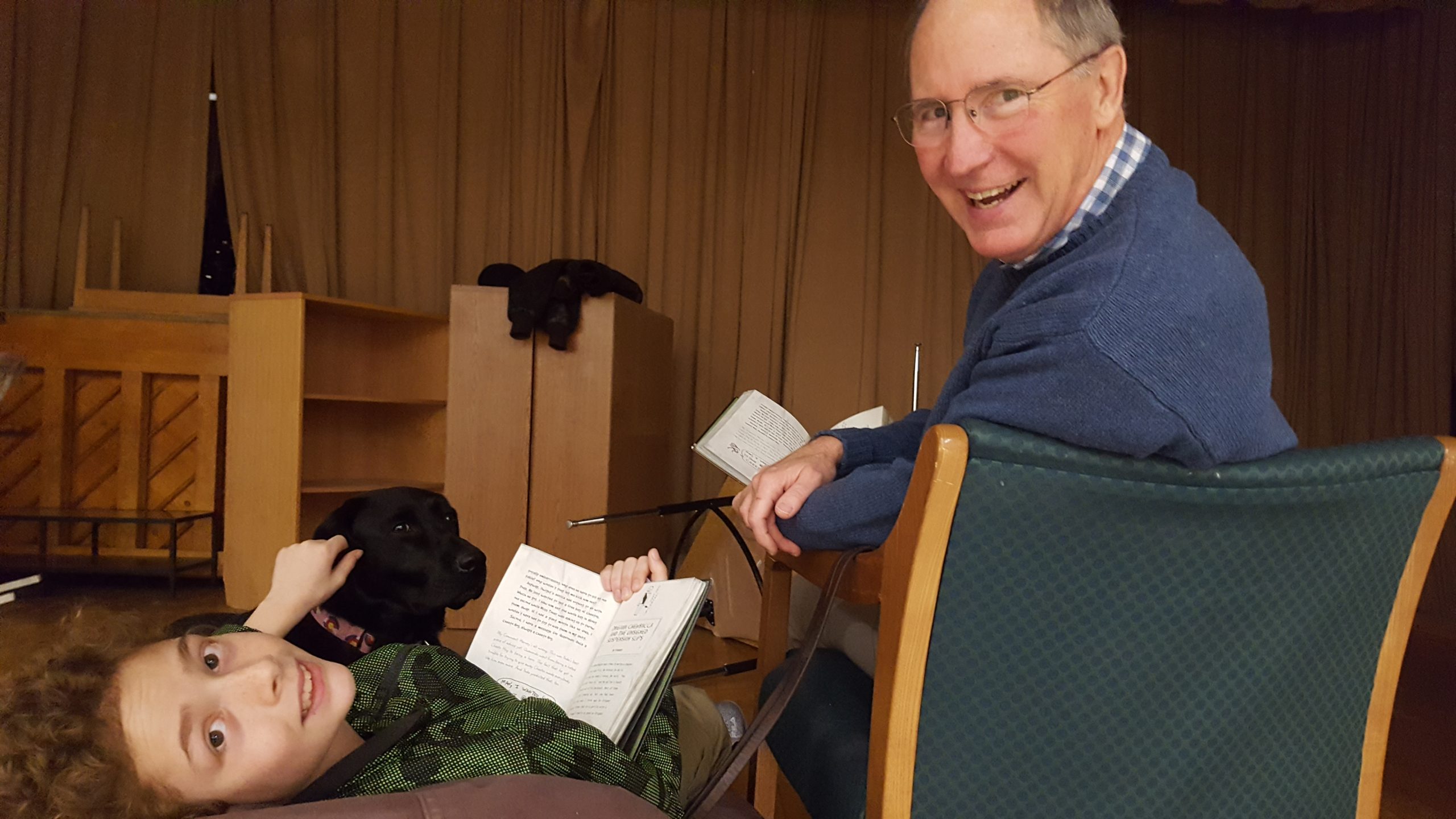
Rob on a bean bag chair with Nella on his lap, and Guy Wroble


One of the secrets of Partners in Literacy is the books, chosen specifically for each student. To start the year, Julie chose Rain, Reign by Ann M. Martin, a book about a neurodiverse kid and a special dog.

Julie’s idea paid off. Rob’s reading level jumped about three grades that year. Each week for two years, he read to Nella. He got to school on time, even early, to not miss the reading sessions. In his school photo, there’s a second face, a black furry one.
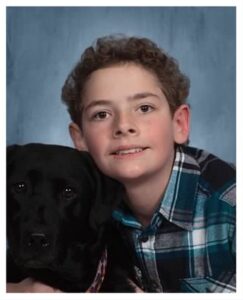
School photo of a boy with a black dog.

School photo of Rob with reading buddy Nella

Then Rob and his mom moved out of state. But that particular bond proved too strong to break. He called often. We zoomed. And each year when Rob was back in the state, we would get together—and Nella would snuggle right in.

School remained a challenging fit for Rob’s neurospicy brain. He ended up in an on-line school. Making it through high school was often in doubt.

But this year, he graduated. And we celebrated. Sometimes reading buddies are for far more than reading. Sometimes, they change lives.
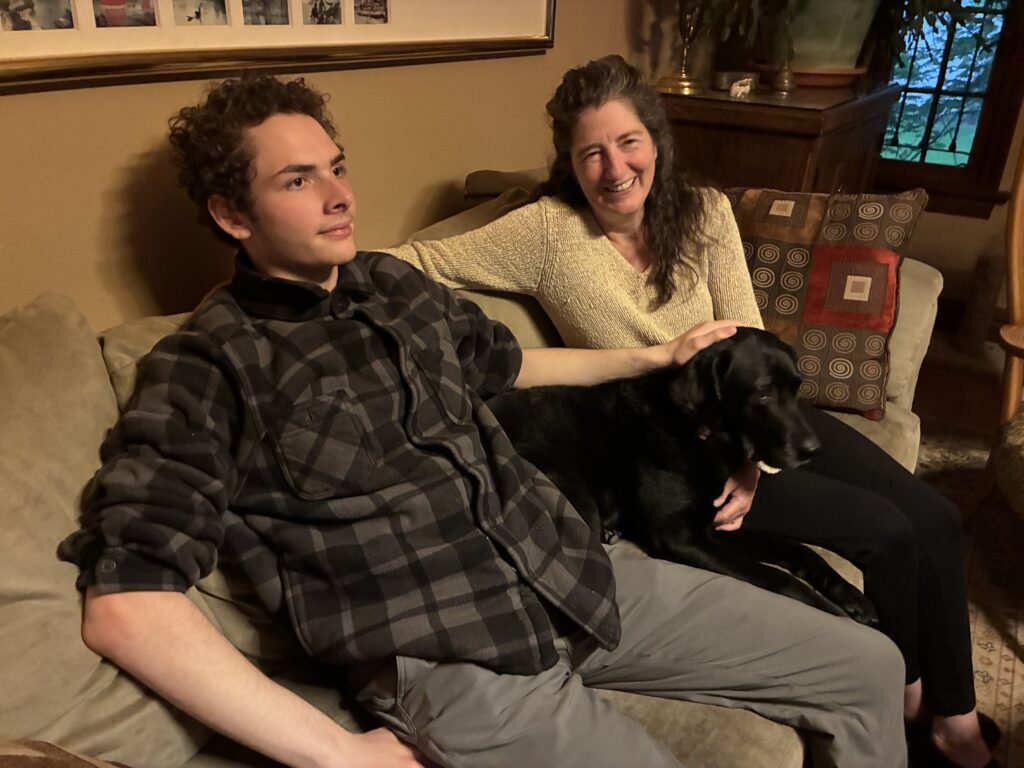
Rob, Nella and Susan seven years after becoming reading buddies with Partners in Literacy

For more information:

Partners in Literacy’s website and an earlier Writer’s Web post.

Article on the science of reading to animals

Rain, Reign by Ann M. Martin — a book that Rob talks about still.
5 Comments

Filed under 2025, Literacy Program, Partners in Literacy, Susan Wroble

Highlights of Highlights!

By Rondi Sokoloff Frieder

I have very strong childhood memories of getting the Highlights for Children magazine in the mail. First of all, it was mail – for me! (And my brothers, but mostly for me.)  I’d spot it on the kitchen counter, whisk it off to my bedroom, and immediately turn to the hidden pictures page. Then I’d search and search until I found every last rake, spoon, ice cream cone, and whatever else was listed at the bottom of the page! Today, Highlights publishes entire workbooks of these puzzles. They even have an app.
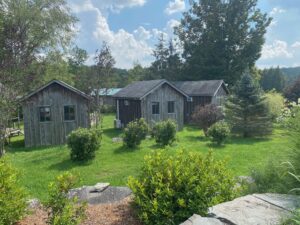
The first issue of Highlights magazine came out in 1946 and was published by the Pennsylvanian husband-and-wife team – Garry Cleveland Meyers and Caroline Clark. These days, the company’s corporate headquarters is  based in Columbus, Ohio, and includes Zaner-Bloser, Stenhouse Publishers, and Staff Development for Educators. But there’s another arm of the organization you may not know about – The Highlights Foundation. This is a 501 c-3 non-profit, established in 1984, that offers “workshops, retreats, and other support to writers, illustrators, and all creators of kid-friendly content.” (For a quick history of the company, go to: https://www.highlights.com/about-us/history.) The Foundation was established in 1984  in Chautauqua NY, but is now located in an idyllic rural setting in Honesdale, PA. George Brown, a descendant of Garry and Caroline, is its dynamic Executive Director.

During the pandemic, I took two of the Foundation’s classes online: “Filling the Writer’s Toolbox” with Emma Dryden, and “DIY Revision for your Novel or Non-Fiction” with Susan Campbell Bartoletti. But in August, after being prodded by my writing coach and award-winning author Sarah Aronson, and fellow Story Spinner and RMC-SCBWI Regional Advisor, Susan Wroble, I attended my first in-person event. And even though I am not a fan of mosquitos, ticks, humidity, or frizzy hair, this truly was the “highlight” of my summer.

“The Whole Novel Workshop,” was a six-day intensive for writers of MG and YA fiction. It differed from my other two classes in that it required an application. That meant submitting the first fifteen pages of my MG manuscript, a synopsis, and a cover letter. When my acceptance arrived, I literally whooped and hollered to the dog! Only that’s when the real work began. Not only would I be working on my revision during the workshop, I would also be receiving an in-depth critique of my full manuscript (from the brilliant, hilarious, and award-winning author, Crystal Allen) before I even arrived on campus. There were also three Zoom meetings with our  group (twenty participants and ten faculty), two books to read (one YA novel, one on craft), and partial manuscripts, synopses, and cover letters to read from the members of our assigned “Brain Trust” group (7-8 people). We used the Canvas platform to introduce ourselves (and our pets) and to explore writing prompts, articles, and podcasts. Needless to say, “The Whole Novel Workshop” could have been called “The Whole Summer Workshop!”

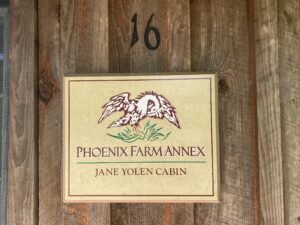
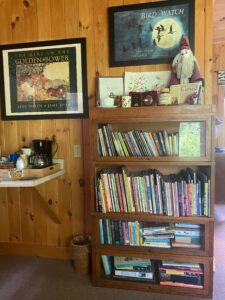
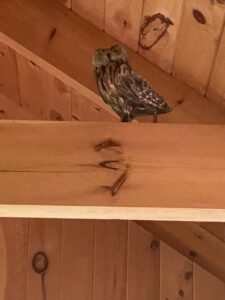
Finally, on August 21, the big day arrived. I pulled up to my home for the week, “#16,” the Jane Yolen cabin! (OMG – how did they know???) and basked in the beauty of my surroundings. There was a lovely front porch, with windows overlooking a wooded glen, a bookshelf filled with Jane’s books, posters on the wall, and an owl perched on the rafters. (I love OWL MOON!)

                .                                 

That evening, we all gathered for the start of what can only be described as a week of serious work, tremendous growth, and pure joy. There were craft workshops, thought-provoking morning prompts, critiques, time to write (alone or in community), Brain Trust groups (45-minute discussions about your manuscript led by YOU), one-on-one discussions, interviews with your main character (conducted by the dramatic Crystal!), pristine walks, and time to think about and work through your revision ideas. And the food! Ask anyone who has attended a Highlights workshop and they will definitely talk about the food. The chefs and servers prepare gourmet works of art three times a day, with snacks available twenty-four seven!

I could talk about this magical week for hours. (And believe me, I have.) Instead, here’s a  stream-of-consciousness recap:

Know who your audience is and what your character really wants. (So true, Rob.) Emotion drives action. Look for the fractals. (Jennifer) Journal until you’ve figured things out and do the swirlies. (Sarah) Discuss ideas with fellow novelists. (We love talking about these things, right Nora?!) Go for long walks. (Thanks for being our guide, George.) Play with tense and POV and balance dialogue, narrative, and description by using colored pens. (Nancy) Get rid of unnecessary characters. (Find your orderly, get rid of the priest- Crystal) Try new plotting tools. (Can’t wait to use yours, Erin.) Writing prompts open your mind to new possibilities! (Yes, Melissa!) No writing is wasted time. (More Melissa) Don’t be afraid of marketing. (I will be in touch, Mia.) And other assorted other words of wisdom: Pay attention to your secondary characters. It’s all about voice. Play and think in the rock garden. Be open about making changes. Make writer friends and support their work. (Miss you all!)

And of course… Keep going!

Our incredible faculty rocked it EVERY DAY and worked alongside us. (There was an open mike night on our last evening… WOW!) Endless thanks to: Crystal Allen, Sarah Aronson, Nora Shalaway Carpenter, Rob Costello, Erin Dionne, Mia Garcia, Jennifer Jacobsen, Erin Entrada Kelly, Alex Villasante, Nancy Werlin, Melissa Wyatt . Can you believe this line-up? I am still in awe of each and every one of them.

You must go to Highlights. (Even with the mosquitoes, ticks, and frizzy hair.) Put it on your to-do list. Right now. highlightsfoundation.org/upcoming/workshops.

I can’t wait to go back.


5 Comments

Filed under craft advice, critique, Partners in Literacy, Revision process, Rondi Frieder, Susan Wroble

A Literacy Program that Works

By Susan Wroble

Imagine a school where students love books… a school where every single student had a reading partner — a trusted, caring adult who showed up each week, often staying with that student year after year after year. And imagine a literacy program at that school where the students were able to select from books that were chosen specifically for them, books that matched their interests and their reading level. It seems impossible, but it is exactly what reading specialist Julie Neitz Wielga has created — a reading intervention program that works.

The Partners in Literacy Difference

The program began almost twenty years ago as a typical remedial literacy program. At Denver’s Odyssey School (a combined elementary and middle expeditionary learning school within the public school system), struggling second and third graders were assisted by a few adult volunteers. But then the teachers asked for volunteers for other students. Students asked if they could get a reading buddy. Parents asked if their child could be in the program. It grew to the point where it made more sense to include everyone than to just leave a few students out.

In 2011, the program incorporated as a non-profit named Partners in Literacy. Partners in Literacy works via a two-pronged approach. They assemble a large team of volunteers to provide each class with an adult for every student, either one-on-one or in small groups, and they create a library at the school of books that are curated to match those students’ interests.

The reading sessions are spread throughout the week. Kindergarteners and first graders, for example, might be on Mondays, while 2nd and 3rd graders might have reading on Tuesdays. All of the teachers, the principal and vice-principal are reading buddies. Others are parents and community members. Many of these volunteers come more than one day a week, working with multiple students.

The reading sessions are scheduled as the first activity of the school day, allowing volunteers to give 50 minutes of volunteering time and still get to work. Getting volunteers can be challenging, because, as Julie notes, “we need people who like kid’s books and kids.” To find new volunteers, Julie explained that Partners in Literacy places notices in the local papers and in nearby Little Free Libraries, but “word of mouth is the best way we recruit.”

Partners in Literacy differs from other literacy programs, like Mile High United Way’s Read with Me or the nationwide Reading Partners, in the development of a curated library. “We don’t look like these programs,” Julie explained. “We bring in our books. Having a library curated to the students’ interests makes such a difference.” In an era where many schools and school systems have eliminated their libraries, Partners in Literacy believes that children need to know that reading takes practice, focus, and time, but it is really worth it. Their goal is to steer each class, and each school, towards a strong reading culture.

Early Interventions

The life-long implications of failing to read are staggering. The U.S. Department of Education estimates that 85% of juvenile offenders have reading problems, and more than 60% of prison inmates are functionally illiterate. In terms of brain development, the size of the Broca’s area of the brain, which is linked to literacy skills, correlates with socio-economic status — the lower this status, the smaller this area of the brain.

Neuroscientist Joanna Christodoulou of the MGH Institute of Health Professions studies reading and the brain, and whether early intervention programs can help. Her research showed working with a child who is struggling to read literally changes the size of the Broca’s area and its connections within the brain.

In the early grades, Partners in Literacy is exactly the type of program that makes a difference in brain development. Kids struggling to read learn best when they can be given a buffer against the effects of chronic stress. The Partners in Literacy model, where adults and students take turns reading the book aloud then discussing it together, provides this buffer in the form of a safe, caring adult. Best of all, the kids have not been singled out for a remedial program. Instead, this safety net is offered to every single student in the school.

Middle School Magic

As vital as early interventions in reading can be, for middle school students, Partners in Literacy can work magic. “It is important for these kids to see themselves as intellectually alive at an age when they are working out their identities,” Julie said. “At this age, kids begin to recognize and make their own choices about their educational lives.” During middle school, the reading partnerships often morph into book groups, where the students decide together what book to read, and the pace of reading. Often, they choose to read at home between the weekly sessions and discuss their responses when they are together.

Partners in Literacy is unique in that it combines the inclusion of every student and the development of a curated library. And in combining those two elements, they have shown that it is completely possible to create a school culture that makes every child a reader. 


Leave a Comment

Filed under Literacy Program, Partners in Literacy, Susan Wroble