
Category Archives: Literacy Program

The Power of a Reading Buddy

By Susan Wroble

Seven years ago, our pup Nella was recruited for a job.

Nella, a black lab mix bred by Canine Companions.

Julie Neitz Wielga directs Partners in Literacy, a non-profit that creates communities of readers in schools. She matches up each student with an adult reading buddy, and the two meet weekly to read and discuss carefully chosen books. It a powerful—and highly successful—model for developing literacy.

But one student needed more.

Julie had worked with Rob in 4th and 5th grades, and he was going into 6th in a combined elementary/middle school. Rob was the type of kid who was always out of his seat, always bouncing up to get water or wander the halls, always heading off to talk to teachers instead of the other students. The type of brilliant kid who fails classes. The type of kid who doesn’t read because he can’t sit still. For this student, a regular reading buddy hadn’t been enough.

Julie thought that a dog might be the key. She knew that our family raised service dog pups , and we had kept Nella when she didn’t graduate for medical reasons and had worked to certify her as a therapy dog. In the summer before Rob started middle school, Julie took me on a tour of the school and we brainstormed how reading to Nella might work for this specific student. When I spotted a gigantic bean bag chair, we had a plan.

Nella and either my husband or I would head to the school library to pick up the books, then meet Rob at the chair, which we had positioned in a quiet corner of the auditorium stage. Rob sank into the chair. And Nella—all 55 pounds of her—jumped right of top of Rob, snuggled in, and listened to him read. It’s close to impossible for a student to spring out of their seat with a reading buddy providing that much pressure and weight and support.
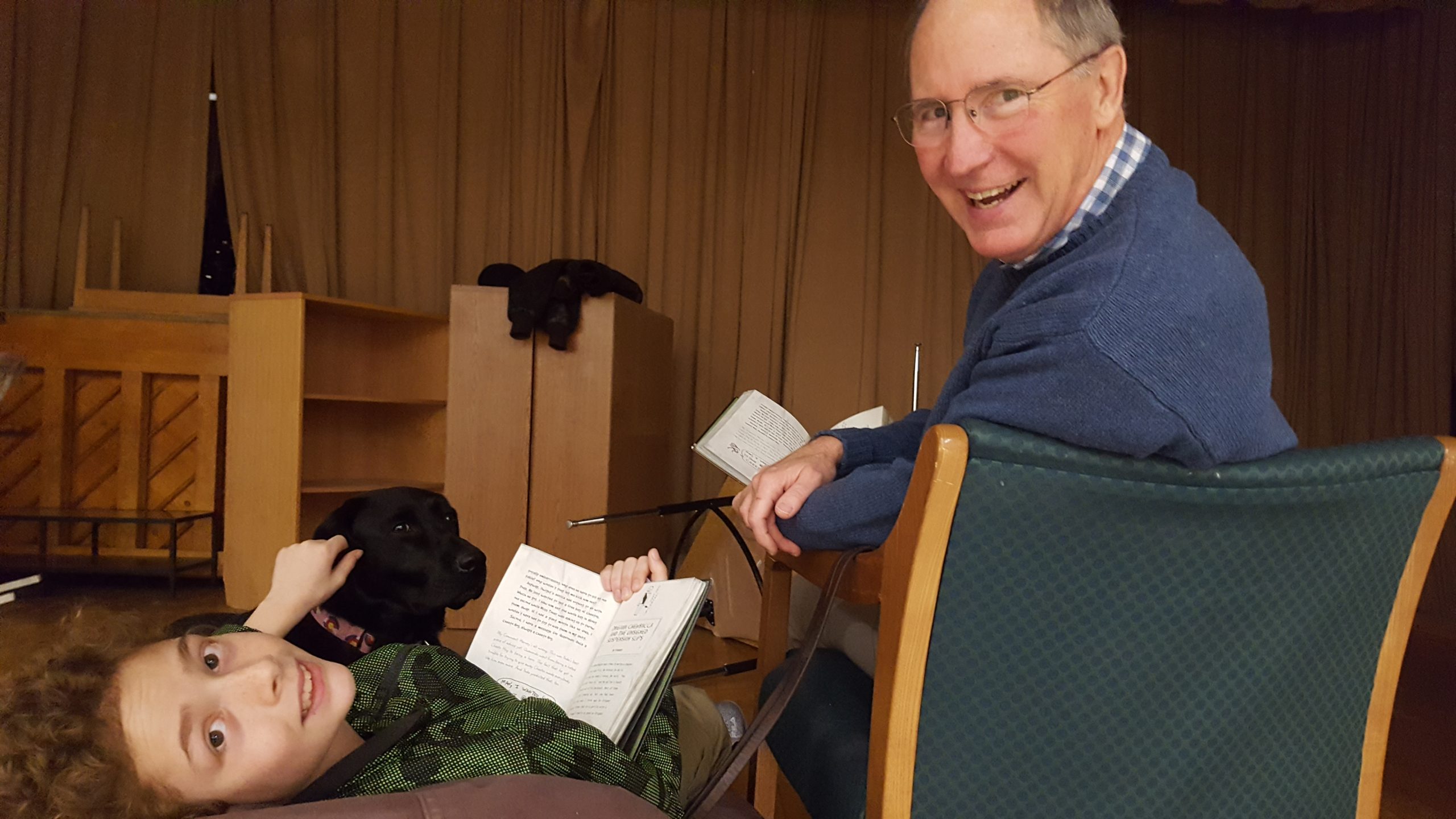
Rob on a bean bag chair with Nella on his lap, and Guy Wroble


One of the secrets of Partners in Literacy is the books, chosen specifically for each student. To start the year, Julie chose Rain, Reign by Ann M. Martin, a book about a neurodiverse kid and a special dog.

Julie’s idea paid off. Rob’s reading level jumped about three grades that year. Each week for two years, he read to Nella. He got to school on time, even early, to not miss the reading sessions. In his school photo, there’s a second face, a black furry one.
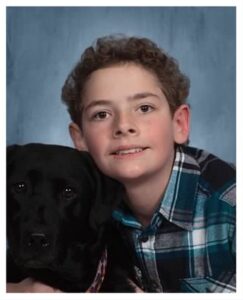
School photo of a boy with a black dog.

School photo of Rob with reading buddy Nella

Then Rob and his mom moved out of state. But that particular bond proved too strong to break. He called often. We zoomed. And each year when Rob was back in the state, we would get together—and Nella would snuggle right in.

School remained a challenging fit for Rob’s neurospicy brain. He ended up in an on-line school. Making it through high school was often in doubt.

But this year, he graduated. And we celebrated. Sometimes reading buddies are for far more than reading. Sometimes, they change lives.
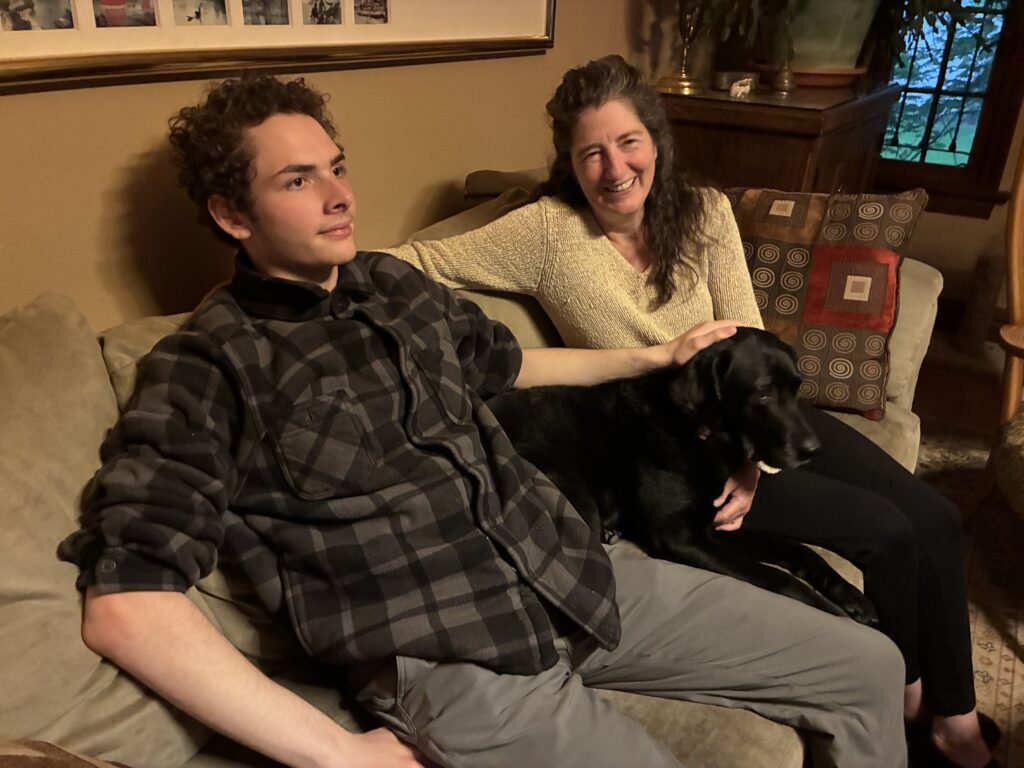
Rob, Nella and Susan seven years after becoming reading buddies with Partners in Literacy

For more information:

Partners in Literacy’s website and an earlier Writer’s Web post.

Article on the science of reading to animals

Rain, Reign by Ann M. Martin — a book that Rob talks about still.

5 Comments

Filed under 2025, Literacy Program, Partners in Literacy, Susan Wroble

Auditioning: Putting My Pages Out There

The timer went off. I had just finished a productive 50-minute revising session. But then… my break turned into being online too long. I disappeared into the SCBWI website, reading all about upcoming webinars. Yes, I was procrastinating. Yes, I was hoping a super power would finish editing a chunk of my young adult novel. It was due to my young adult novel exchange partner in five days.

Just as I was about to close the website, one webinar jumped out at me. It cheered, “Sign up. Now! Don’t think. Do it.” The webinar featured an agent giving live feedback on the first 10 pages. Ten pages? Wow! Rare, I thought. And curious. One seat was left. It was mid-day. The pages were due at 5pm the next day.

“Nope, too late,” I thought. “Besides, my manuscript isn’t query ready.” Meanwhile, my neuro divergent brain was full speed ahead, doing a jig and high on a possible challenge. I quickly googled the agent’s website and Manuscript Wish List. I got goosebumps. She was seeking the themes steeped in my YA novel.

Minutes later, I was registered. Plus, I paid extra ($25) for the agent’s post webinar detailed critique of my first 50 pages. What an adrenalin rush! What a perfect way to put my pages out there. An audition of sorts.

The spontaneity was energizing. This wasn’t the first time that I had jumped and registered last minute for a pitch or contest. Perhaps, the stars simply align that way for me.

Unfortunately, in this instance, there was one problem. A big problem. I had not looked at the first five chapters of my YA novel in months. Many months. I had been hyper focused on cutting, editing and polishing the last act. Yikes!

I immediately hunkered into my editing cave. The good news, it was easy to cut and edit, because I had moved parts from the beginning to the second and third acts. The bad news, it was very challenging to re-figure the first chapter. It no longer fit, as a result of my final revision. I felt stuck and overwhelmed. If only it made sense to start with chapter two. But, I needed a set up. Ugh.

I re-read the Beat Sheets (from SAVE THE CAT! BEAT SHEET WORKBOOK by Jamie Nash) that I had done and re-done for this novel. I re-read the first act. I handwrote notes; did free writes of possible first pages. Geesh. Was I really going back to the drawing board? Insane! I couldn’t delay; couldn’t stop. I had a deadline.

Fast forward. The webinar was an incredible experience. Each attendee’s first five pages appeared on screen, while the facilitator read them aloud. The agent devoted six minutes to each work, giving succinct, insightful, thought-provoking feedback aloud that she had prepared in advance. Everyone listened. No interactions, discussions, questions. I loved the meditative, deep thinking mood – and generous quiet time to soak up the sound of our prose and a professional’s reaction.

Of course, I was nervous and full of “I should have changed this, cut that…” But it was too late. It was un-polished. It didn’t matter. My work was out there. The curtains were wide open. An audition.

Lesson learned: Put my pages out there before I’m ready to query. The webinar pushed me outside the “I have to” box. I have to have a full manuscript ready before I…  Ever since, it has felt liberating and reassuring to keep entering pages in a contest, online sessions, etc. Intimidating? You bet! But these auditions keep me moving forward and believing in my novel. Best of all, they give me a reality check.

By the way, the agent’s detailed ($25) feedback was a huge perk. Pages of positives, keen insightful suggestions, along with discerning questions. I have added her to my To Query spreadsheet.

Here’s to auditioning your work in progress! Why wait? Give these opportunities a try and look for more. Congratulate yourself on putting your pages out there.

Webinars: SCBWI Regional Virtual Events https://www.scbwi.org/regional-virtual-events

March contests for YA novel excerpts: (Winners are assigned to an editor or mentor that coaches you to a polished manuscript.)

#RevPit 2024 Annual Contest  https://reviseresub.com/annual-contest

First Page Prize   https://www.firstpagesprize.com/

Gutsy Great Novelist  https://gutsygreatnovelist.com/chapter-one-prize/

Uncharted Novel Excerpt Contest  https://www.unchartedmag.com/uncharted-magazine-novel-excerpt-prize-judged-by-keshe-chow/


There’s no time like the present. –MG and YA acclaimed author, Victoria Hanley


2 Comments

Filed under 2023, Agents, craft advice, critique, Karen McChesney, Literacy Program, Main character, Middle Grade, Motivation, Persistence, Revision process, RMC-SCBWI, Upcoming

Go Writers, Go!

It was a writer’s dream. That’s how I felt at the recent grand opening of Lighthouse Writers Workshop new building. I was with over 500 other writers in the stunning, custom-built, cozy three-story building designed just for writers. Just for writers!

“We want this to be your home,” said Co-Founder and Director Michael Henry. And, we want it to be a place where writers of all ages, levels, backgrounds, genres come “hang out and write,” added Andrea Dupree, Co-Founder and Program Director.

What could be better? That night, when I left this writer’s paradise, I was riding high. High on great gratitude.

Gratitude for:

-living in a city that has invested in Lighthouse and writers

-living in a state with an incredibly supportive kid-lit writer community

-getting to teach youth at Lighthouse

-my awesome writer critique group, Story Spinners

-SCBWI-RMC

-my writing groups: Young Adult writers, NaNo writers

-my Monday accountability group

-my super supportive husband and friends

-my manuscript exchange partners

-my two late aunts who modeled creative follow-your-dreams living

Wow, I have been incredibly fortunate to have many, many cheerleaders on this crazy journey of querying picture books and revising young adult novels. At the grand opening, one author-speaker reminded, “writers need other writers, create your community.” I am immensely proud that I have created my writer community. And it keeps growing! I have great cheerleaders. Best of all, they have shown me how to be a cheerleader; they have inspired me to make time and show up for other writers.

In that spirit, I decided to share some of my favorite cheers from other writers. I keep them in a notebook and glance at them often, especially when I get a bad case of imposter syndrome. These words give me courage; remind me to have fun; renew my “I can do this.”

May these comments cheer you on, too.

For imposter syndrome: Before writing, take a few minutes to jot down what you’re thinking. Your doubts, your insecurities. Spit ‘em out! Then, write your goal for your session, such as word count, number of pages. At the end of your session, write down what you did.

 Congrats on doing the hard work on your YA. It’ll pay off. Sometimes you just have to plough through the hard stuff.

What an achievement! I am so proud and inspired by your achievement of finishing another revision.

Did you sign on yet for film rights for your book?!!!! I can picture it as a movie.

You hooked me with your pitch. I want to read it!

You sound very clear on your intentions for your YA. Get your story out there!

Hip, hip hooray! I know you’re passionate about this story and I applaud you for sticking with it. This is very hard work!

Aim to send 100 queries. I got my agent on query 101.

It doesn’t matter how long it takes you to finish. What’s most important is that you are staying with the hard work.

Here’s to being cheerleaders and having cheerleaders. Go writers, go!

Lighthouse Writers Workshop is the largest literary center in the Rocky Mountain West. They offer writing instruction, workshops, events, and support for writers of kid-lit, fiction, nonfiction, poetry, and many other genres. New location: 3844 York St., Denver CO 80205. For more information: Lighthouse Writers Workshop |


4 Comments

Filed under 2023, Agents, craft advice, critique, Karen McChesney, Literacy Program, Motivation, PBParty, Persistence, Picture Books, Revision process, RMC-SCBWI

A Literacy Program that Works

By Susan Wroble

Imagine a school where students love books… a school where every single student had a reading partner — a trusted, caring adult who showed up each week, often staying with that student year after year after year. And imagine a literacy program at that school where the students were able to select from books that were chosen specifically for them, books that matched their interests and their reading level. It seems impossible, but it is exactly what reading specialist Julie Neitz Wielga has created — a reading intervention program that works.

The Partners in Literacy Difference

The program began almost twenty years ago as a typical remedial literacy program. At Denver’s Odyssey School (a combined elementary and middle expeditionary learning school within the public school system), struggling second and third graders were assisted by a few adult volunteers. But then the teachers asked for volunteers for other students. Students asked if they could get a reading buddy. Parents asked if their child could be in the program. It grew to the point where it made more sense to include everyone than to just leave a few students out.

In 2011, the program incorporated as a non-profit named Partners in Literacy. Partners in Literacy works via a two-pronged approach. They assemble a large team of volunteers to provide each class with an adult for every student, either one-on-one or in small groups, and they create a library at the school of books that are curated to match those students’ interests.

The reading sessions are spread throughout the week. Kindergarteners and first graders, for example, might be on Mondays, while 2nd and 3rd graders might have reading on Tuesdays. All of the teachers, the principal and vice-principal are reading buddies. Others are parents and community members. Many of these volunteers come more than one day a week, working with multiple students.

The reading sessions are scheduled as the first activity of the school day, allowing volunteers to give 50 minutes of volunteering time and still get to work. Getting volunteers can be challenging, because, as Julie notes, “we need people who like kid’s books and kids.” To find new volunteers, Julie explained that Partners in Literacy places notices in the local papers and in nearby Little Free Libraries, but “word of mouth is the best way we recruit.”

Partners in Literacy differs from other literacy programs, like Mile High United Way’s Read with Me or the nationwide Reading Partners, in the development of a curated library. “We don’t look like these programs,” Julie explained. “We bring in our books. Having a library curated to the students’ interests makes such a difference.” In an era where many schools and school systems have eliminated their libraries, Partners in Literacy believes that children need to know that reading takes practice, focus, and time, but it is really worth it. Their goal is to steer each class, and each school, towards a strong reading culture.

Early Interventions

The life-long implications of failing to read are staggering. The U.S. Department of Education estimates that 85% of juvenile offenders have reading problems, and more than 60% of prison inmates are functionally illiterate. In terms of brain development, the size of the Broca’s area of the brain, which is linked to literacy skills, correlates with socio-economic status — the lower this status, the smaller this area of the brain.

Neuroscientist Joanna Christodoulou of the MGH Institute of Health Professions studies reading and the brain, and whether early intervention programs can help. Her research showed working with a child who is struggling to read literally changes the size of the Broca’s area and its connections within the brain.

In the early grades, Partners in Literacy is exactly the type of program that makes a difference in brain development. Kids struggling to read learn best when they can be given a buffer against the effects of chronic stress. The Partners in Literacy model, where adults and students take turns reading the book aloud then discussing it together, provides this buffer in the form of a safe, caring adult. Best of all, the kids have not been singled out for a remedial program. Instead, this safety net is offered to every single student in the school.

Middle School Magic

As vital as early interventions in reading can be, for middle school students, Partners in Literacy can work magic. “It is important for these kids to see themselves as intellectually alive at an age when they are working out their identities,” Julie said. “At this age, kids begin to recognize and make their own choices about their educational lives.” During middle school, the reading partnerships often morph into book groups, where the students decide together what book to read, and the pace of reading. Often, they choose to read at home between the weekly sessions and discuss their responses when they are together.

Partners in Literacy is unique in that it combines the inclusion of every student and the development of a curated library. And in combining those two elements, they have shown that it is completely possible to create a school culture that makes every child a reader. 


Leave a Comment

Filed under Literacy Program, Partners in Literacy, Susan Wroble