Category Archives: Kate Messner

Hosting a Writing Salon in Montreal!

About a month ago, my son Noah asked me if I’d be interested in teaching a writing class for his friends. He lives in Montreal, and my husband I would be visiting him over Memorial Day weekend. Noah has been hosting “salon-type” evenings at his apartment ever since the pandemic. Montreal had an eight o’clock curfew back then,  and in response to this, Noah and his extremely creative friends, began gathering in small groups for events at their apartments. They offered everything from jazz jams to yoga stretching to candle-making. And if the session ran past curfew, many of them unrolled their sleeping bags and spent the night.

I told him I’d be happy to teach a class. After all, I am a teacher and I write almost every day. But my expertise was in elementary education. And I write children’s books. I needed to create an activity that would appeal to a group of international thirty-somethings, many of whom work in the tech field.  Hmm…

I thought about the variety of writing workshops I’d attended over the years. Most of them focused on plotting tools, character arcs, and world building. These were great, but I needed something with more universal appeal. Something that might inspire poetry, song-writing, or journaling. I thought about the prompt intensive I took with Andrea Wang: (https://inthewritersweb.com/2022/12/the-stories-hidden-inside-you/) and the revision workshop with Kate Messner: (https://inthewritersweb.com/2024/03/highlights-from-the-2024-scbwi-winter-conference/). Both of these classes had us tapping into childhood memories to spark the stories within us.

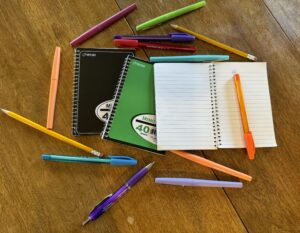
I went through my notes and came up with a variety of prompts, starting with childhood memories and moving to present day experiences. I asked my attendees to bring a blank notebook and their favorite writing implements. (I brought extra of both, knowing some people were rushing over from work to the event.) By 6:30, there were 17 people gathered in my son’s living room. They all settled in on couches, chairs, pillows, and the floor, and looked like they were ready to write.

The prompts would be five minutes in duration. I began by saying that some of the prompts would resonate, while others would not. I told them not to worry. This was not a school assignment. There would be no critique and no grades. I invited them to write poems, draw pictures, or make lists. I wanted them to enjoy themselves. I also told them the writing would get easier as we progressed.

We started with the question: “What is your earliest memory?” People stared at their notebooks. Others looked at the floor or the ceiling, while some got right to work. Eventually, the pens and pencils started moving. Everyone was slowly, but surely, getting into the flow. The teacher in me was thrilled to see my “students” scribbling away.

To be honest, an hour of writing by hand can be tedious. Some people were literally wiggling their fingers in between prompts to loosen up the muscles. I told them writing by hand was important for this fast-paced activity. It made it harder to edit and forced them to keep going. They understood this and before long, were immersed in their writing and flipping through pages in their notebooks. It was going well!

I had prepared twenty prompts and chose the following eleven because of our time constraints.

  1. Describe the house or apartment and neighborhood you grew up in. Use your senses.
  2. Tell us about a memorable family trip. Where did you go? Who was there? Include as many details as possible.
  3. Who was your first real friend growing up? What did you do together? Are you still in touch with this person?
  4. What is your favorite food and when was the last time you had it? Who prepared it?
  5. First crushes: Who was it? Give us details!
  6. Is there a story in your family that gets told over and over again? Tell us that story.
  7. Write about an amazing trip you’ve taken as an adult. Where did you go? Who was with you? Try to include all the five senses in your writing.
  8. Successes: Write about a time you achieved something extraordinary. How did it feel?
  9. Failures: Describe the most devastating failure or disappointment in your life. What happened and how did you handle it?
  10. What is the scariest thing that has ever happened to you? Write about it using lots of emotion.
  11. Think about the most hilarious thing that has ever happened in your life. Write about this now and try to reignite those feelings of fun, laughter, and joy.

This took up the full hour because 12×5=60 minutes! We had twenty minutes to share before the next session, which was being taught by my husband. Each person was invited to read what they had written or tell the story in their own words. Only one person felt uncomfortable doing this, but at the end, she came over and said this was one of the most powerful experiences she’s ever had. She had no idea these events and feelings were lurking inside her brain, waiting to burst forth.

Can you guess which prompts were the most popular? Earliest childhood memories, favorite foods, and first crushes were the winners. Two people even had the same favorite food story – a sweet, buttery, stuffed pastry from India. One person described a crush she had on a boy in kindergarten. Another spoke about how his mother sang to him every night before he went to bed. And one women described the house she lived in as a child, which was so vivid, I told her it would be the perfect setting for a middle grade novel.

As writers, we enjoy creating a compelling plot. We rejoice in finding the perfect verb to convey a feeling. And we love the challenge of imagining a setting with lots of sensory details. Did any of these attendees feel this way? As it turned out, the answer was a resounding yes. One person told me she was now inspired to take a writing class Another said he had no idea these memories would be so emotional for him. A third said he needed to do more prompts when he taught his adult writing class for immigrants. I was elated. Telling our stories is the universal human language.

By the way, my husband’s class was about how to plan a multi-day bicycle trip. Perhaps when our “students” go on a bike trip, they’ll take some time to write about it!



6 Comments

Filed under Andrea Wang, craft advice, Kate Messner, Rondi Frieder, Uncategorized

Highlights from the 2024 SCBWI Winter Conference

By Rondi Sokoloff Frieder

“Poetry inspires all other writing!” Joseph Coelho

“Go snoop in your protagonist’s bedroom.” Kate Messner

“Throw rocks at your characters!” Phil Bildner

“There’s always more to learn!” James Ransome

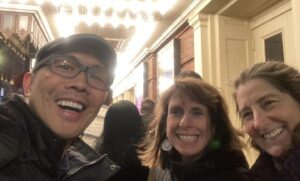
 I recently had the pleasure of attending the SCBWI WINTER CONFERENCE in New York with my RMC-SCBWI buddies, Susan Wroble and Stan Yan. Susan and Stan are the dynamic co-regional advisors for the Rocky Mountain Chapter and spending time with them made the weekend extra-special. We went to a Broadway play, strolled through Central Park, ate in charming restaurants, and regularly checked-in to discuss our sessions.

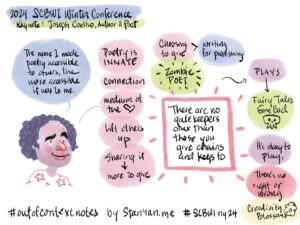
I’ve attended this conference before, but not in many years. I remembered being wowed by the inspirational keynote speakers, and blown-away by the impressive portfolio showcase. This year did not disappoint. Our opening speaker was the Children’s Poet Laureate from the United Kingdom, Joseph Coelho –  www.thepoetryofjosephcoelho.com. Joseph was extremely entertaining and drew us in with zany poetry prompts, rap writing, and tales of riding his bike through the countryside, collecting library cards (he has 213). His mission – to engage children in literacy. Here’s author/illustrator Stan Yan’s visual documentation of this presentation:

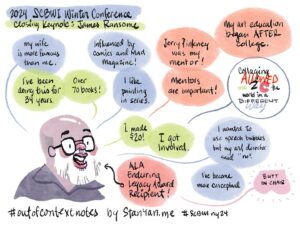
Our closing keynote was the award-winning illustrator (and sometimes author), James Ransome. James has published over 70 books for children, many with his wife, Lisa Cline Ransom. http://jamesransome.com. James’s vibrant use of color and innovative composition evokes an emotional response in the reader every time. His illustrations linger in your mind, long after you’ve turned the page. James’s passion for being a lifelong learner was infectious. He encouraged us to always take classes to hone our craft and told us to never stop creating.

But the highlight of the conference for me, were the “Creative Labs.” We all signed up for two, three-hour intensives in our genre – one on Saturday and one on Sunday.  In my case, these workshops focused on revising middle grade novels. My incredible teachers were Kate Messner, https://katemessner.com and Phil Bildner  https://philbildner.com.

In Kate’s REVISION HALF-MARATHON, she told us that “Revision is magical. You are shaping your manuscript into something TRUE!” She asked us to spend some time thinking about THEME. And once we figured out what that was, she suggested we post this in our workspace to remind us that theme must show up in every scene. She also set the timer and had us write about two things: “My novel is about… But underneath that, it’s really about…” I’ve done this exercise before and it is always enlightening.

Kate also talked about loglines and pitches and reminded us that we must write these in order to really know what our book is about. But the second part of the intensive, the heart of the workshop, involved snooping around in our main character’s bedroom! And man-oh- man, was this eye-opening. I thought I knew almost everything about my main character. But oooooh, there was so much more to discover, right in the most obvious place!

Coincidentally, the opening scene of my novel takes place in my protagonist’s bedroom. But after starting this exercise, I realized I didn’t have a detailed enough picture of what this room actually looked like. Kate asked us to consider the following: Does your MC have her own space or does she share? What’s in her closet and dresser? Are there books on a shelf? What are the titles? Stuffed animals? Collections of rocks, shells, baseball cards? Is she neat or messy? What kind of technology does she use? And my favorite… What is ON and UNDER her bed? Kate also had us make character circles, with inner circle friends vs. outer circle friends. Then she asked us how these circles changed throughout the course of the book – a very important component of most MG stories. Brilliant!

Kate loves charts and gave us a zillion ideas on how to make them. She suggested a chart to track important characters and themes in each chapter. A chart that monitors emotions and image systems. And finally, a chart that looked for the frequency of short sentences vs. long. She also suggested making a calendar and map of our setting. She even gave us chart paper to take home so we could start the work! This was a master class. I can’t wait to use some of these “magical tools to make something true!”

My second Creative Lab was with the dynamic writer and teacher, Phil Bildner. It was entitled “Breathing Life Back into Your Manuscript.” I had taken a class with Phil at another conference and I knew we were in for a treat. Phil’s session was extremely interactive. First, he had us working alone, then with one partner, and eventually three of us spent time creating a completely new story together! In the partner-exercise, we were asked to clean out our pockets; either in our clothing or from our purse or backpack. He asked us to use three of the found objects in a new scene in our novel. That’s when I literally struck gold. I found a gold candy wrapper that sparked an idea. Gold is now an image system that pops up throughout my novel.

Phil also had us reimagine an abandoned manuscript as a different genre. I scribbled down a variety of picture book ideas from a MG novel that has not sold. Phil also gave us a list of mentor texts to read and, more importantly, provided us with resources to combat the banned books movement: Authors Against Book Bans, Unite Against Book Bans, Book Riot, PEN America, We Need Diverse Books, and many more. He is passionate about this cause and inspired us all with his activism. Because if books didn’t matter, they wouldn’t be banned.

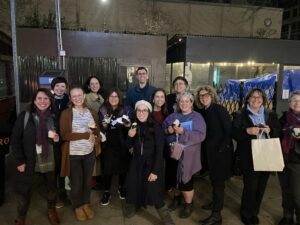
I also had the opportunity to have dinner “off-site” with the amazing Jewish Kidlit Mavens. I am in the Maven’s Facebook group, but hadn’t met these people in-person. Most of the authors/illustrators who attended were from the NY/NJ area. And what an impressive group – Liza Wiemer, Chana Stiefel, Ann Koffsky, Josh Levy, Kimberly Marcus, and Yevgenia Nayberg, to name a few. It was such a treat to spend the evening with these inspirational creators of books for children with Jewish content.

But the biggest takeaway for me was the strong sense of community we all felt by being together, in-person, with a common goal – to create the highest quality books possible for children. Oh, and one more thing… I had a very promising critique with an agent. Fingers crossed for a positive outcome!


4 Comments

Filed under Book Banning, James Ransome, Jewish Kidlit Mavens, Joseph Coelho, Kate Messner, Phil Bildner, SCBWI, SCBWI, STAN YAN, Susan Wroble, Uncategorized