By Susan Wroble
Seven years ago, our pup Nella was recruited for a job.
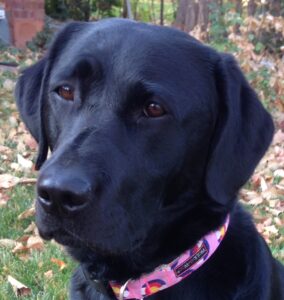
Nella, a black lab mix bred by Canine Companions.
Julie Neitz Wielga directs Partners in Literacy, a non-profit that creates communities of readers in schools. She matches up each student with an adult reading buddy, and the two meet weekly to read and discuss carefully chosen books. It a powerful—and highly successful—model for developing literacy.
But one student needed more.
Julie had worked with Rob in 4th and 5th grades, and he was going into 6th in a combined elementary/middle school. Rob was the type of kid who was always out of his seat, always bouncing up to get water or wander the halls, always heading off to talk to teachers instead of the other students. The type of brilliant kid who fails classes. The type of kid who doesn’t read because he can’t sit still. For this student, a regular reading buddy hadn’t been enough.
Julie thought that a dog might be the key. She knew that our family raised service dog pups , and we had kept Nella when she didn’t graduate for medical reasons and had worked to certify her as a therapy dog. In the summer before Rob started middle school, Julie took me on a tour of the school and we brainstormed how reading to Nella might work for this specific student. When I spotted a gigantic bean bag chair, we had a plan.
Nella and either my husband or I would head to the school library to pick up the books, then meet Rob at the chair, which we had positioned in a quiet corner of the auditorium stage. Rob sank into the chair. And Nella—all 55 pounds of her—jumped right of top of Rob, snuggled in, and listened to him read. It’s close to impossible for a student to spring out of their seat with a reading buddy providing that much pressure and weight and support.
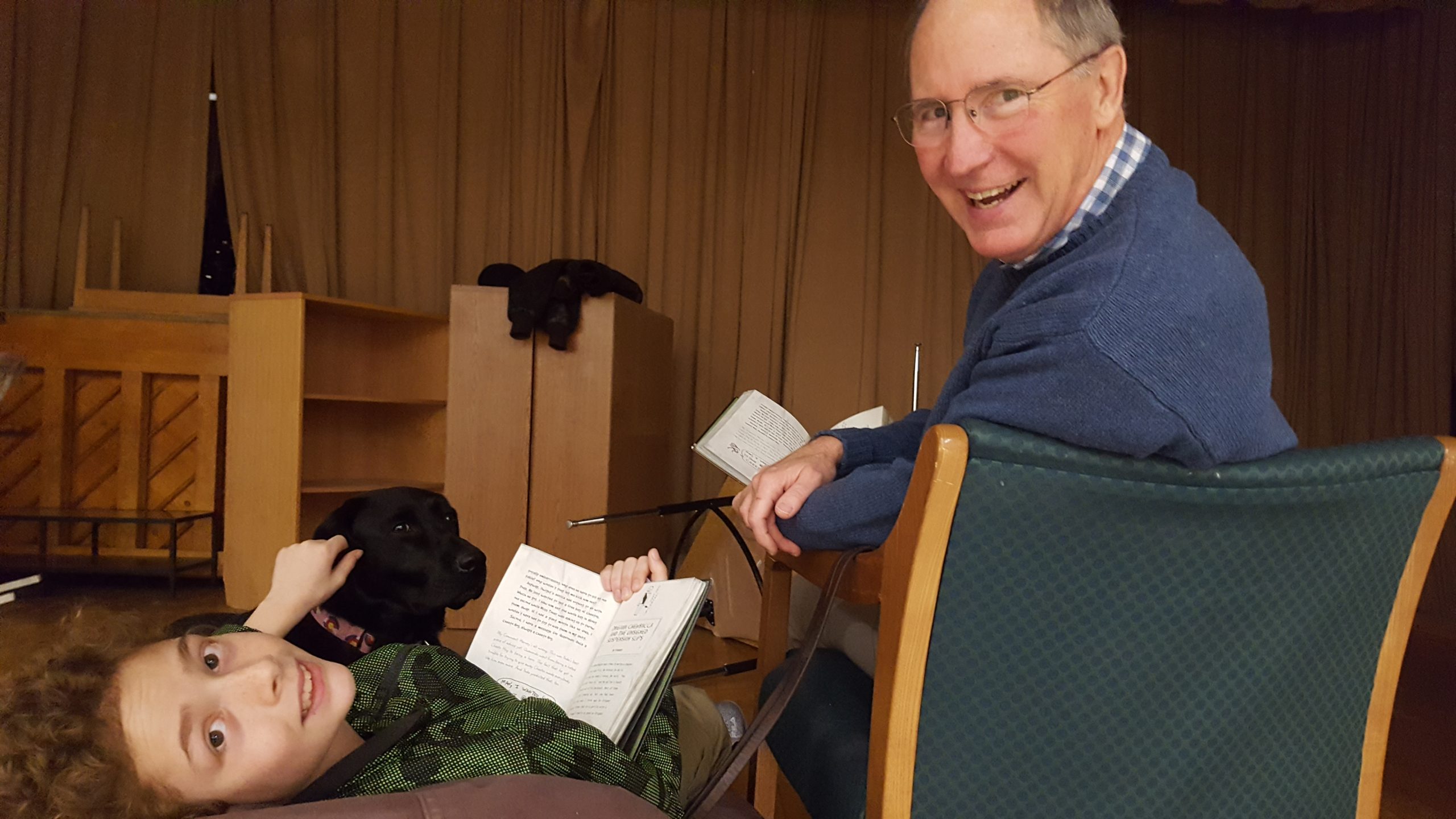
Rob on a bean bag chair with Nella on his lap, and Guy Wroble
One of the secrets of Partners in Literacy is the books, chosen specifically for each student. To start the year, Julie chose Rain, Reign by Ann M. Martin, a book about a neurodiverse kid and a special dog.
Julie’s idea paid off. Rob’s reading level jumped about three grades that year. Each week for two years, he read to Nella. He got to school on time, even early, to not miss the reading sessions. In his school photo, there’s a second face, a black furry one.
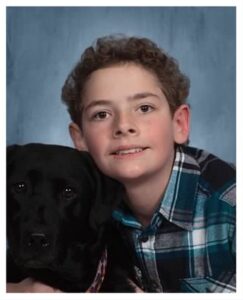
School photo of Rob with reading buddy Nella
Then Rob and his mom moved out of state. But that particular bond proved too strong to break. He called often. We zoomed. And each year when Rob was back in the state, we would get together—and Nella would snuggle right in.
School remained a challenging fit for Rob’s neurospicy brain. He ended up in an on-line school. Making it through high school was often in doubt.
But this year, he graduated. And we celebrated. Sometimes reading buddies are for far more than reading. Sometimes, they change lives.
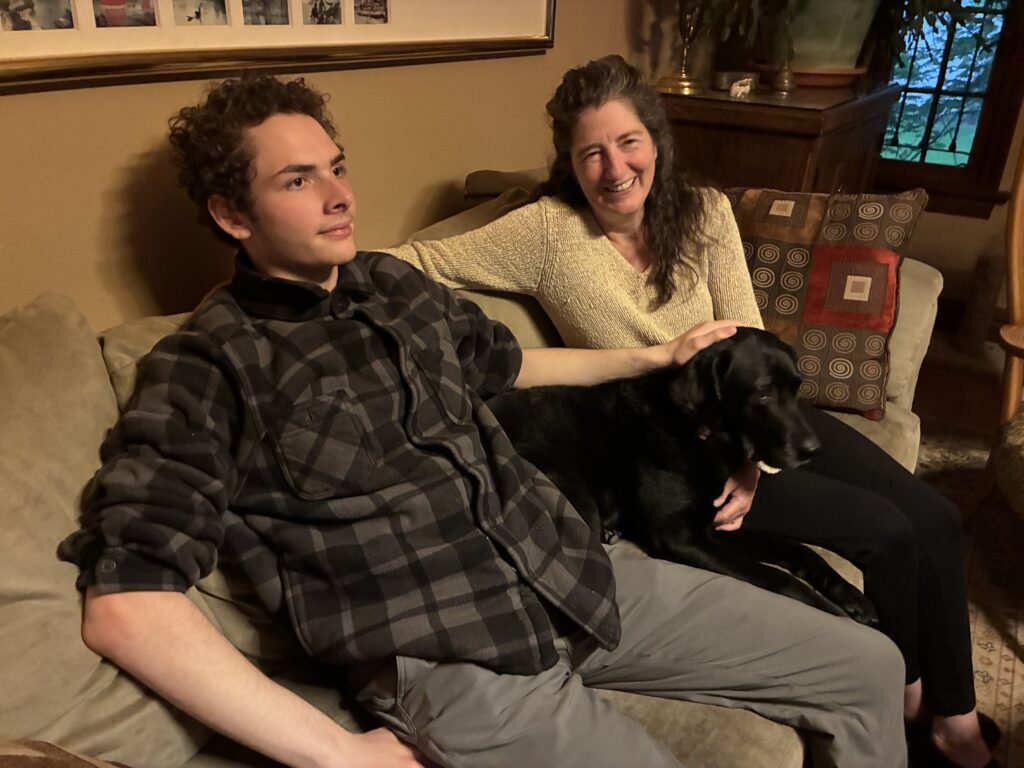
Rob, Nella and Susan seven years after becoming reading buddies with Partners in Literacy
For more information:
Partners in Literacy’s website and an earlier Writer’s Web post.
Article on the science of reading to animals
Rain, Reign by Ann M. Martin — a book that Rob talks about still.
 But for writers, a generic thesaurus often isn’t enough. One of my favorite thesaurus-like resources has been linguistic professor Beth Levin’s ENLISH VERB CLASSES AND ALTERNATIONS: A PRELIMINARY INVESTIGATION.While I can not tell you what a verb alternation is, I do know that Prof. Levin’s lists are priceless. For my upcoming picture book DAWN CHORUS: PROTECTING BIRDSONG AROUND THE WORLD (Holiday House, 2026), I featured a variety of endangered birds, and was searching for a whole lot of different words that described the emergence of early morning birdsong. And the list I needed was there, under “Verbs of Sound Emission.”
 Another treasure that should be on every writer’s shelf is Angela Ackerman and Becca Puglist’s best-selling
 Jen Bryant’s THE RIGHT WORD is a nonfiction picture book that tells the story of young Peter Mark Roget, who made lists of related words in his desire to use the perfect word. Like many writers, I am indebted—and so, so grateful—for his work.