
Category Archives: 2023

Auditioning: Putting My Pages Out There

The timer went off. I had just finished a productive 50-minute revising session. But then… my break turned into being online too long. I disappeared into the SCBWI website, reading all about upcoming webinars. Yes, I was procrastinating. Yes, I was hoping a super power would finish editing a chunk of my young adult novel. It was due to my young adult novel exchange partner in five days.

Just as I was about to close the website, one webinar jumped out at me. It cheered, “Sign up. Now! Don’t think. Do it.” The webinar featured an agent giving live feedback on the first 10 pages. Ten pages? Wow! Rare, I thought. And curious. One seat was left. It was mid-day. The pages were due at 5pm the next day.

“Nope, too late,” I thought. “Besides, my manuscript isn’t query ready.” Meanwhile, my neuro divergent brain was full speed ahead, doing a jig and high on a possible challenge. I quickly googled the agent’s website and Manuscript Wish List. I got goosebumps. She was seeking the themes steeped in my YA novel.

Minutes later, I was registered. Plus, I paid extra ($25) for the agent’s post webinar detailed critique of my first 50 pages. What an adrenalin rush! What a perfect way to put my pages out there. An audition of sorts.

The spontaneity was energizing. This wasn’t the first time that I had jumped and registered last minute for a pitch or contest. Perhaps, the stars simply align that way for me.

Unfortunately, in this instance, there was one problem. A big problem. I had not looked at the first five chapters of my YA novel in months. Many months. I had been hyper focused on cutting, editing and polishing the last act. Yikes!

I immediately hunkered into my editing cave. The good news, it was easy to cut and edit, because I had moved parts from the beginning to the second and third acts. The bad news, it was very challenging to re-figure the first chapter. It no longer fit, as a result of my final revision. I felt stuck and overwhelmed. If only it made sense to start with chapter two. But, I needed a set up. Ugh.

I re-read the Beat Sheets (from SAVE THE CAT! BEAT SHEET WORKBOOK by Jamie Nash) that I had done and re-done for this novel. I re-read the first act. I handwrote notes; did free writes of possible first pages. Geesh. Was I really going back to the drawing board? Insane! I couldn’t delay; couldn’t stop. I had a deadline.

Fast forward. The webinar was an incredible experience. Each attendee’s first five pages appeared on screen, while the facilitator read them aloud. The agent devoted six minutes to each work, giving succinct, insightful, thought-provoking feedback aloud that she had prepared in advance. Everyone listened. No interactions, discussions, questions. I loved the meditative, deep thinking mood – and generous quiet time to soak up the sound of our prose and a professional’s reaction.

Of course, I was nervous and full of “I should have changed this, cut that…” But it was too late. It was un-polished. It didn’t matter. My work was out there. The curtains were wide open. An audition.

Lesson learned: Put my pages out there before I’m ready to query. The webinar pushed me outside the “I have to” box. I have to have a full manuscript ready before I…  Ever since, it has felt liberating and reassuring to keep entering pages in a contest, online sessions, etc. Intimidating? You bet! But these auditions keep me moving forward and believing in my novel. Best of all, they give me a reality check.

By the way, the agent’s detailed ($25) feedback was a huge perk. Pages of positives, keen insightful suggestions, along with discerning questions. I have added her to my To Query spreadsheet.

Here’s to auditioning your work in progress! Why wait? Give these opportunities a try and look for more. Congratulate yourself on putting your pages out there.

Webinars: SCBWI Regional Virtual Events https://www.scbwi.org/regional-virtual-events

March contests for YA novel excerpts: (Winners are assigned to an editor or mentor that coaches you to a polished manuscript.)

#RevPit 2024 Annual Contest  https://reviseresub.com/annual-contest

First Page Prize   https://www.firstpagesprize.com/

Gutsy Great Novelist  https://gutsygreatnovelist.com/chapter-one-prize/

Uncharted Novel Excerpt Contest  https://www.unchartedmag.com/uncharted-magazine-novel-excerpt-prize-judged-by-keshe-chow/


There’s no time like the present. –MG and YA acclaimed author, Victoria Hanley


2 Comments

Filed under 2023, Agents, craft advice, critique, Karen McChesney, Literacy Program, Main character, Middle Grade, Motivation, Persistence, Revision process, RMC-SCBWI, Upcoming

How Writing Got Me Through a Very Tough Year

2023 has been a tough year for me. It began in January when my 97-year-old father’s health began to seriously deteriorate. And after many trips back and forth from Denver to New York, it was clear that the end was near. He passed away on May 18. It was a long life well-lived, but still, a big loss for everyone who knew him.

Then on the day before the funeral, when we were flying from my son’s business school graduation in Washington DC to New York, my husband received the final diagnosis of his recent health problem. He had multiple myeloma, cancer of the plasma cells, which seriously affects the body’s immune system. After the funeral, three shivas, and a couple of days of cleaning out my dad’s condo, we flew back to Denver. My husband would begin treatment. This included a regimen of twice-a-week infusions of a targeted drug therapy for three months. It was supposed to be followed by a stem cell transplant in October. Only in September, he contracted West Nile virus.

I am not making this up. And for those of you who are unfamiliar with the disease, West Nile is no joke. You get it from a mosquito bite. And although Colorado is known for its dry climate and lack of bugs, this year was different. We had an unusually large amount of rain and much warmer fall temperatures. There were swarms of mosquitoes. Colorado actually had the most cases in the entire country! West Nile can cause a high fever, excruciating headache, tremors, brain fog, paralysis, meningitis or worse. My husband had the first four symptoms. And with his compromised immune system, the virus took hold in a big way. He was hospitalized for two days and sick for five weeks. The stem cell transplant was postponed.

And then in October, the world went crazy. Hamas attacked Israel and a violent war erupted. Anti-Semitism around the world and on college campuses, including my own college campus, reared its ugly head and shook us to the core. It was soul-crushing, complicated, terrifying.

But we had to keep going. My husband slowly recovered from West Nile. Family members flew in to help. Our friends baked and cooked. My morning dog-walking group provided an arena for venting and processing whatever was on my mind. But the biggest distraction of all, was my writing. It became my refuge, my emotional escape hatch, my joy.

Before my dad died and my husband was diagnosed, I serendipitously signed up for the Highlights Foundation online class, “Just Do It” in April. https://inthewritersweb.com/2023/06/. This class became a lifeline of structure and support during my most difficult months – May and June. It pushed me to get up and work on my novel. Every single day. I was moving along at a clip and decided to apply to the “The Whole Novel Workshop,” an in-person retreat at the idyllic Highlights campus in Pennsylvania. I wasn’t sure if this was going to work with my husband’s transplant schedule, but he really wanted me to go. He thought it would be good for me to do something for me. And as it turned out, the transplant was scheduled for the week after I returned from Highlights. The timing was perfect. Our sons flew home to be with my husband while I spent a week in the “Renee Watson cabin,” surrounded by talented writers, inspirational faculty, and the award-winning Highlights cuisine. Oh, and let’s not forget the pair of roosting bald eagles, the white-tailed deer meandering past my cabin, and a rusty red-colored forest right out my window! It was perfect.



There were other ways my writing supported me in a big way. I continued meeting with my always amazing critique group, The Story Spinners, twice a month. Members of my Tuesday writing group, The Nanos, stepped up to host, since I could no longer have people in my house because of my husband’s compromised immune system. I also joined two new online groups: an accountability group from my “Just Do It” class and a critique group of Jewish writers from around the world. I completed my nine years of being the PAL LIAISON for the RMC-SCBWI by moderating the industry panel at the annual Letters & Lines Conference in September and was asked to moderate two more panels at the Denver Festival of Stories, sponsored by Second Star to the Right Book Shop and the non-profit Books To Kids in October. I even got to introduce the keynote speaker, Bruce Cameron!

“Thinking about my writing” also relieved daily stress. I would take walks and ask myself: How can I strengthen my main character’s arc by throwing more obstacles in her way? Is there a better way to describe the setting? What plot twists will surprise my reader? Throwing myself into the world of my books gave me a constructive outlet when I felt overwhelmed, frustrated, or deflated. It was the best way to reflect, regroup, and recharge.

Despite the challenges of the past year, I do have some good news. After 18 days in the hospital, my husband is coming home. Today! The stem cell transplant was successful. He still has months of healing ahead, but we are moving forward. Our younger son earned his MBA and has started a new job. Our older son continues his humanitarian work around the world and is engaged to be married. One niece got married and another had a baby – the first child of the next generation of our family. One of my manuscripts was a finalist for the Golden Pen Award at the RMC-SCBWI Letters & Lines Fall Conference. And my latest novel, the one I workshopped at Highlights, received glowing feedback. It wasn’t easy, but I made it through 2023. And leaning into my life as a writer was a big part of this accomplishment.

How has writing helped you through a personal challenge? Please share your story in the comments.


13 Comments

Filed under 2023, Middle Grade, RMC-SCBW, Rondi Frieder, Second Star to the Right Book Shop, Uncategorized

KidLit Nonfiction Awards

NONFICTION AWARDS

By Susan Wroble

This past summer, my planned presentation on award-winning nonfiction books took a tangent. I realized that instead of award-winning books, what I really wanted to learn about was the nonfiction awards themselves. I knew about the Sibert Awards from the American Library Association but had no idea if there were any other KidLit nonfiction awards out there.

For authors, awards are one way to try to help give your book a longer life—and it turns out that there are other awards besides the Sibert. A LOT of others. I found 17 awards where, unlike the Sibert, the author or the publisher has some input into the nomination process. Some of my favorites of the nonfiction children’s awards include:

The Foundation for Agriculture Award from the American Farm Bureau. Their “Book of the Year Award” goes to
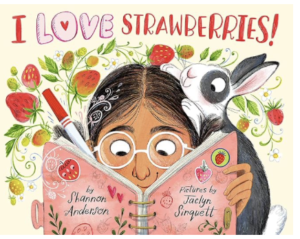
books that have accurate information about agriculture with a positive portrayal. Shannon Anderson’s delightful I LOVE STRAWBERRIES, illustrated by Jaclyn Sinquett, is a fabulous example. And as a side note on this award, the Farm Bureau has its own publishing house, Feeding Minds Press. If you are working on a manuscript that pertains to agriculture in a broad sense, consider submitting it to Feeding Minds.


The AAAS/Subaru SB&F Prize for Excellence in Science Books. This prize is awarded in four different categories: children’s (PBs), middle grade, hands-on, and young adult. The criteria vary a bit by group, but in general must support the development of positive attitudes about learning about STEM topics. The books must be well-organized, with the scientific concepts accurately presented. One of the joys of this particular site is that it is very searchable, both by category and by year.

The Eureka! Children’s Nonfiction Book Awards from the California Reading Association carry a lot of weight—their list is a reference for librarians in other states and around the world. Awards are given to a lot of books: in 2023, there were 10 Gold Awards and 40 Honors Awards.  The authors and illustrators do not need to be from California, and the list of what constitutes nonfiction is simple: everything that is not fiction. That means that this award is a great fit for harder categories like memoir or poetry, folktales or cookbooks.

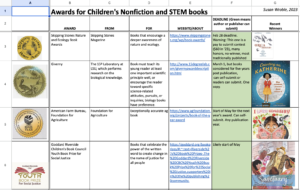
You can access my “Awards for Children’s Nonfiction and STEM” spreadsheet here.  The list is focused on awards that authors have some control over, and is organized by submission date. There may still be others out there that I missed. If you find additions or errors, please contact me. And best wishes on your own awards!

3 Comments

Filed under 2023, Nonfiction, Susan Wroble

Finding The YA in Learning


Murder. Secrets. Drugs. Gossip. Lies. Sexuality. Romance. Magic. Identity. Rumors. Breakups.
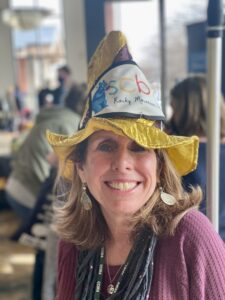
Hang out with a group of YA writers and you’ll likely hear these words, along with more provocative, dark, odd, edgy, far-out, intense, hilarious, eccentric, juicy, shocking topics. We love teens. We love big drama and conjuring a mess for our teen characters in current time or mystical worlds.

Other kid-lit writers often say we’re nuts for writing over 75,000 words. But we can’t get enough. We want to hold on to every word. No wonder our revisions can take years and years as we cut, trim, tighten hundreds of pages.

Thanks to my critique group, Story Spinners, I unexpectedly joined the YA writer “club” years ago after they nudged me to turn my coming-of-age short story into a YA novel. I was clueless and intimidated, but I couldn’t stop writing. I’m incredibly fortunate to be part of the SCBWI-Rocky Mountain Chapter’s YA community. And I’m in awe of how everyone cheers each other on at book launches and events by and for YA writers.

My fellow YA’ers and I adamantly long to be with our peers and find YA-only classes. No offense, picture book and middle grade writers. We adore you and your books! Just like our teen characters, we long to be belong; we want to be in a YA cluster. But, we’ll be the first to admit, we often feel like the misfits in writer land. Afterall, YA novels are a far cry from Middle Grade.

Perhaps that’s why our search for YA-only learning is constant and fierce. The past few months, for instance, several YA writers and I started researching YA-only workshops, courses, and other ways to amp up our learning.

Here’s what we have found so far:

Workshops/Courses:

Wordsmith Workshops https://www.wordsmithworkshops.com/

Vermont College of Fine Arts https://vcfa.edu/writing-novels-for-young-people-retreat/

Hugo House https://hugohouse.org/product/young-adult-fiction-workshop/

Writer’s Digest University https://www.writersonlineworkshops.com/courses/writing-the-young-adult-novel

UCLA Extension https://www.uclaextension.edu/writing-journalism/creative-writing/course/young-adult-novel-i-writing-x-4451

Tin House https://tinhouse.com/workshop/

From SCBWI:

YA Connect and Other Connects https://www.scbwi.org/regions/rmc/events

YA Connect is free and offered every other month by and for YA writers of all levels to learn and meet fellow YA writers. Most YA Connects are both in-person & Zoom.

Michelle Begley Mentorship – Due Oct. 31, 2023 https://www.scbwi.org/regions/rmc/RMC-mentorship-program

Weekly Podcast https://www.scbwi.org/podcasts

Most recent one featured Deborah Halverson, award-winning YA author, including Writing Young Adult Fiction For Dummies and Honk If You Hate Me

Monthly Virtual Events, hosted by chapters across the U.S. https://www.scbwi.org/regional-virtual-events

Coming soon:

Lighthouse Writers Workshop, Denver – YA workshops, gatherings https://lighthousewriters.org/

Of course, there are a lot more YA-only opportunities out there. Share your findings in the comments, please. Meanwhile, YA writers: Keep reaching out to find other YA’ers. And remember, teens can’t wait to read your stories – and drama!

2 Comments

Filed under 2023, Agents, craft advice, critique, Graphic Novels, Karen McChesney, Main character, Middle Grade, Motivation, Persistence, Revision process, RMC-SCBWI, Upcoming, What I am doing now

PAL LIAISON Interview in Kite Tales Magazine

A version of this interview appeared in the Spring 2023 RMC-SCBWI Kite Tales magazine.

Some volunteers make programs better. Some make them good. Others, like Rondi Sokoloff Frieder, take them to a whole new, exceptional level. Frieder grew the RMC-SCBWI Published And Listed (PAL) program from the ground up-cultivating it into one of the most enviable and productive in SCBWI. Susan Wroble, Co-Regional Advisor for RMC-SCBWI, said, “When I started in my leadership position, I was shocked to learn that most other chapters have very few PAL members, and for many, SCBWI is regarded as being an organization to get you published, not to stay in once you are published. However, Rondi has made being a part of our chapter worthwhile—and fun—for so many of our PAL members. In turn, they have been our mentors and Connect speakers and guides, and have brought up the skill level of the entire chapter. Without her work over these past nine years, we wouldn’t be nearly as strong a chapter.”

I had the privilege of interviewing Frieder before she steps down to focus on her own writing career.

Shelly Steig: How long have you been a member of SCBWI?

Rondi Sokoloff Frieder: A very long time! This is actually a great story. Back in 2000, my school principal said I needed to do something with my writing. I had been teaching kindergarten and first grade for over 20 years and loved writing plays, raps and short stories with my students. When I told my brother I was thinking about writing for children, he told me his son (my nephew) had a friend at school whose mother did something with children’s books. He suggested I email her. And guess what? It was Lin Oliver, the co-founder of SCBWI!!! I immediately joined and went to the LA conference that summer. I’ve been a member ever since.
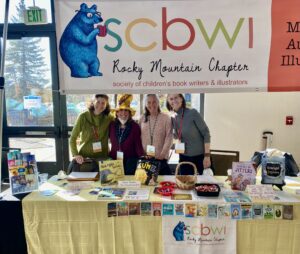
SS: What has being a member of SCBWI meant to you?

RSF: So many things. First and foremost, I love the people! There is nothing like spending time with kindred spirits who totally get what you are trying to do. Writing for children is a challenging, and often discouraging, endeavor. I probably would have given up long ago had it not been for the support and encouragement of this writing community. It’s also where I met my critique partners, the brilliant and talented Story Spinners. We’ve been going strong for over twenty years and even have a blog: www.inthewritersweb.com.

SS: When did you become the PAL Liaison, and how did that come about?

RSF: Great question! I have been the PAL (traditionally published and listed authors and illustrators) Coordinator/Liaison for nine years. After I retired from the classroom, one of my critique partners challenged me to get more involved in the RMC-SCBWI. I looked at the volunteer positions available and noticed there was an opening for the CCIRA (Colorado Chapter of the International Reading Association) Coordinator. CCIRA hosts an annual literacy conference for teachers and librarians and the RMC-SCBWI usually purchases a table in their Exhibits Hall. This immediately resonated with me. I had been attending this conference for years as a teacher and always loved it. Plus, it was held at a hotel five minutes from my house! I emailed the Co-Regional Advisors to say I was interested. They were thrilled and also asked me to host a table at the annual Colorado Teen Literacy Conference. Our next Co-RA she asked if I’d be willing to expand my job. She envisioned four PAL events a year and changed the position title to PAL Liaison. Together, we developed the new model. Now, along with CCIRA, I coordinate the annual Book Birthday Bash, webinars tailored specifically to the needs of PALs, meet-and-greets at local bookstores and social/support gatherings. We even hosted the YALSA (Young Adult Library Services Association) group at a reception when the American Library Association Conference was in Denver!

SS: What was your favorite part of being the liaison?

RSF: I absolutely love all the PAL events. Our authors and illustrators are a delight to work with and our programs are inspirational and informative. But if I had to pick my most favorite thing of all, it would be moderating a panel at CCIRA. I’ve used a variety of formats from Speed Dating with authors, illustrators and teachers to opening for keynote speaker, John Schu, librarian extraordinaire and former Ambassador of School Libraries for Scholastic Book Fairs. For the past two years, I’ve led an actual session at the conference and this year’s was over-the-top incredible! We had sixteen authors and illustrators present to a packed room of teachers and librarians. Their anecdotes took us from laughter to tears as we learned about the “stories behind the books.” I was so proud of our literary rockstars!
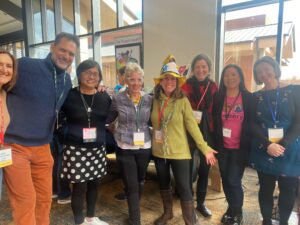

SS: What are you working on with your own projects?

RSF: I am smitten with middle grade! I recently submitted my time-travel, baseball, comic book, golem romp to a slew of agents. While I wait for their responses, I am working on a humorous MG story about friendship and grief that takes place in a summer camp in the Rocky Mountains.

SS: Anything else you’d like our members to know?

RSF: I’m very proud of the fact that our PALs have stayed super involved in the RMC-SCBWI. Apparently, this is not typical. In most chapters, after people get traditionally published, they disappear. By providing dynamic programming for our PAL authors and illustrators, we have been able to keep them engaged. Along with attending PAL events, they have become mentors, webinar presenters, and speakers at our annual conference. Also, being the PAL Liaison has enabled me to work directly with many of our outstanding local bookstores. We have held PAL events at Second Star to the Right, Book Bar, The Bookies, The Wandering Jellyfish and The Tattered Cover. Getting to know these booksellers has given me tremendous insight into the publishing world. Children’s book people are the best!

6 Comments

Filed under 2023, Book Birthdays, CCIRA, Interviews, Kite Tales, RMC-SCBW

Go Writers, Go!

It was a writer’s dream. That’s how I felt at the recent grand opening of Lighthouse Writers Workshop new building. I was with over 500 other writers in the stunning, custom-built, cozy three-story building designed just for writers. Just for writers!

“We want this to be your home,” said Co-Founder and Director Michael Henry. And, we want it to be a place where writers of all ages, levels, backgrounds, genres come “hang out and write,” added Andrea Dupree, Co-Founder and Program Director.

What could be better? That night, when I left this writer’s paradise, I was riding high. High on great gratitude.

Gratitude for:

-living in a city that has invested in Lighthouse and writers

-living in a state with an incredibly supportive kid-lit writer community

-getting to teach youth at Lighthouse

-my awesome writer critique group, Story Spinners

-SCBWI-RMC

-my writing groups: Young Adult writers, NaNo writers

-my Monday accountability group

-my super supportive husband and friends

-my manuscript exchange partners

-my two late aunts who modeled creative follow-your-dreams living

Wow, I have been incredibly fortunate to have many, many cheerleaders on this crazy journey of querying picture books and revising young adult novels. At the grand opening, one author-speaker reminded, “writers need other writers, create your community.” I am immensely proud that I have created my writer community. And it keeps growing! I have great cheerleaders. Best of all, they have shown me how to be a cheerleader; they have inspired me to make time and show up for other writers.

In that spirit, I decided to share some of my favorite cheers from other writers. I keep them in a notebook and glance at them often, especially when I get a bad case of imposter syndrome. These words give me courage; remind me to have fun; renew my “I can do this.”

May these comments cheer you on, too.

For imposter syndrome: Before writing, take a few minutes to jot down what you’re thinking. Your doubts, your insecurities. Spit ‘em out! Then, write your goal for your session, such as word count, number of pages. At the end of your session, write down what you did.

 Congrats on doing the hard work on your YA. It’ll pay off. Sometimes you just have to plough through the hard stuff.

What an achievement! I am so proud and inspired by your achievement of finishing another revision.

Did you sign on yet for film rights for your book?!!!! I can picture it as a movie.

You hooked me with your pitch. I want to read it!

You sound very clear on your intentions for your YA. Get your story out there!

Hip, hip hooray! I know you’re passionate about this story and I applaud you for sticking with it. This is very hard work!

Aim to send 100 queries. I got my agent on query 101.

It doesn’t matter how long it takes you to finish. What’s most important is that you are staying with the hard work.

Here’s to being cheerleaders and having cheerleaders. Go writers, go!

Lighthouse Writers Workshop is the largest literary center in the Rocky Mountain West. They offer writing instruction, workshops, events, and support for writers of kid-lit, fiction, nonfiction, poetry, and many other genres. New location: 3844 York St., Denver CO 80205. For more information: Lighthouse Writers Workshop |


4 Comments

Filed under 2023, Agents, craft advice, critique, Karen McChesney, Literacy Program, Motivation, PBParty, Persistence, Picture Books, Revision process, RMC-SCBWI

JUST DO IT!

In the middle of March, I began sending my middle-grade time-travel novel out to agents. And as all experienced writers know, the best thing to do when you are waiting for query responses is to work on something else. My “something else” was an idea I got from a friend after we attended Andrea Wang’s intensive at the RMC-SCBWI Letters and Lines conference last September. (https://www.rondibooks.com/the-stories-hidden-inside-you/) But even though I had a “Beat Sheet” outline from Save the Cat for the Novel by Jessica Brody, I hadn’t written a single word of the story. Luckily, after an animated conversation with my friend and teacher, award-winning author Sarah Aronson (https://saraharonson.com/), I decided to sign up for her eight-week online Highlights class, JUST DO IT – Your Collaborative Support Group for Finishing Your Draft. Sarah would be co-teaching this class with the incredibly articulate and inspirational author and coach, Chris Tebbetts. (https://christebbetts.com/). It sounded like the perfect way to get this book started.

If you have ever done NANOWRIMO (The National Novel Writing Month-long challenge to write 50,000 words in 30 days) you know the joy of writing fast. Just Do It! has a similar premise. It focuses on a creating a daily writing practice with many extra goodies thrown in. The formal part of the class is a one hour Zoom on Wednesday nights where Sarah and Chris give informative presentations on craft. Only there is so much more. Whether you are working on a picture book or a young adult novel, there are writing sprint sessions every day at a variety of times, morning prompts, and inspirational quotes. There are accountability groups, Discord channels for discussion and sharing, and OPEN MIKES! We also received videos and slides and oodles of handouts. But the best part of these two months was being part of a supportive writing community. Our class had over fifty participants from across North America, two guest speakers, and many Highlights staff members coordinating logistics behind the scenes. I felt like I was at a two-month writing retreat without leaving my house.

So, you may ask, after weeks of diligently sitting  at my computer, did I finish my draft? Unfortunately, the answer is no. A variety of expected, and unexpected, life cycle events collided right smack in the middle of the eight weeks. However, I did write 24,000 words, which is probably half the book, right? And more importantly, I am now totally immersed in the world of my new story. I wake up every morning with character traits, plot twists, and image systems rolling around in my brain. And after my recent critique with Sarah, I am considering all kinds of possibilities. I am in the zone!

But there’s more. The virtual writing sprints will continue through the summer which should help me pound out the next 24,000 words. Also, my accountability group is planning to keep meeting on a regular basis. We are committed to cheering each other on to the finish line. But here is my biggest takeaway – the greatest change in my writing process: I am way much more comfortable with integrating the concepts of “discovery and play” into my drafting. I have also found the courage to silence my internal editor. (One person in my accountability group has named her IE and repeatedly tells her to stop talking. I now do the same thing and it is phenomenal.) I am finally accepting the fact that plot changes happen when your characters come to life on the page. And although my “Beat Sheet” has been dramatically modified, my themes are stronger and my main character’s true wants and needs are clearer to me. It’s funny, but along with me just doing it, my characters are just doing it, too! And I can’t wait to see what they do next.

If this sounds like something you might be interested in, another Just Do It! class is being offered by Sarah and Chris this fall. You can sign up here: https://www.highlightsfoundation.org/workshop/just-do-it-your-collaborative-support-group-for-finishing-your-draft-fall/


4 Comments

Filed under 2023, craft advice, Main character, Middle Grade, Motivation, Persistence, Revision process, Rondi Frieder, WORD NERD

Not to be Missed Nonfiction

By Susan Wroble

The Rocky Mountain Chapter of SCBWI is one of those truly great organizations, filled with people who willingly share their knowledge to support others. It was the reason I stepped in to volunteer for the chapter’s leadership team—I wanted to keep this organization going. In the nearly two years since then, one of the accomplishments I am happiest about is that we have created some Connect Groups to meet the specific needs of some of our members.

One of those newly created Connect Groups is specifically for nonfiction. The chapter has a strong and growing group of nonfiction creators, and this past year marked the birth of some noteworthy nonfiction that I wanted to bring to your attention. Not only are these great books for the kids in your life, but many should make it to your keeper shelves as both beloved treasures and mentor texts.

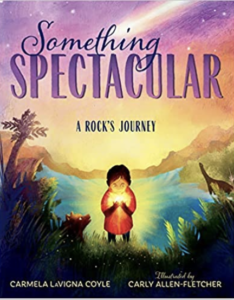
For many kids and adults, Carmela LaVigna Coyle is a rock star for her 20-year series PRINCESSES (starting with DO PRINCESSES WEAR HIKING BOOTS). But my personal favorite is her latest, SOMETHING SPECTACULAR: A ROCK’S JOURNEY (Muddy Boots, illustrated by Carly Allen-Fletcher). Structured as a timeline from about 272 million years to today, this story traces the geological journey of a rock through time, from the sediment on the bottom of a forgotten sea to a sandstone heart found and treasured by a young girl. Layered and lyrical, filled with onomatopoeia and alliteration, this book is a stunning read-aloud. And I’ve marveled at the way Carmela kept the young girl, who does not appear until the last page, central to the story. This book lives up to its name—it is truly spectacular!


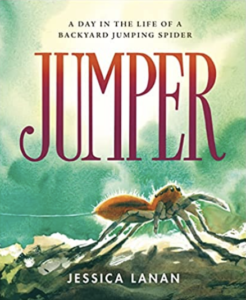
One of the favorite and most influential books of my childhood was BE NICE TO SPIDERS by Margaret Bloy Graham. When I saw RMC author and illustrator Jessica Lanan’s book, I knew it would be a book I would treasure. JUMPER: A DAY IN THE LIFE OF A BACKYARD JUMPING SPIDER (Roaring Book Press, 2023) draws readers in from the very first spread reaching out to ask them to imagine: “What if you were very small? Smaller than a cat or a dog, a bar of soap or a bottle cap. As small as a bean. What would your world be like?” The pages of backmatter are exceptional and include not only a glossary and life cycle and anatomy, but sections on how jumping spiders hear and see and feel—and walk on walls! Jessica’s illustrations, done in ink, watercolor, and gouache, shift back and forth from the perspective of Jumper to the perspective of a child. Both her text and her artwork invite comparisons.
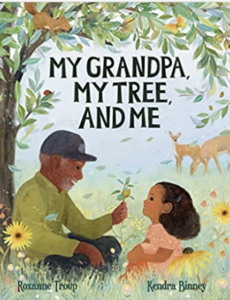
Roxanne Troup lives in Colorado now, but growing up in Missouri, her family (like everyone around) had a pecan tree in their yard. Roxanne’s book MY GRANDPA, MY TREE AND ME (Yeehoo Press, 2022; illustrated by Kendra Binney) flows between the care of a girl’s pecan tree and those in her grandfather’s pecan orchard. Set over the course of a year, the story is so quietly beautiful that it was only on the second reading that I realized it was one of the best examples of a compare and contrast book that I had seen. It’s now one of my favorite mentor texts for that structure. Teachers could use both MY GRANDPA, MY TREE AND ME and JUMPER for a fabulous lesson on two very different and very effective ways to contrast subjects.


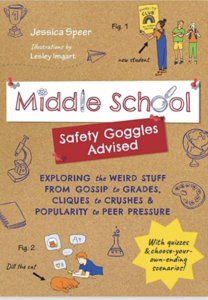
With a master’s degree in social sciences, author Jessica Speer has carved out a niche for her books that blends science and activities with true stories. In researching her latest book, MIDDLE SCHOOL: SAFETY GOGGLES ADVISED (Familius, illustrated by Lesley Imgart), Jessica spent time in conversation with a hundred middle schoolers, asking them what their greatest challenges were, and those top concerns became the chapters in her book. Coming out in August, Jessica has a book that most families with kids will need: THE PHONE BOOK: STAY SAFE, BE SMART AND MAKE THE WORLD BETTER WITH THE POWERFUL DEVICE IN YOUR HAND. For authors, her books are fabulous mentor texts, not only for engaging and interactive books, but for activities that can be included as resources either within a book or on websites.
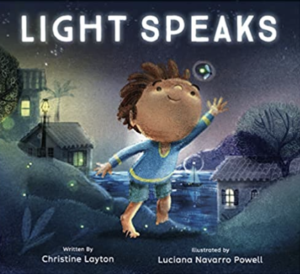


Christine Layton’s picture book LIGHT SPEAKS (Tilbury House, illustrated by Luciana Navarro Powell) is so gorgeous that it brought me near tears. Using spare, poetic text, she introduces the physical properties of light to very young listeners. As a former volunteer in the space section of Denver’s Museum of Nature and Science, I especially loved this spread: “Light tells the space between stars. It echoes off planets and moons—doppled, glowing and brilliant.” Christine’s brilliant backmatter takes each of those properties and explains them each in more detail.


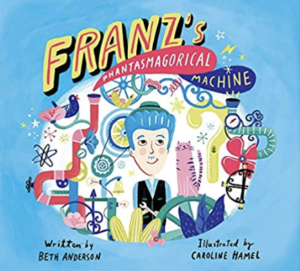
Beth Anderson had not one but THREE (!!!) books come out this past year. Beth is a master at picture book biographies and in finding the heart layer, that lens or angle or viewpoint that makes her subject matter and her book stand out. Her biography FRANZ’S PHANTASMOGORICAL MACHINE (Kids Can Press, Illustrated by Caroline Hamel), about the self-taught inventor Franz Gsellmann, celebrates the drive to build and create and invent—just for the sake of invention—and to not give up. Beth’s books are all so well-crafted that I find myself turning to them again and again for insights on language choice, structure, and most of all, heart.

I hope that you too find yourself drawn to this incredible list—for reading, for gifting, for learning the craft of nonfiction writing. Enjoy!

3 Comments

Filed under 2023, Nonfiction, RMC-SCBWI, Susan Wroble

Get Ready To Submit Your Novel!

By Rondi Sokoloff Frieder

As I get ready to submit my latest middle grade novel to agents, I am filled with a mishmash of emotions. I’m excited, nervous, anxious, and dare I say it… petrified! I have been working on this book, on and off, for over ten years. It has been written, critiqued, revised, workshopped, re-imagined, edited, and rewritten. This is my seventh draft. And although it is way better than when I started, I am still filled with a case of the jitters as I get ready to set it out into the world.

I love this book. And I’m hoping agents and editors will, too.

If you are also getting ready to submit your novel to agents, please keep the following in mind:

  1. You must truly believe that you have done everything possible to make this book the best it can be.
  2. Your critique partners should agree and cheer you on.
  3. Write a query letter. Make sure it is tightly written with a unique hook. Have your critique partners give you feedback and rewrite it.
  4. Draft a synopsis. And get feedback on that, too. This is one of the hardest things to write. Especially if you are limited to one page for a 50,000 word book. Use a template and polish it until it shines.
  5. Create  a short bio. Many agents are asking for this, especially if you are submitting to them on Query Tracker – querytracker.net .
  6. Research agents who are looking for what you have written. You can start with Manuscript Wish List – manuscriptwishlist.com , but make sure to visit the agent’s website to make sure they are still with the same agency. Development editor Susan Chang (www.susanchangeditorialcom) also recommends becoming familiar with Publishers Marketplace and reading the acknowledgement pages of comp books to identify the type of agent who would be interested in your genre. Check social media platforms like Twitter, TicTok, Instagram, and Post.news to see what agents are currently looking for. Go through your conference/webinar notes and identify agents who might be a good fit. Even if the conference was a while ago, mention you attended and went to their sessions. Agents know  writing a book takes a very long time.
  7. Make a spreadsheet to keep track of your submissions. Some people do this on Query Tracker. I do it on Excel and use six columns: Name of Agent, Name of Agency, Date Submitted, Why I am Submitting to this Agent (met at a conference or watched a webinar where they presented), Response Time (if stated), Response Date, Comments.
  8. Tailor your query letter to each specific agent. Tell them how you found them and why your book is right for them.
  9. Send your queries out in batches. I would start with ten–twenty. However, Susan Chang says you can go as high fifty! The industry is glutted right now and agents are busy. She recommends casting a wide net.
  10. If your responses are mostly form letters (or no response at all which is THE WORST!), you probably need to rework the query letter or look at your first ten pages. Perhaps you can improve the writing or amp up the pacing. If you are getting personalized rejection letters, you are on the right track. Send out another batch. If you get requests for partials or fulls, CELEBRATE!!!! You are getting close.
  11. It may take months to hear from an agent. To keep from getting totally stressed out, start working on your next project. All agents want clients who are building a career. Outline your next novel, take a class, storyboard a picture book, and don’t forget to READ!
  12. Congratulate yourself for completing the process. You had an idea, you developed it, you got feedback, and you put it out there.

I am in the middle of doing all of the above. Like you, I am thrilled to finally be sending this story out into the world. But I am also nervous about the responses I will get (or never get!). And while I wait and obsessively check my email in-box, I will work on my next project.  I have the idea, an outline, three chapters, and a new notebook for journaling. I have signed up for an accountability class and am hoping to workshop this book later in the year. I am pushing on. Because I am a writer. And this is what writers do.


10 Comments

Filed under 2023, Agents, craft advice, critique, Middle Grade, Motivation, Rondi Frieder, Susan Chang

The Secret of Children’s Book Publishing

By Susan Wroble, February 2023

Psssst… Want to know the secret of children’s book publishing? At the Rocky Mountain Chapter of SCBWI’s panel at the CCIRA literacy conference in February, authors and illustrators shared some of the stories behind their stories. The answer? It’s simple and painful, both.

Persistence.

For some, persistence has meant staying focused over time. Author/Illustrator Kaz Windness is truly on fire, with seven book deals this year! But getting to this point? That took twenty years. And learning the industry also meant learning when a book would be best illustrated by someone else. Kaz wrote A BOOK IS A FRIEND (fall 2024) with illustrator Heather Brockman-Lee’s artwork in mind

Author Jennifer Chambliss Bertman joined SCBWI back in 2000. She worked on writing picture books for years, getting nowhere. She was ready to give up when she decided to try writing for an older audience, and began work on her highly successful middle-grade books instead. After 23 years, Jennifer’s debut picture book, A GOOD DEED CAN GROW, was released last month.

Bianca Schultz’s passion is literacy and growing readers. She founded The Children’s Book Review in 2008 with the goal of helping kids and their parents, caregivers and librarians find great books. The first of her popular “Dragon” series was published in 2020.

Persistence can come in other forms. For Laura Perdew, it meant being willing to write about lots of topics. She found one of the short-cuts into publishing—the work-for-hire market. WFH books are typically found in school libraries. The publisher, not the writer, determines the specifications. Laura now has more than fifty WFH books, along with her debut traditionally published picture book, THE FORT.

Author/Illustrator Gregory Barrington had published his first picture book with Harper Collins, but the editor wasn’t at all excited about Greg’s new manuscript. Greg was asked to write a fractured fairy tale instead. He wrote five completely different stories featuring Goldilocks and the Three Bears. He picked his favorite—and was too nervous to submit it. It didn’t come across the way he wanted on the page. Greg decided the solution was NOT to send it. He asked for a virtual meeting, then he read the manuscript aloud. GOLDILOCKS AND THE THREE KNOCKS was released in November.

Albert Whitman had published Jenny Goebel’s book ADELITA, about a sea turtle, when they asked her to write one on insects. No problem, she thought. The catch? They wanted a book on insects as food. By release date, Jenny still hadn’t managed to eat an insect. Imposter syndrome hit hard. The Butterfly Pavilion was all out of edible insects, so Jenny spent the day in search of a bug to eat. Unfortunately, success came in the form of jalapeno-flavored fried crickets. She’s since discovered more easily purchased (and eaten!) “gateway bugs.” And just like her book, they are CHOCOLATE CHIRP COOKIES.

Both Julie Danneberg and Natasha Wing have had incredibly successful series—Julie with the JITTERS series and Natasha with THE NIGHT BEFORE series. And both have worked not only to keep those series going, but to publish in other areas, from nonfiction to jokes.

Sometimes persistence means a lot of research. Author Jessica Speer knew she wanted to focus on problems kids face in middle school. But she wasn’t exactly sure what the biggest challenges were. So she went to schools and listened. She surveyed students. Her book MIDDLE SCHOOL: SAFETY GOOGLES ADVISED focuses on the top ten problems identified by kids.

For authors Andrea Wang and Beth Anderson, persistence has entailed digging deep—sometimes into hard places emotionally—to find the heart of the story. For others, it has been work to find the words. Lynn Becker was hooked by the idea of a sea shanty. Finding just the right words for MONSTERS IN THE BRINY meant literally walking it out, pounding out the beat with her feet. With her novel-in-verse ALONE, author Megan E. Freeman struggled to find the best ways in each poem to convey the story in the fewest possible words, leaving the rest up to the reader.

Author/illustrator Julie Rowan-Zoch was faced with an unusual request—illustrating for a celebrity author. Saturday Night Live’s actor Bobby Moynihan had submitted sample illustrations with his manuscript NOT ALL SHEEP ARE BORING, but the publisher reached out to Julie instead. Many of her initial sketches were turned down before Julie hit the type of compositions the publishers felt comfortable with for this book that they knew would have a huge circulation run.

COVID in the family kept author Kellye Crocker from the CCIRA conference, but PAL Liaison Rondi Frieder told teachers about her book. What Rondi didn’t tell them was that DAD’S GIRLFRIEND AND OTHER ANXIETIES had been hit by supply chain problems, and the publication date had been delayed by months. Then the books didn’t even arrive on time for the rescheduled publication date. Kellye refused to give up, and held a launch party with advance reader copies of the book!

Sometimes, it is the characters who are persistent. Heather Mateus Sappenfield was an adult and YA author. When a fully-formed 12-year-old character named Rill hit her mind, Heather wasn’t remotely interested in writing middle grade. It took Heather and Rill more than a year together before Heather realized that Rill was just the right person to tell an important story. As a teacher, Heather had sometimes walked into her school to find clusters of children, crying. Their parents had been deported the night before. After her book was published, Heather almost threw away an envelope from the Colorado statehouse, assuming it was junk. Instead, it was a treasure—the Colorado General Assembly acknowledged her book’s importance in the state.


Whatever the form it may take for you, the secret is clear. Stick with it. Persist.

8 Comments

Filed under 2023, CCIRA, Persistence, RMC-SCBWI, Susan Wroble