Category Archives: 2022

The Stories Hidden Inside You

By Rondi Sokoloff Frieder

At this year’s RMC-SCBWI Letters and Lines Conference, I attended an afternoon intensive entitled “Generating Ideas From Your Own Experience.” It was led by the multi-award-winning-Colorado-rock star-author, Andrea Wang https://andreaywang.com/, and was filled with useful tips and strategies. The goal of this workshop was to uncover important moments in our lives that could inspire the development of our next story, while also enhancing our current projects. For me, it did both!

We began with lots of  writing exercises. They were quick – less than five minutes for each prompt – and hand-written in notebooks. (I also brought a set of thin colored markers to make the writing more fun.) Apparently, this fast-paced format was crucial to unlocking the most visceral of memories; experiences that had a dynamic emotional impact on our lives and lurked just below the surface. I was amazed at what I remembered. Detailed anecdotes that had been  buried inside me for years, even decades, were waiting to burst forth.

Many of the prompts Andrea used in the workshop came from the New York Times writing list “650 Prompts for Narrative and Personal Writing”: https://static01.nyt.com/images/blogs/learning/pdf/2016/650promptsnarrativewritingLearningNetwork.pdf. This list includes everything from Overcoming Adversity to Animals and Pets to Meals and Food and Friends and Family. It’s a fabulous resource for jump-starting your creativity.

So what gems did I uncover as I scribbled pages and pages of my memories in green, orange and turquoise? There were detailed descriptions of my family, my childhood neighborhood, the ins and outs of friendships over the years, favorite foods, games, family trips, toys, sports, hobbies, school experiences, and impactful teachers. Many memories focused on my mother who was the child of Hungarian-Jewish immigrants and a first-generation American. She was clearly determined to expose us to a myriad of experiences. These included a wide variety of sports, all the arts, warm family gatherings, musical holiday celebrations, delicious foods with a Hungarian twist, and a strong emphasis on doing well in school.

I also discovered hidden memories about summer camps I attended, concerts I went to, friendship issues, boyfriends, my biggest successes and failures, and why fall is my favorite season.  Details about broken bones, having my tonsils out, visiting my mother-in-law every week in a memory care facility for three years, and how upset I am about gun violence in this country came pouring out of me. There were also many stories that revolved around raising my two sons and two golden retrievers here in Colorado.

After each prompt, we took time to share what we had written. Some people felt comfortable reading their entire pieces aloud, while others shared a quick synopsis. One thing became obvious from the get-go. These untapped memories were deeply rooted inside us and filled with emotion. Some stories made us laugh, while others caused us  to tear up. And some were not for sharing at all. Not yet. The memories were too raw. But Andrea encouraged us to use these  emotional memories in our stories whenever possible. She told us how she used her own family stories to create two of her most recent books: WATERCRESS (Neal Porter Books) and THE MANY MEANINGS OF MEILAN (Kokila). Her honesty and vulnerability were  inspirational. But she also said  you don’t have to write an autobiography to utilize these memories. You can integrate them into your settings, your characters’ flaws and  problems, and your plot points. It’s the use of  the emotional component of your memories that counts. This is what will keep your reader turning the page.

For me, the sharing of our stories was the most powerful part of the workshop. Everyone was so passionate about what they had experienced. And  that clearly included me. Because the next day, a fellow attendee emailed me, suggesting  I consider using one of the stories I told as my next book idea. And guess what? I’ve already created a detailed outline and written three chapters! That story was in me all the time waiting to be told and I hadn’t even realized it.

So dig in, fellow writers. Mine your brain for memories and start working on your next project. You never know what you might discover.

Other places to find writing prompts:

https://blog.reedsy.com/creative-writing-prompts/

https://thinkwritten.com/365-creative-writing-prompts/

https://www.writtenwordmedia.com/500-writing-prompts-to-help-beat-writers-doubt/

https://www.writersdigest.com/prompts

https://thewritepractice.com/inspiration/writing-prompts/
2 Comments

Filed under 2022, Caldecott Medal, craft advice, Main character, Motivation, Revision process, Uncategorized

The Secret Agent Files: Notes about Agenting

By Susan Wroble

“Why,” asked a woman near me, “is it so very hard now to find agents who want to represent picture books? I can find plenty of agents for Middle Grade and YA, even for graphic novels and author/illustrator books. But finding one to come to our conference that represent author-only picture books is getting really tough.”

It was a great question, and was addressed to an industry panel during the Regional Team meeting of the Society of Children’s Book Writers and Editors in New York in October. Our chapter has the same problem. We have lots of members who write picture books, but finding agents who would be good fits for our conferences and who are also open to picture book submissions is hard.

The answer, of course, was money. Stacey Barney is an Associate Publisher at Nancy Paulson Books, an imprint of Penguin Random House. She explained that picture books simply make less money than other formats for everyone involved, including the agents. It doesn’t mean that you can’t find an agent for a picture book. It does mean—like so much else in this industry—that it takes persistence.

Writers often talk about their “training books,” the first books they wrote when they were learning the process. Almost always, those books are languishing in some file, never having made it to print. But Stacey talked about an entirely different set of training books as she explained the publisher’s ‘Rule of Three.’ “You start by buying a book you love,” she explained, “and you build up a good rapport with the author. By the time you get to their third book, you have established the author in this industry. The first and second books are like a training camp. They won’t be break-out best-sellers. With the third, the author has arrived.” That means that an author’s beloved debut novel—the one that finally made it to print after writing a few others—is, for the publisher, just the first of the training books. For me, that comment explained a lot about agents’ and publishers’ desires to help build a career, not publish one book.

A week later, I attended an agent panel put on virtually by SCBWI Metro New York that provided additional insights into the author/agent relationship. One question asked of each of the three agents (Saba Sulaiman at Talcott Notch, Linda Camacho at Galt & Zacher, and Eve Adler at Red Fox Literary) was how they got their clients. Surprisingly, meeting someone in person at a conference was low on each list. However, the majority of clients came in through the query inbox. The catch is that many agents are closed, with the only way to submit through attending a conference or workshop. So those conferences and events remain an essential way to reach agents.

Given that, it may seem that cost is a barrier to entry, but that isn’t necessarily true. The panel I attended was free. More than five hundred people signed up. And each of the agents who presented has opened their submissions to all attendees at the panel if they have works that fit.

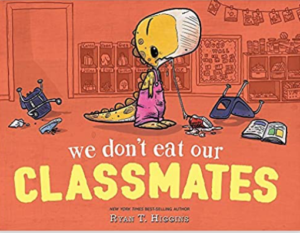
The panel’s moderator was Harold Underdown, Executive Editor at Kane Press and creator of The Purple Crayon website, a gold mine of information on children’s publishing. Harold asked the agents about recent developments in the industry, and the answer was fascinating… they recommended leaning into the weird. Specifically, they noted that neat genre categories are blurring. Saba Sulaiman noted that “there is a thirst for stories that blur genre, like a horror comedy. We want the weird!” Linda Camacho backed this up, saying that “there is a need for escapism, and a thirst for horror and for romance. Blurring genres tends to provide more avenues for creativity.” As an example of blurred genre in picture books, Saba recommended looking at Ryan T. Higgins We Don’t Eat Our Classmates. “It’s a totally unexpected dinosaur book, that funny, sweet, cute and is also a first day of kindergarten book.”

Harold also asked about tips and best practices in terms of searching for an agent. Some of the best resources are agency websites, SCBWI’s Essential Guide, Manuscript Wishlist, and Query Tracker. In addition, Saba recommended getting a short-term subscription ($25 for one month) or a limited subscription ($10 for a day) to Publisher’s Marketplace.  And then, she suggested, pay attention to the pitches. “It’s a great way to learn how to pitch a book.”

And that may be a great way to land one of those elusive agents!

3 Comments

Filed under 2022, Agents, Harold Underdown, Picture Books, RMC-SCBWI, Saba Sulaiman, Stacey Barney, Susan Wroble

What I’m doing now: Wrestling With Feedback

By Rondi Sokoloff Frieder

“I love that part!”

“Really? It didn’t work for me.”

Last summer, I attended “The Whole Novel Workshop” on the idyllic campus of the Highlights Foundation in the Pocono Mountains of Pennsylvania. I brought along a middle-grade manuscript that had been revised numerous times, and got ready to make it sparkle and shine.

Before we got started, one of our faculty members gave us an introductory pep talk. “Just so you know,” she began. “All of you will have to rewrite your books. This is why you are here. But don’t worry, you can do it.” Most of us had to be thinking the same thing: “Maybe some people have to redo the entire thing, but my book is amazing. It just needs a few tweaks and a bit of trimming.” To this I now say, LOL!

Despite my overconfidence, I decided to open my mind to possibility. I listened to the suggestions of my Brain Trust partners and marveled at the insights of our well-published faculty. I threw myself into the writing exercises that revealed twists and turns I hadn’t considered. I reworked my plot. I played around with present vs past tense. And most importantly, I thought long and hard about the crucial themes in this story. What did my protagonist really want?

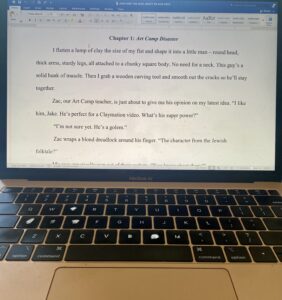
When I got home, I continued the work. I eliminated unnecessary characters (at least four), I changed the personalities of two of my secondaries, and enhanced components of the story that would make it funnier. Then, after months and months of revising, I gave this new draft to my always brilliant SCBWI critique group, The Story Spinners. My husband and son also volunteered to read the book, and I sent ten pages and a synopsis to an agent who was doing critiques at the RMC-SCBWI fall conference. The book was definitely stronger, but there were new elements that needed to be evaluated. I was too close to the story to know if they were working. While I waited for my readers to plow through the manuscript, I threw myself into another project.
A month later, the feedback began to roll in. And while there was a great deal of consensus, my readers also had conflicting responses. This was when the “wrestling” part of the revision process set in. Who should I believe?

This is the nature of critique. Some comments will be subjective while others will be quite valid. Here’s the rule of thumb: if something in your manuscript is bothering three or four readers, you must consider making the changes. But, if you really want to keep this section in your book, you must make it stronger. For example, one of my critique partners loves when my main character hears his deceased great-grandfather’s voice in his head. But another reader said it didn’t add anything to the story and that I should cut it. I wrestled with the possibilities. Hmm, what to do? Well, I also love the voice of the great-grandfather. Only this feedback let me know that if I want it to stay in the book, I need to amp it up and make it a more integral part of the story.

There were also sections of the book that were flagged by a reader who had a particular expertise. My sporty son said one of the baseball scenes was unrealistic. Another said a parade would never be in the late afternoon. They both had very good points. I fixed both of these things immediately.

But the most important thing I did as I “wrestled with feedback” was to put the manuscript aside. I did not begin revising for two long weeks. I let my readers’ notes roam around in my subconscious and take shape. I also took a lot of deep breaths! Because getting feedback on your creative work can be extremely overwhelming and downright discouraging. Taking a break from the “noise” helped me get back to work with a more positive outlook. I was also more open to making the changes I was resistant to when I first heard them.

Eventually, I was ready to dig in. I pulled up the line edits and read each and every one. I considered all the possibilities and made choices. I finished the revision. Then I sent it off to one more trusted reader – a person who has not read the entire book. He will see it with fresh eyes. Some of his comments will resonate, some will not. I will wrestle with this. Because this is what writers do. We write, get feedback, and rewrite. And as the author who coached us at Highlights said, I CAN do this. And so can you.


6 Comments

Filed under 2022, craft advice, critique, Motivation, Revision process, Rondi Frieder, What I am doing now

Lessons from the Booksellers

By Susan Wroble

Over the summer, I had the opportunity to attend three different events hosted by the Rocky Mountain Chapter of SCBWI that focused on relationships with booksellers. First, RMC’s Perfect Partners webinar featured a panel of five local Indie booksellers:

Later in the summer, the chapter’s PAL (published and listed) group gathered at the Wandering Jellyfish bookstore for a session hosted by Jerilyn Patterson and Carissa Mina. Finally, the RMC Northern Colorado Connect hosted author Susan Kusel, who has held jobs as both a librarian and book buyer, focused on how your book gets into bookstores and libraries.

The three events differed in scope but complemented and built on each other. The biggest takeaway? As Jerilyn Patterson noted, “The big A can’t do community.” That’s the role and the benefit of Indies.

Indie Bookstores and Bookshop.org:

If you are looking for independent bookstores, search IndieBound. Type in a city or a zip code, and you’ll get a map and list of all the local Indies.

Once you know the Indies around you, start using Bookshop. Bookshop.org launched just before Covid as an alternative to Amazon for socially conscious shoppers, and their platform was instrumental in helping Indies survive the pandemic shutdowns.

As an author or illustrator, you can set up a Bookshop link—but don’t! As a creator, you will get back only a very small percentage back on each sale from Bookshop. But if you have an Indie sell your books through Bookshop links, they earn 30% on each sale. That is enough to make a huge difference in their bottom line, and helps keeps these stores stay afloat. Here are the takeaways:

  • As an author or illustrator, select and work with a local Indie. Have the buying link on your website for your books go to that Indie’s bookshop page.
  • When you want to buy a book, go to Bookshop.org, click on “choose a bookstore” on their top menu, and from their map of participating bookstores in that area, click on “Support this Shop!”
  • Don’t post Indie buying links in the same post as Amazon buying links. Amazon already sells 60% of books in the US with a growing market share, and the Indies need all our support.

Developing Relationships with Bookstores:

  • Follow bookstores and engage with them on social media. This engagement can be as simple as taking a selfie outside of their store, perhaps with a book that you bought. Respond to their posts with a share or a comment or an emoji.
  • Attend events at the bookstores.
  • Email or text or message and social media the bookstore to introduce yourself, or talk to them while you are there—they want to hear from you. Megan E. Freeman, RMC Webinar Coordinator, recommends bookstore tourism, visiting Indie bookstores at each place you travel!
  • If you can go into the store in person, give advance notice. This allows them to round up your books to sign—and perhaps, given enough advance notice order additional books for signing.
  • Follow the Indies not only in your area, but also in the area where you grew up. As Susan Kusel noted, developing a relationship at the bookstore near where your mother lives is especially important, because family friendships lead to book purchases!
  • SWAG: Bookmarks are the best. Bookstores can set out your bookmarks on the counter and put them in books in a similar genre to promote your book. Temporary tattoos or stickers are also really popular. Don’t send postcards—the bookstores can’t really do anything with them.
  • Bookstores work with publishing sales reps to order books. If you would like local bookstores to carry your books, you need to notify them very early in the process (as soon as you know release dates and long before the actual release), so that they can order copies.

Launches and Events at Bookstores:

  • Visit all the local bookstores and explain that you are a local author with a book coming out. Give an ARC (Advanced Reader Copy) if possible. Shelf Awareness has free newsletters about newly released books and the book industry. Indie bookstores can tailor the copy of Shelf Awareness that they send to their mailing lists, and they will often tailor that to highlight local authors and illustrators.
  • Select one local Indie as the one you will feature to pre-order signed copies that buyers can pick up in the store, or have mailed from there. Use that bookstore for your book launch.
  • If possible, set up a date to go into the bookstore in advance of your event to plan things out.
  • Work with the bookstore to develop a plan for your event—and it needs to be an event, not just a book signing. Brainstorm activities with the booksellers for events that could generate excitement.
  • Tie the event into your book. For example, Megan E. Freeman, whose middle grade book ALONE is in free verse, held a poetry workshop, and Kaz Windness, whose picture book book SWIM, JIM! is about overcoming fears, hosted a pool party parade.
  • Public speaking can be scary. Consider joining Toastmasters if you need practice in engaging your audience.
  • Publicize your event—bookstores do a lot of different events, so they need your audience. The most successful events are a true partnership. There are events where no one shows up, and the difference between those events and the highly engaged ones is often the amount of advance planning.
  • Celebrate the release of a paperback version as if it is a brand-new book, and plan events.

A Few Notes on Libraries:

Unlike bookstores, libraries are ordering books much later in the release process, often after the books have been released and almost always after the initial reviews have come out.

  • Request that your local library carry your books. It is perfectly acceptable for an author or illustrator to submit a request for their own books—and you can have your friends ask too!

Book Reviews:

Posting a supportive book review is a fabulous way to support other creatives, and it can lead to more sales at bookstores. Goodreads is the world’s largest site for book recommendations. It is owned by Amazon, and you can post the same review in both places. You can post reviews on Amazon without buying the book from them. Collect good karma and post, post, post!

  • As you read mentor texts and comp titles, post reviews of the books you enjoy.
  • Post reviews of books from any group you are in (critique groups, debut groups, SCBWI groups, classes…)
  • If you have friends writing work-for-hire (WFH), post reviews of those books as well. They don’t tend to get reviewed, but those rare reviews are incredible gifts, because they can be used in the author’s press kit and promotional materials.

Looking forward to hearing tips from others — please add your suggestions in the comments!

1 Comment

Filed under 2022, RMC-SCBWI, Second Star to the Right Book Shop, Susan Wroble, Wandering Jellyfish

Revising OUT LOUD!

By Rondi Sokoloff Frieder

Ever since I made the decision to become a serious writer, members of my family have asked me to edit their writing projects. I have said yes to college essays, business presentations, and even a Master’s thesis. But before I ever agree to do this, I always require the writer use one important self-editing tool – they must read their work out loud! They can read it alone in a quiet room or give a dramatic performance for the dog. It doesn’t matter, as long as they do it. This may sound like a common revision strategy to those of you who have been writing for a long time. But believe me, many people skip this step.

You can begin by reading whatever you have written out loud to yourself. It’s amazing how helpful this is, particularly for creating snappy dialogue and getting rid of repetitive words. You should also record yourself using the Voice Memo app on your phone and then listen back. I use this for first pages and sections with high tension. If you are writing a picture book, listening to yourself read the manuscript  will give you a good sense of rhythm, flow, and word choice.

It is also helpful to have someone from your critique group read your story out loud to you. This will help you hear how easily the book can be read by a parent, teacher, or child. But if you are writing something longer, you may want to have your computer read to you.

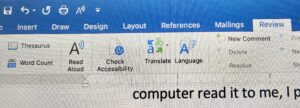
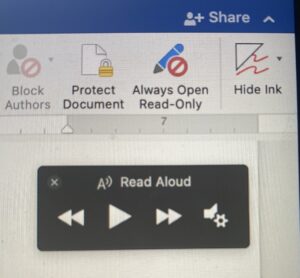
That’s right, your computer can read!  If you use “Microsoft Word,” this tool can be found in the “Review” section. Just click on “Review” and look for the “Read Aloud” icon in the top menu bar. Most versions allow you to adjust the speed and gender of the voice. I must warn you though, the voice of this reader is quite flat. There will be no emotion expressed, except for a slight shift when the computer comes to a question mark. If this monotone voice annoys you, there are other programs that have more versatility. My son recently bought one called Speechify. Speechify gives you the choice of a variety of voices and accents and has a much more human tone.

Despite its lack of intonation, I find the Microsoft Word “Read Aloud” feature surprisingly helpful. My middle grade novels range from 40,000 to 60,000 words. It would be almost impossible to have another person read an entire book out loud to me. And when you read to yourself, you miss things. Your brain is ahead of your voice and you are much more focused on plot, rather than word choice and repetition. I just finished having my computer read my latest WIP  before sending the manuscript out to my critique group.


Here’s what happened:

  1. I eliminated 4,000 words. Seriously, 4,000!!!! Many were words I used too much throughout the manuscript, or used too many times on a page. The biggest culprits were: I mean, that, you know, today, right, around, about, on, up, down, back, really, but, pull, nod, smile.
  2. I got rid of unnecessary sentences. One of my worst habits is saying something is going to happen and then have it happen. The actual action is almost always enough.
  3. I got rid of entire paragraphs that DID NOT move the story forward. These were often over-descriptions of a setting or character, or a conversation that went on for too long.
  4. I omitted adjectives, especially colors, sizes of things, and over-descriptions of food.
  5. I tightened up punctuation,  eliminating and adding commas, and getting rid of exclamation points!!!!

I also added things:

  1. I enhanced emotional reactions to action, but made sure they were not overly physical.
  2. I added details that clarified information for the reader. Sometimes, these things were in my mind, but not on the page.
  3. I made sure that changes to the story were consistent throughout the manuscript, especially when I eliminated characters.
  4. I added small words that I had accidentally left out, particularly a, the, in, on, to.
  5. This story used to be in past tense, but I switched it to present. When the computer read it to me, I picked up on places I missed making the changes!

As you probably know, this is not the final version of my book. I will be getting another round of feedback from my critique partners in early July.  And after I review their comments, and input the suggestions that resonate, the dog and I will settle back into my studio and have that Microsoft Word lady read the book to me again . OUT LOUD, OF COURSE!

Authors note: I used the “Read Aloud” feature for this blog!

9 Comments

Filed under 2022, Computer tricks, craft advice, critique, Revision process, Rondi Frieder, WORD NERD

PBParty — Something to Celebrate!

By Susan Wroble

February 28, 2022. Denver, Colorado.

During our Story Spinners Critique Group, member Beth Duncan asked if anyone was submitting to PBParty. “What’s PBParty?” I asked.

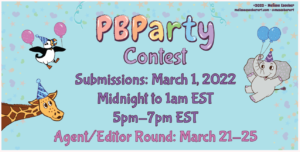
For those of you as in the dark as I was, PBParty is an annual contest for unagented picture book writers and illustrators, hosted by author Mindy Alyce Weiss. Submissions (just the first 70 or so words of manuscripts) are judged, finalists are selected, and agents and editors are invited to look over the entries.

The submissions window, it turned out, was that night. In fact, with the time zone changes, it was just after our meeting ended. I had a very polished manuscript with an accompanying query letter in my files. Why not? I filled out the submission form, pressed send, and promptly forgot about it. Those weeks were a little busy…


March 17, 2022. Cerritos, Mexico.

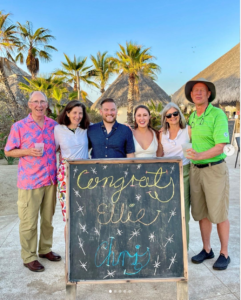
On a beach on west coast of the Baja peninsula, surfers rode into shore, a pelican floated in the pool, and my husband and I were engulfed in hugs as friends began to arrive for our daughter’s wedding that weekend. That’s when, unexpectedly, my phone rang. “Susan!” Beth said. “You’re a PBParty finalist!”


March 25, 2022. Denver, Colorado

With rather spotty wifi at our hotel (and a few other things going on right then!) it took another week and the return home for me to begin to understand PBParty.

The 2022 team of PBParty judges (Mindy Alyss Weiss, Matt Tesoriero, Gabriele Davis, Lori Degman, Jenna Waldman, Aixa Perez-Prado, and Sylvia Chen) sifted through nearly a thousand submissions to select the finalists: fifty manuscripts and twenty in the illustration showcase. Those were posted on a site for agents and editors to review. If the editors and agents were interested, they would request the full manuscript or portfolios. Over on the PBParty Facebook site, it was hard to keep up as Mindy posted requests. By the end of the week, more than FIVE HUNDRED had come in!

Not everyone got a request, some got many. And this is where Mindy’s magic really shines. From those who never heard anything, to those who signed with agents and editors, to those (like me) still on the journey waiting to hear back to find out if their work will be picked up—every one of us felt like a winner. The Facebook community of past and present finalists was always there to answer questions, support, commiserate, and celebrate. To call PBParty a contest is not doing it justice. Mindy has achieved something far more difficult. She creates community. And that is truly something to celebrate!
2 Comments

Filed under 2022, PBParty, Susan Wroble

Writing Alone, But Together

I’m done. No, not with my revising. Darn it. But, even better, at least from my birds-eye view: I’m done trying to feel like a writer and I am darn giddy to report that I no longer imagine suppose-to’s, like cozying up my studio or writing at coffee shops. No more! For the past few years, I have been a writer; I have kept my behind in a chair. Yes, I still slug through, mumble ugh, write total crap… Doesn’t matter. I am writing!

I know I’m not the only writer who has tried to feel like one. Maybe I’m growing up as a writer. Hear ye! Finally. Oh, I have a long, long way to learn. But I am saving a lot of time – getting right to writing, instead of fussing with lighting candles (great if helps you!). Now, I arrive at one of my favorite writing spots – my studio or kitchen table – and do my quick set-up: cups of java and water to left of laptop, paper and pen to right, blanket o’er my lap, timer set. By the way, my red-black plaid blanket is full of childhood stories from when I would use it to build forts, watch tv, trick ‘n tease with my brothers.

A brief trip back to those days… I always needed complete quiet to do my homework. I vividly, fondly recall high school nights – my brother Jim at one end of our long Formica kitchen table, me at the other. We read, took notes and penned essays in silence, while our dad was at his second job, our mom and youngest brother sound asleep, our oldest brothers away at college. Even though Jim was a quick study, whipping through homework while jotting social plans, he always checked in with me. It was as if he knew the exact moment I got restless, started daydreaming. “How ya doing, kid?” he would say. Whether I grumbled frustration or not a word, he would smirk, jump up and open the fridge. Message: Let’s take a break together.

Together. Today, I still need complete quiet when I write (and lotsa jumping up, taking breaks!) and to be with other writers. I prefer writing alone, but together. So, that’s what I’ve created for myself – being with other writers, being held accountable. Every week, I get and give plenty of “how ya doing?” check in’s and everyone is a-okay with a short answer or not a word. We’re sticking together.

Here’s my list of formal and informal sessions that keep my behind in my chair. There are plenty more, including for writers who prefer chatting, music, dogs barking, prompts… You go! My sessions – with strangers or writer friends – guarantee someone is at the other end of “the table” and we’re together writing in silence. And, I get to stay in my favorite spot! May you, too, find your table and whoever you need at the other end.

Virtual Sessions: Writers from across the globe, including many U.S. SCBWI members.

Writers’ Hour https://writershour.com/

3 times daily Monday-Friday

The Chicago Writers Circle meetup.com/The-Chicago-Writer-s-Circle

1 time daily Sunday-Saturday

My (Private) Writing Session:

Text Partner: I write with a long-time writer friend minimum twice weekly. We text at start and end. Revs my creativity and writing!

My Accountability:

  • Monday Morning E-mail: I exchange weekly goals and accomplishments with other children’s writers. Keeps me honest, nudges me.
  • YA Accountability Partner: Email and phone call meetings. Motivating!
  • Story Spinner SCBWI Critique Group: We meet twice monthly for feedback on manuscripts, query letters, ideas, outlines, research, etc. Can’t imagine writing without them!!
  • SCBWI British Isles Group: E-mail check ins. Inspiring!


I am writing the success of my every breath.
–Mahogany L. Browne, award-winning author of CHLORINE SKY and other YA novels, board books

I have never heard a more eloquent silence.

–Laurie Halse Anderson, award-winning author of SPEAK and other YA novels, picture books

3 Comments

Filed under 2022, craft advice, critique, Karen McChesney, Picture Books, Revision process, RMC-SCBWI

2022 Picture Books To Look Forward To – According to Me.

Hello friends!

In my non-writing life I’m a librarian and recently I had the opportunity to share with patrons some picture books I think will be standouts in 2022. I thought I would share those same picture books with you you! Some disclaimers first:

  • These are books a) I think will be big sellers and/or b) look cool or important to me. HIGHLY subjective.
  • I’ve only actually READ a few of them, so my assessment is based on the past successes/work of the authors and illustrators, the covers, and publisher summaries.
  • Most, if not all, of these will be published in the first half of 2022.
  • I’m sure I missed a lot of great books because while I looked at several sources it’s impossible to know EVERYTHING that is coming out in 2022. Also I only had 20 minutes for my part of the presentation so I definitely had to be selective. There were more on my list.

So, without further ado, my picks. Add yours in the comments!

BOARD BOOKS (Ages birth – 2)

  • I’m Up and I’m Still Up by Antoinette Portis 
    • Companion books about a baby who is… you guessed it, awake. With repeating words and shapes, this will be a regular read-aloud.
  • Puppy Dog, Puppy Dog What Can You See? by Amelia Hepworth and Pintachan 
    • You can’t go wrong with an interactive lift-the-flap! For babies and toddlers, this will be a sure hit. Ask the question and then look at the hints to guess before lifting the flap to see if you’re right. Includes a mirror at the end to even further involve your little one in the story! Others in the series are Ladybug, Little Hen, and Elephant 
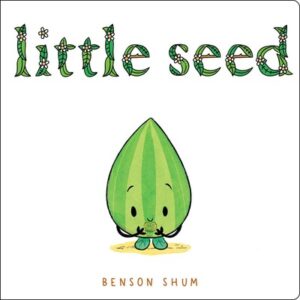
  • Little Seed by Benson Shum 
    • How cute is this? Little seed wants to hug the whole world! How do you hug a panda? An armadillo? 
  • My Nap/Mi Siesta and My Party/Mi Fiesta by Raúl the Third and Elaine Bay 
    • From the team behind the ¡Vamos! books we have this bilingual board book series featuring their character Coco Rocha who is, yes, a cockroach.  
  • First Morning Sun by Aimee Reed and Jing Jing Tsong 
    • Sharing your child’s milestones with rhyming text and beautiful illustrations. 
  • Boop the Snoot by Ashlyn Anstee 
    • What kid doesn’t want to be invited to “boop the snoot” of various animals? I might get a copy of this for myself, it looks so cute.  
  • Baby Bug by Wednesday Kirwan 
    • Baby bug explores the natural world and learns how to wiggle, roll and splash from her creepy crawly friends. The thick,dark outlines on the pictures make this a great book to share with babies under 1 whose eyesight is still developing!  

BOOKS FOR TODDLERS (Ages 1 – 4)

  • Little Pups in Big Trucks by Bob Shea and Brian Won (Adurable series) 
    • This is a new series by two book creators I love, Bob Shea and Brian Won. These puppies are just beginning puppy school. But when their teacher is stuck under some rocks, they’ll have to use everything they’ve just learned to help her!  
  • How To Say Hello to a Worm by Kari Percival 
    • The subtitle for this book is “a first guide to outside.” And that’s just what it is – a guide for littles on engaging with nature.  
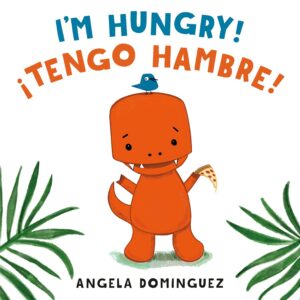
  • I’m Hungry/Tengo Hambre by Angela Dominguez 
    • Another great bilingual title from Angela Dominguez that seamlessly blends the two languages. Dinosaur is hungry, and bird is trying to figure out what he wants to eat.  
  • Little Cat Hide and Seek Emotions by Audrey Bouquet 
    • This looks like a sweet and fun way for children to learn the names for different emotions – which goes a long way toward easing their frustration when they don’t have the words to tell you how they feel.  
  • Big Green Garage by Jen Arena and Mike Dutton
    • The book advertises “15! Satisfying!  Novelty! Elements! And that is enough to pull any child in. Flaps to lift, gears to turn, tabs to pull and levers to… lever?  

FAVORITE AUTHORS/ILLUSTRATORS (All ages but mostly 3+)

  • Endlessly Ever After by Laurel Snyder & Dan Santat 
    • Fractured Fairy Tale! Choose-your-own-adventure! What’s not to love? 
  • The Blur by Minh Le and Dan Santat 
    • The team behind Drawn Together brings you a new superhero: THE BLUR. This child is able to do everything with supersonic speed, including growing up. Parents, sound familiar?  
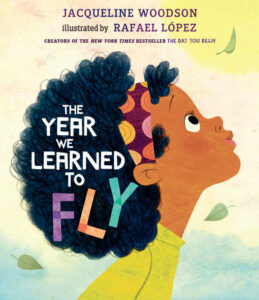
  • The Year We Learned to Fly by Jacqueline Woodson & Rafael López 
    • From the team behind The Day You Begin! Two children hear from their grandparents how their ancestors used their “brilliant and beautiful minds” to show their strength and resiliance. The children then follow suit, using their imaginations to overcome boredom dream of what might be.
  • Somewhere in the Bayou by Jarret & Jerome Pumphrey 
    • By the authors of the award winning Old Truck and last year’s Old Boat. A group of swamp critters discover that the log they’re using to travel across the pond isn’t a log after all.  
  • Hey Bruce! By Ryan T. Higgins 
    • Another title in the super-popular Bruce series! In this outing, readers follow the geese’s instructions to make Bruce do whatever they want. It’s interactive! 
  • Creepy Crayon by Aaron Reynolds and Peter Brown 
    • First we had creepy carrots, then a creepy pair of underwear, and now a crayon gets creepy! The first two in the series were super popular, so there’s no doubt this one will be too.  
  • Everything Will Be Okay by Anna Dewdney and Judy Schachner 
    • Little Bunny is having a bad day. In this rhyming story, Bunny finds some good in a day that starts out with a lot of bad. From the author of the Llama Llama books and illustrator of Skippyjon Jones.  
  • Believe in Yourself: What We learned from Arthur by Marc Brown 
    • For your nostalgia needs, Marc Brown has brought back his beloved character Arthur on his 25th anniversary. Filled with quotations and life lessons – this will be a popular book for graduation gifts!  
  • Llama Llama Back to School by Anna Dewdney and Reed Duncan 
    • While Anna Dewdney sadly passed away, this popular series (also now a Netflix show) continues.
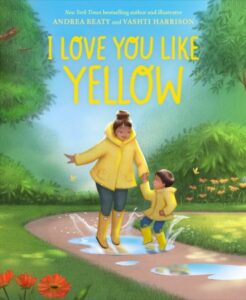
  • I Love You Like Yellow by Andrea Beaty and Vashti Harrison 
    • Andrea Beaty wrote the Ada Twist, Scientist series and Vashti Harrison wrote and illustrated the Little Leaders series – both New York Times bestsellers. This rhyming book celebrates unconditional love.  
  • Love You By Heart by Peter H. Reynolds 
    • Peter H. Reynolds is the author/illustrator of the “Creatology” series that includes The Dot and Ish and other bestselling books. This celebration of love will be a popular gift book.  

NEW AND NOTABLE (All ages but mostly 3+)

  • I Forgive Alex by Kerascoet 
    • From the team behind  I Walk With Vanessa. A boy named Alex upsets a friend and must ask for forgiveness. Wordless.
  • Being a Dog: A Tail of Mindfulness by Maria Gianferrari and Pete Oswald 
    • Enjoy the day with a child and their dog and follow the cues to bark, wag and sniff along. Backmatter includes a mindfulness walk you can take with your little one.  
  •  Beauty Woke by NoNiequa Ramos and Paola Escobar 
    • A puerto rican girl feels great about her heritage and how she looks but later starts doubting as she grows older and sees how people who look like her are treated. Her community helps her find that pride again! 
  • A is for Bee: An Alphabet Book in Translation by Ellen Heck 
    • How language is similar and different around the world.
  • Powwow Day by Traci Sorell and Madelyn Goodnight 
    • Traci Sorrell is one of the most well-known Native American (Cherokee, to be exact) authors writing picture books today! River feels the healing power of her community as she recovers from illness and wonders if she’ll ever dance in the Powwow again. 
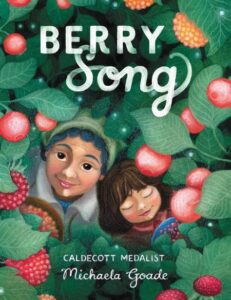
  • Berry Song by Micaela Goode 
    • Micaela Goade won a Caldecott medal for illustrating We Are Water Protectors, but this is the first book she’s written AND illustrated. A grandmother and granddaughter gather gifts from the earth: salmon, herring eggs, and so many kinds of berries, and express their gratitude for these gifts.  
  • Kindergarten, Where Kindness Matters Every Day by Vera Ahiyya (the Tutu Teacher) and Joey Chou 
    • Vera Ahiyya gained fame during the pandemic for her Instagram content as The Tutu Teacher. This is her first picture book, and it’s about the ways we show kindness to each other from the point of view of new kindergarteners.  
  • See You Someday Soon by Pat Zietlow Miller and Suzy Lee 
    • Pat Zietlow Miller has FIVE picture books coming out this year! I chose this one to share because I love Suzy Lee’s illustrations and the topic is especially timely – that those we love, even though they’re far away, are never far from our hearts.  
  • I Love You Because I Love You by Muon Thi Van and Jessica Love 
    • A call-and-response celebration of love featuring diverse families 
  • Blue by Nana Ekua Brew-Hammond and Daniel Minter 
    • You didn’t think anyone could create a WHOLE picture book about a color? Well, these two did!  And it sounds really cool! How did ancient Afghan painters make blue? When did blue become a mainstream, and not-expensive-to-create color? 
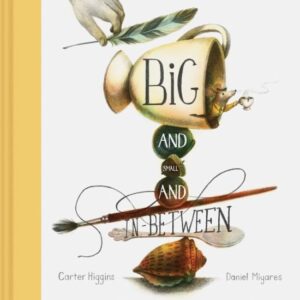
  • Big and Small and In-Between by Carter Higgins and Daniel Miyares 
    • Billed as YOU ARE (NOT) SMALL meets THE QUIET BOOK. It makes the concept of size personal. 
  • Daddy Speaks Love by Leah Henderson and E.B. Lewis 
    • Celebrates fathers, especially Black fathers, and how they guide and influence their children. With illustrations by the iconic watercolorist E.B. Lewis.  
  • Shapes: My first pop-up by Matthew Reinhart and Ekaterina Trukhan 
    • Matthew Reinhart is the KING of amazing pop-up books. This one is for toddlers and is a companion to a similar book about colors! 
  • Baby, Sleepy Baby by Atinuke and Angela Brooksbank 
    • I LOVE the partnership between Atinuke and Angela Brooksbank. They’ve created some of my favorite books, especially B is for Baby. This book is a lullaby based on a song Atinuke’s father used to sing to her in Nigeria.  

HUMOR (All Ages but mostly 3+)

  • No Bunnies Here by Tammi Sauer & Ross Burach 
    • A bear comes looking for some bunnies, so, thinking bear’s intent is to eat them, a bunny attempts to convince bear that there are NO BUNNIES HERE. A story about assumptions! Hilarious.  
  • My Parents Won’t Stop Talking! By Emma Hunsinger and Tille Walden 
    • A common lament! A girl’s trip to the park is ruined when her parents meet friends and then WON’T STOP TALKING to them!  
  • Don’t Eat Bees: Life Lessons from Chip the Dog by Dev Petty and Mike Boldt 
    • Seems like an obvious thing to do, right? But still, it happens. Chip gives us hilarious life lessons only a dog could have learned. From the author/illustrator team behind I Don’t Want to Be a Frog.  
  • Goodnight Butterfly by Ross Burach 
    • From the author/illustrator of The Very Impatient Caterpillar and The Little Caterpillar that Could. Butterfly is restless and can’t sleep, but he uses some mindfulness techniques to calm down and drift off.  
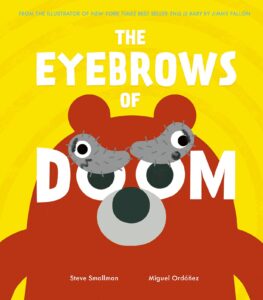
  • Eyebrows of Doom by Steve Smallman and Miguel Ordoñez 
    • Just the title makes me laugh. Bear finds a pair of slugs covered in fuzz while cleaning his cave. They inspire him to do unkind things. The eyebrows next find a young girl who does an equally unkind thing. This continues until they get a surprise at the zoo.  
  • Slug In Love by Rachel Bright and Nadia Shireen 
    • Continuing the slug theme, we have Slug in Love! Doug the Slug needs a hug. But who will hug a slug? Will he find love? 
  • Counting To Bananas by Carrie Tillotson and Estrela Lourenço 
    • This is a counting book, but Banana can’t WAIT for its turn to be counted! A MOSTLY rhyming book.  

SEQUELS (All ages but mostly 3+ 

  • Queen of Kindergarten by Derrick Barnes and Vanessa Brantley-Newton 
    • From the author/illustrator team behind the King of Kindergarten we have this companion title. This girl  is READY to rock Kindergarten.  
  • Pretty Perfect Kittycorn by Shannon Hale & LeUyen Pham 
    • The sequel to one of my favorites of last year, Itty Bitty Kittycorn. In this story, Unicorn worries that he’s not as perfect as everyone thinks he is and maybe kitty won’t be his friend anymore. A common worry for kids (and some adults like me). 
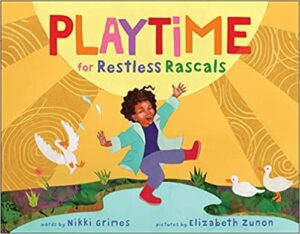
  • Playtime for Restless Rascals by Nikki Grimes and Elizabeth Zunon 
    • This follows the same pattern as their previous books Bedtime for Sweet Creatures and Off to See the Sea. This outing celebrates the bond between parent and child and the play, which is the “work of childhood” according to Mr. Rogers (and he was right).  
  • Amy Wu and the Warm Welcome by Kat Zhang and Charlene Chua 
    • The series started with Amy Wu and the Perfect Bao and continued with Amy Wu and the Patchwork Dragon. Now Amy Wu tries to make a new classmate from China feel welcome by inviting him to her dumpling party!  

COLORADO AUTHORS AND ILLUSTRATORS (All ages but mostly 3+)

I feel like I should preface this section by saying that this is by NO MEANS an exhaustive list of the amazing books being created by Colorado authors and illustrators. These folks just happen to be more on my radar (as they’re my friends, and, in one case, a work colleague). Also, I’m focusing on traditional publishing here. If you’re a Colorado author with a book coming out in 2022, please add it in the comments! I didn’t exclude you on purpose, I promise!

  • A Grand Day by Jean Reidy and Samantha Cotterill 
    • Celebrates the bond between grandparent and grandchild. 
  • Me and You in a Book Made for Two by Jean Reidy and Joey Chou
    • The sequel to What Will You Do in a Book About You? which was a popular graduation gift. 
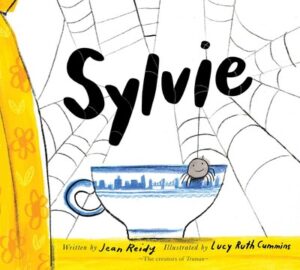
  • Sylvie by Jean Reidy and Lucy Ruth Cummins 
    • The team behind the beloved turtle Truman! Sylvie the Spider keeps watch over her people in the apartment building where she lives, out of sight. But when something seems off, Sylvie must decide whether or not to step into the spotlight to fix things. Truman even makes an appearance! 
  • Swim, Jim by Kaz Windness 
    • Jim is a crocodile, and afraid to swim. Can he find a way to learn, but on his own terms?  
  • Her Name was Mary Katherine: The Only Woman Whose Name is on the Declaration of Independence by Ella Schwartz and Dow Phumiruk  
    • Mary Katherine Goddard, a businesswoman and newspaper publisher ,stepped up and printed the Declaration of Independence so that it could be widely distributed. And she added her name at the bottom as a printing credit!  
  • Yes We Will: Asian Americans Who Shaped This Country by Kelly Yang and Dow Phumiruk 
    • Kelly Yang is a New York Times best selling author and Dow is one of several notable Asian-American illustrators to work on this book. 
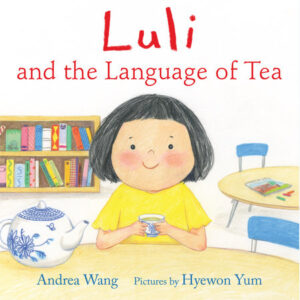
  • Luli and the Language of Tea by Andrea Wang and Hyewon Yum 
    • Luli makes friends in her ESL class by sharing a cup of tea, something familiar to all the kids in the class, no matter what their home language is. 
  • Strut, Baby, Strut by Amika Kroll and Ebony Glenn 
    • A celebration of girls as they grow up! 

Happy reading!

7 Comments

Filed under 2022, Mary Kuehner, Picture Books, Upcoming