
By Susan Wroble
“Why,” asked a woman near me, “is it so very hard now to find agents who want to represent picture books? I can find plenty of agents for Middle Grade and YA, even for graphic novels and author/illustrator books. But finding one to come to our conference that represent author-only picture books is getting really tough.”
It was a great question, and was addressed to an industry panel during the Regional Team meeting of the Society of Children’s Book Writers and Editors in New York in October. Our chapter has the same problem. We have lots of members who write picture books, but finding agents who would be good fits for our conferences and who are also open to picture book submissions is hard.
The answer, of course, was money. Stacey Barney is an Associate Publisher at Nancy Paulson Books, an imprint of Penguin Random House. She explained that picture books simply make less money than other formats for everyone involved, including the agents. It doesn’t mean that you can’t find an agent for a picture book. It does mean—like so much else in this industry—that it takes persistence.
Writers often talk about their “training books,” the first books they wrote when they were learning the process. Almost always, those books are languishing in some file, never having made it to print. But Stacey talked about an entirely different set of training books as she explained the publisher’s ‘Rule of Three.’ “You start by buying a book you love,” she explained, “and you build up a good rapport with the author. By the time you get to their third book, you have established the author in this industry. The first and second books are like a training camp. They won’t be break-out best-sellers. With the third, the author has arrived.” That means that an author’s beloved debut novel—the one that finally made it to print after writing a few others—is, for the publisher, just the first of the training books. For me, that comment explained a lot about agents’ and publishers’ desires to help build a career, not publish one book.
A week later, I attended an agent panel put on virtually by SCBWI Metro New York that provided additional insights into the author/agent relationship. One question asked of each of the three agents (Saba Sulaiman at Talcott Notch, Linda Camacho at Galt & Zacher, and Eve Adler at Red Fox Literary) was how they got their clients. Surprisingly, meeting someone in person at a conference was low on each list. However, the majority of clients came in through the query inbox. The catch is that many agents are closed, with the only way to submit through attending a conference or workshop. So those conferences and events remain an essential way to reach agents.
Given that, it may seem that cost is a barrier to entry, but that isn’t necessarily true. The panel I attended was free. More than five hundred people signed up. And each of the agents who presented has opened their submissions to all attendees at the panel if they have works that fit.
The panel’s moderator was Harold Underdown, Executive Editor at Kane Press and creator of The Purple Crayon website, a gold mine of information on children’s publishing. Harold asked the agents about recent developments in the industry, and the answer was fascinating… they recommended leaning into the weird. Specifically, they noted that neat genre categories are blurring. Saba Sulaiman noted that “there is a thirst for stories that blur genre, like a horror comedy. We want the weird!” Linda Camacho backed this up, saying that “there is a need for escapism, and a thirst for horror and for romance. Blurring genres tends to provide more avenues for creativity.” 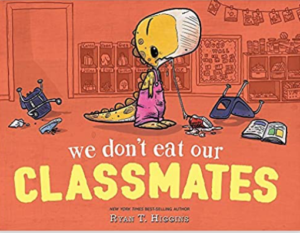 As an example of blurred genre in picture books, Saba recommended looking at Ryan T. Higgins We Don’t Eat Our Classmates. “It’s a totally unexpected dinosaur book, that funny, sweet, cute and is also a first day of kindergarten book.”
Harold also asked about tips and best practices in terms of searching for an agent. Some of the best resources are agency websites, SCBWI’s Essential Guide, Manuscript Wishlist, and Query Tracker. In addition, Saba recommended getting a short-term subscription ($25 for one month) or a limited subscription ($10 for a day) to Publisher’s Marketplace. And then, she suggested, pay attention to the pitches. “It’s a great way to learn how to pitch a book.”
And that may be a great way to land one of those elusive agents!
Thank you for the good information, well-written of course!
Great post and fabulous graphics. Will try to make my stories weirder!!!!
Wonderful post!!