
Most of us have heard of the Caldecott and Newbery medals – children’s book awards that have been around for, well, a VERY long time. But have you heard of the CLEL Bells? No? Take a seat, I’ve got a story to tell.
I’ve been a librarian, as of this summer, for 25 years. And in those 25 years, my job has changed quite a bit – in good ways and bad. But one incredibly satisfying way in which it’s changed is in the way children’s librarians view their work. While we still work hard to connect children with the right book at the right time, and help them grow a love of reading through storytime, we recognize now that our work goes beyond that. And a big reason for that shift in thinking came with the advent of Every Child Ready to Read.
Every Child Ready to Read (ECRR) is a framework created in the mid-2000s in a partnership between the Public Library Association and the Association of Library Service to Children (both divisions of the American Library Association). Using the most current research available at the time, it focused on how libraries could (and did) empower parents and caregivers to help their children get ready to learn to read later on. It helped librarians understand how the activities we did every day in our storytimes helped build early literacy skills, and gave us the language to talk to caregivers about these skills and how to encourage them at home.
It was a shift that wasn’t easy for some librarians. Storytime had always been about THE BOOKS, primarily. And while reading stories continued, now many of us were incorporating early literacy “tips” into our programs that explained more of the WHY we do what we do in storytimes: Why songs and movement were important learning tools along with books. Why we ask questions as we read stories. Why we don’t expect the children to sit quietly the whole time. How all of these things are building language skills and vocabulary knowledge and brain connections. Breaking this “fourth wall” and speaking directly to the parents was hard for many, but most of us practiced and got used to it. Because we know, WE KNOW, that this is important. The work we do was, and is, helping children get ready to read.
The first iteration of ECRR described six skills that young children needed to develop in order to make learning to read easier. They were:
- Print motivation – loving books and reading, and therefore being motivated to learn to read;
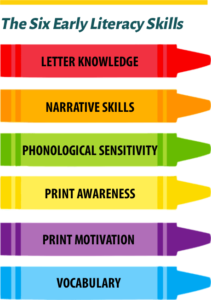
- Print awareness – understanding that print is all around us and is used for many purposes (in books, on signs, lists, letters,
etc); knowing how print works (in English we read left to right, top to bottom); - Narrative skills – understanding how stories work (beginning, middle and end) and being able to tell stories and retell/describe events and make predictions;
- Vocabulary – knowing lots of words!
- Letter Knowledge – recognizing letters and knowing their names and sounds;
- Phonological Awareness – being able to hear and play with the smaller sounds that make up words, like letter sounds and rhymes.
The second iteration, recognizing feedback from a lot of librarians that said that sharing terms like “phonological awareness” with parents felt… inauthentic (read: a little too highfalutin’) when we were trying to let parents know the simple benefits of singing with one’s child, turned the six skills into 5 practices that librarians could encourage caregivers to do with their children at home to build early literacy skills – all of which are things we do in storytime. The 5 practices are:
- READ. Seems obvious, doesn’t it? But really, there is nothing better for building a future reader than reading or sharing books with them.
- TALK. Recent research has shown how vital conversations are to growing a young child’s brain. They are learning language, how to communicate, vocabulary, social-emotional skills, and so much more.
- SING. Not only does singing promote phonological awareness, but it also develops memory skills and grows vocabulary and language.
- WRITE. Here it doesn’t mean just working with crayons and pencils and words. It means growing fine motor skills that allow us to hold a crayon or pencil. It means understanding that writing is used for more than just books, it’s also used to communicate in lists, signs, letters, and more.
- PLAY. Children learn best through play, and that includes learning skills they can use when later reading – like building their imaginations, background knowledge about the world, and vocabulary.
 One outgrowth of this shift was the creation of Colorado Libraries for Early Literacy (CLEL) which I had the good fortune to be involved with from its inception. Born in 2008, this organization, sponsored by the Colorado State Library, seeks to support libraries and librarians across Colorado in our work with young children and families. The organization has grown by leaps and bounds and now includes an annual conference attended by librarians many parts of the country.
One of the things CLEL realized in our early years is that nobody was recognizing books that were particularly good at supporting early literacy skills growth. As the center of storytime remains the book, CLEL wanted to create an award that would do just that. And the CLEL Bell Awards were born.
The CLEL Bells are an “annual recognition of five high-quality picture books that provide excellent support of early literacy development in young children.” There is one for each of the 5 practices above – READ, TALK, SING, WRITE and PLAY. Additionally, the committee creates an activity sheet to go along with each book to extend the learning. And without further ado, the 2024 winners, announced just a couple of weeks ago, are:
READ: This is a Story by John Schu and Lauren Castillo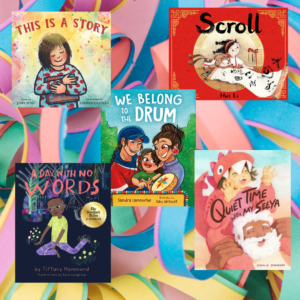
TALK: A Day With No Words by Tiffany Hammond and by Kate Cosgrove
WRITE: Scroll by Hui Li
SING: We Belong to the Drum by Sandra Lamouche and Azby Whitecalf
PLAY: Quiet Time With My Seeya by Dinale Dabarera
The award has been in existence 10 years and all of the past winners are listed on the website, along with their activity sheets. In the first year the award committee, which I got to be a part of, also selected 25 “Silver Bell” awards to recognize 5 books in each practice category published in the prior 25 years.
Go check out these amazing picture books – and share with your little ones!
 The timer went off. I had just finished a productive 50-minute revising session. But then… my break turned into being online too long. I disappeared into the SCBWI website, reading all about upcoming webinars. Yes, I was procrastinating. Yes, I was hoping a super power would finish editing a chunk of my young adult novel. It was due to my young adult novel exchange partner in five days.