By Susan Wroble, February 2023
Psssst… Want to know the secret of children’s book publishing? At the Rocky Mountain Chapter of SCBWI’s panel at the CCIRA literacy conference in February, authors and illustrators shared some of the stories behind their stories. The answer? It’s simple and painful, both.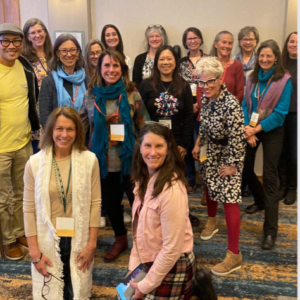
Persistence.
For some, persistence has meant staying focused over time. Author/Illustrator Kaz Windness is truly on fire, with seven book deals this year! But getting to this point? That took twenty years. And learning the industry also meant learning when a book would be best illustrated by someone else. Kaz wrote A BOOK IS A FRIEND (fall 2024) with illustrator Heather Brockman-Lee’s artwork in mind
Author Jennifer Chambliss Bertman joined SCBWI back in 2000. She worked on writing picture books for years, getting nowhere. She was ready to give up when she decided to try writing for an older audience, and began work on her highly successful middle-grade books instead. After 23 years, Jennifer’s debut picture book, A GOOD DEED CAN GROW, was released last month.
Bianca Schultz’s passion is literacy and growing readers. She founded The Children’s Book Review in 2008 with the goal of helping kids and their parents, caregivers and librarians find great books. The first of her popular “Dragon” series was published in 2020.
Persistence can come in other forms. For Laura Perdew, it meant being willing to write about lots of topics. She found one of the short-cuts into publishing—the work-for-hire market. WFH books are typically found in school libraries. The publisher, not the writer, determines the specifications. Laura now has more than fifty WFH books, along with her debut traditionally published picture book, THE FORT.
Author/Illustrator Gregory Barrington had published his first picture book with Harper Collins, but the editor wasn’t at all excited about Greg’s new manuscript. Greg was asked to write a fractured fairy tale instead. He wrote five completely different stories featuring Goldilocks and the Three Bears. He picked his favorite—and was too nervous to submit it. It didn’t come across the way he wanted on the page. Greg decided the solution was NOT to send it. He asked for a virtual meeting, then he read the manuscript aloud. GOLDILOCKS AND THE THREE KNOCKS was released in November.
Albert Whitman had published Jenny Goebel’s book ADELITA, about a sea turtle, when they asked her to write one on insects. No problem, she thought. The catch? They wanted a book on insects as food. By release date, Jenny still hadn’t managed to eat an insect. Imposter syndrome hit hard. The Butterfly Pavilion was all out of edible insects, so Jenny spent the day in search of a bug to eat. Unfortunately, success came in the form of jalapeno-flavored fried crickets. She’s since discovered more easily purchased (and eaten!) “gateway bugs.” And just like her book, they are CHOCOLATE CHIRP COOKIES.
Both Julie Danneberg and Natasha Wing have had incredibly successful series—Julie with the JITTERS series and Natasha with THE NIGHT BEFORE series. And both have worked not only to keep those series going, but to publish in other areas, from nonfiction to jokes.
Sometimes persistence means a lot of research. Author Jessica Speer knew she wanted to focus on problems kids face in middle school. But she wasn’t exactly sure what the biggest challenges were. So she went to schools and listened. She surveyed students. Her book MIDDLE SCHOOL: SAFETY GOOGLES ADVISED focuses on the top ten problems identified by kids.
For authors Andrea Wang and Beth Anderson, persistence has entailed digging deep—sometimes into hard places emotionally—to find the heart of the story. For others, it has been work to find the words. Lynn Becker was hooked by the idea of a sea shanty. Finding just the right words for MONSTERS IN THE BRINY meant literally walking it out, pounding out the beat with her feet. With her novel-in-verse ALONE, author Megan E. Freeman struggled to find the best ways in each poem to convey the story in the fewest possible words, leaving the rest up to the reader.
Author/illustrator Julie Rowan-Zoch was faced with an unusual request—illustrating for a celebrity author. Saturday Night Live’s actor Bobby Moynihan had submitted sample illustrations with his manuscript NOT ALL SHEEP ARE BORING, but the publisher reached out to Julie instead. Many of her initial sketches were turned down before Julie hit the type of compositions the publishers felt comfortable with for this book that they knew would have a huge circulation run.
COVID in the family kept author Kellye Crocker from the CCIRA conference, but PAL Liaison Rondi Frieder told teachers about her book. What Rondi didn’t tell them was that DAD’S GIRLFRIEND AND OTHER ANXIETIES had been hit by supply chain problems, and the publication date had been delayed by months. Then the books didn’t even arrive on time for the rescheduled publication date. Kellye refused to give up, and held a launch party with advance reader copies of the book!
Sometimes, it is the characters who are persistent. Heather Mateus Sappenfield was an adult and YA author. When a fully-formed 12-year-old character named Rill hit her mind, Heather wasn’t remotely interested in writing middle grade. It took Heather and Rill more than a year together before Heather realized that Rill was just the right person to tell an important story. As a teacher, Heather had sometimes walked into her school to find clusters of children, crying. Their parents had been deported the night before. After her book was published, Heather almost threw away an envelope from the Colorado statehouse, assuming it was junk. Instead, it was a treasure—the Colorado General Assembly acknowledged her book’s importance in the state.
Whatever the form it may take for you, the secret is clear. Stick with it. Persist.