
By Susan Wroble
Over the summer, I had the opportunity to attend three different events hosted by the Rocky Mountain Chapter of SCBWI that focused on relationships with booksellers. First, RMC’s Perfect Partners webinar featured a panel of five local Indie booksellers:
- Juli Guyer of BookBar and The Bookies
- Lauren Casey of Second Star to the Right
- Jerilyn Patterson of The Wandering Jellyfish
- Wendy Withers of Books Are Awesome
- Nicole Szmyd of Old Firehouse Books
Later in the summer, the chapter’s PAL (published and listed) group gathered at the Wandering Jellyfish bookstore for a session hosted by Jerilyn Patterson and Carissa Mina. Finally, the RMC Northern Colorado Connect hosted author Susan Kusel, who has held jobs as both a librarian and book buyer, focused on how your book gets into bookstores and libraries.
The three events differed in scope but complemented and built on each other. The biggest takeaway? As Jerilyn Patterson noted, “The big A can’t do community.” That’s the role and the benefit of Indies.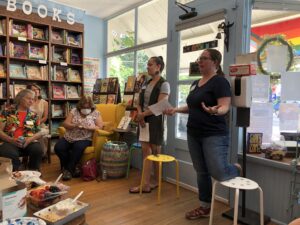
Indie Bookstores and Bookshop.org:
If you are looking for independent bookstores, search IndieBound. Type in a city or a zip code, and you’ll get a map and list of all the local Indies.
Once you know the Indies around you, start using Bookshop. Bookshop.org launched just before Covid as an alternative to Amazon for socially conscious shoppers, and their platform was instrumental in helping Indies survive the pandemic shutdowns.
As an author or illustrator, you can set up a Bookshop link—but don’t! As a creator, you will get back only a very small percentage back on each sale from Bookshop. But if you have an Indie sell your books through Bookshop links, they earn 30% on each sale. That is enough to make a huge difference in their bottom line, and helps keeps these stores stay afloat. Here are the takeaways:
- As an author or illustrator, select and work with a local Indie. Have the buying link on your website for your books go to that Indie’s bookshop page.
- When you want to buy a book, go to Bookshop.org, click on “choose a bookstore” on their top menu, and from their map of participating bookstores in that area, click on “Support this Shop!”
- Don’t post Indie buying links in the same post as Amazon buying links. Amazon already sells 60% of books in the US with a growing market share, and the Indies need all our support.
Developing Relationships with Bookstores:
- Follow bookstores and engage with them on social media. This engagement can be as simple as taking a selfie outside of their store, perhaps with a book that you bought. Respond to their posts with a share or a comment or an emoji.
- Attend events at the bookstores.
- Email or text or message and social media the bookstore to introduce yourself, or talk to them while you are there—they want to hear from you. Megan E. Freeman, RMC Webinar Coordinator, recommends bookstore tourism, visiting Indie bookstores at each place you travel!
- If you can go into the store in person, give advance notice. This allows them to round up your books to sign—and perhaps, given enough advance notice order additional books for signing.
- Follow the Indies not only in your area, but also in the area where you grew up. As Susan Kusel noted, developing a relationship at the bookstore near where your mother lives is especially important, because family friendships lead to book purchases!
- SWAG: Bookmarks are the best. Bookstores can set out your bookmarks on the counter and put them in books in a similar genre to promote your book. Temporary tattoos or stickers are also really popular. Don’t send postcards—the bookstores can’t really do anything with them.
- Bookstores work with publishing sales reps to order books. If you would like local bookstores to carry your books, you need to notify them very early in the process (as soon as you know release dates and long before the actual release), so that they can order copies.
Launches and Events at Bookstores:
- Visit all the local bookstores and explain that you are a local author with a book coming out. Give an ARC (Advanced Reader Copy) if possible. Shelf Awareness has free newsletters about newly released books and the book industry. Indie bookstores can tailor the copy of Shelf Awareness that they send to their mailing lists, and they will often tailor that to highlight local authors and illustrators.
- Select one local Indie as the one you will feature to pre-order signed copies that buyers can pick up in the store, or have mailed from there. Use that bookstore for your book launch.
- If possible, set up a date to go into the bookstore in advance of your event to plan things out.
- Work with the bookstore to develop a plan for your event—and it needs to be an event, not just a book signing. Brainstorm activities with the booksellers for events that could generate excitement.
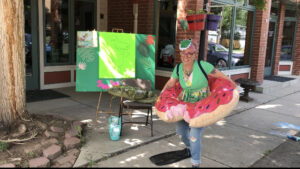
- Tie the event into your book. For example, Megan E. Freeman, whose middle grade book ALONE is in free verse, held a poetry workshop, and Kaz Windness, whose picture book book SWIM, JIM! is about overcoming fears, hosted a pool party parade.
- Public speaking can be scary. Consider joining Toastmasters if you need practice in engaging your audience.
- Publicize your event—bookstores do a lot of different events, so they need your audience. The most successful events are a true partnership. There are events where no one shows up, and the difference between those events and the highly engaged ones is often the amount of advance planning.
- Celebrate the release of a paperback version as if it is a brand-new book, and plan events.
A Few Notes on Libraries:
Unlike bookstores, libraries are ordering books much later in the release process, often after the books have been released and almost always after the initial reviews have come out.
- Request that your local library carry your books. It is perfectly acceptable for an author or illustrator to submit a request for their own books—and you can have your friends ask too!
Book Reviews:
Posting a supportive book review is a fabulous way to support other creatives, and it can lead to more sales at bookstores. Goodreads is the world’s largest site for book recommendations. It is owned by Amazon, and you can post the same review in both places. You can post reviews on Amazon without buying the book from them. Collect good karma and post, post, post!
- As you read mentor texts and comp titles, post reviews of the books you enjoy.
- Post reviews of books from any group you are in (critique groups, debut groups, SCBWI groups, classes…)
- If you have friends writing work-for-hire (WFH), post reviews of those books as well. They don’t tend to get reviewed, but those rare reviews are incredible gifts, because they can be used in the author’s press kit and promotional materials.
Looking forward to hearing tips from others — please add your suggestions in the comments!